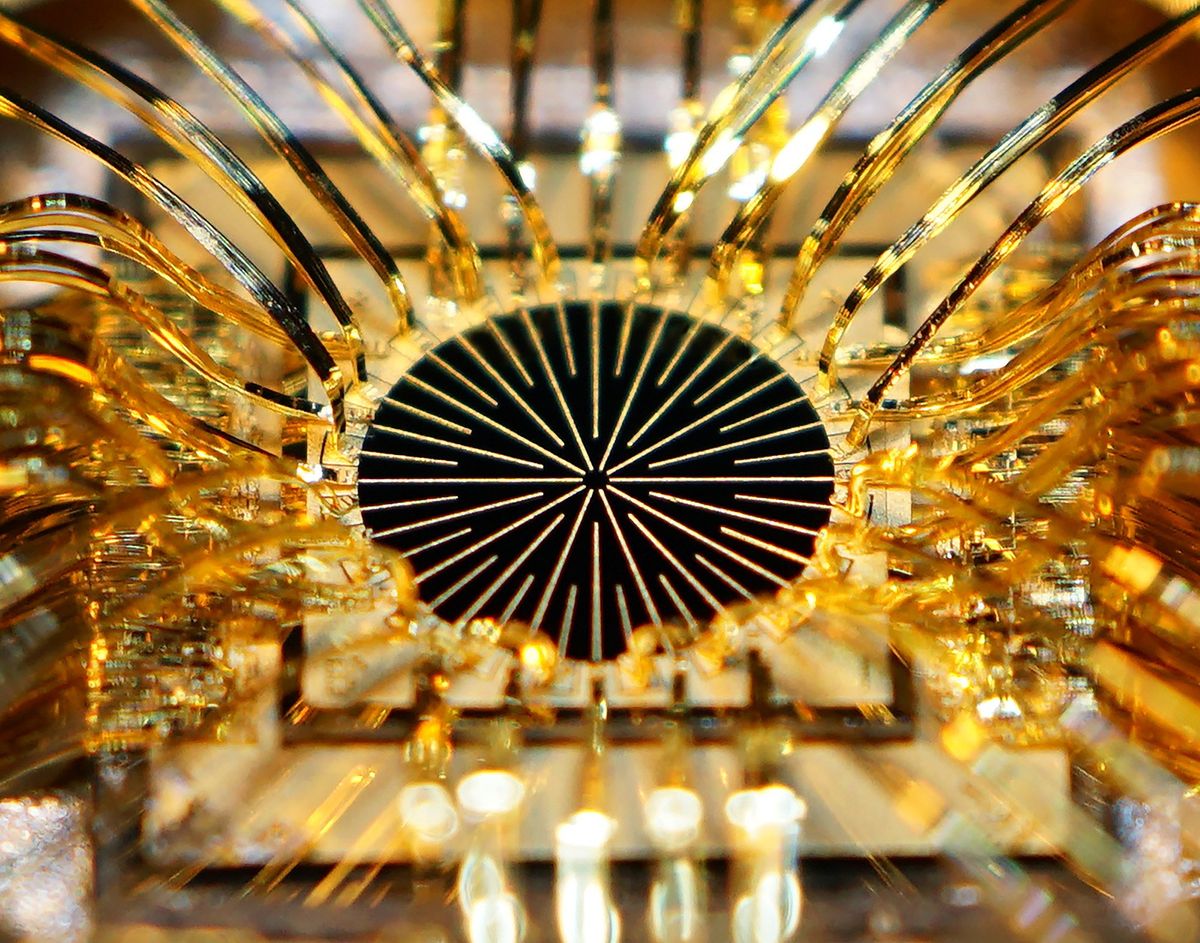
The promise of multijunction solar cells made from colloidal quantum dots (CQDs) has been discussed as a hopeful prospect for collecting a broad spectrum of light from the sun. If achieved, it would make possible extremely high energy-conversion rates for photovoltaics (PVs).

The solar power conversion efficiency for the device, according to the Nature abstract, is 4.2 percent—not quite staggering, since levels of 5 percent have been reported as the state of the art for CQD multijunction PVs.
The breakthrough appears to be in that "graded recombination layer," which serves as an interface between the visible and infrared junction passing electrons between the two layers.When one considers that tandem CQD solar cells are believed to possess astronomical conversion efficiency rates of 42%, it would seem that the 4.2% achieved by the University of Toronto researchers means there is still room for improvement on the technology. Nonetheless, Sargent has expressed hope that the technology described in the Nature Photonics paper will make it to market and be integrated into building materials, mobile devices, and automobile parts in the next five years.
In addition to the science, what I find interesting about the story is that this research was in part made possible by a US $10 million grant given to Sargent back in 2008 by King Abdullah University of Science and Technology (KAUST) in Thuwal, Saudi Arabia.
It seems Saudi Arabia is committed to developing solar energy alternatives despite sitting on one of the world’s largest oil reserves.
The Conversation (0)