Professor Zhong Lin Wang at Georgia Tech has been championing his work in exploiting the piezoelectric qualities of zinc oxide nanowires for years now with his so-called "nanogenerators".
Now researchers at the Korea Advanced Institute of Science and Technology (KAIST) have taken up the mantle of Wang’s work by creating a piezoelectric “nanogenerator” more easily and cheaply than ever before.
The research, which was initially published in the Wiley journal Advanced Materials, produced a piezoelectric nanocomposite through relatively simple processes such as spin-casting and the bar-coating method. So this new generation of “nanogenerators” is not restricted by a complicated and high-cost process or even size.
Even Wang himself is impressed by this work. “This exciting result first introduces a nanocomposite material into the self-powered energy system, and therefore it can expand the feasibility of nanogenerator in consumer electronics, ubiquitous sensor networks, and wearable clothes," says Wang.
The lead researcher on this project, Keon Jae Lee, a Professor at the Department of Materials Science and Engineering at KAIST, has a comprehensive website that covers much of the work.
One of the videos from that website (below) manages to demonstrate just how uncomplicated the process is to create this nanocomposite and shows how it works in generating an electric charge from the movement of a finger.
While Wang has been expert at getting this research into the media, it hasn't yet found itself in commercial products. It should be interesting to see if these manufacturing simplifications and cost reductions will help push this technology into consumer electronics where Wang always envisioned it could be.
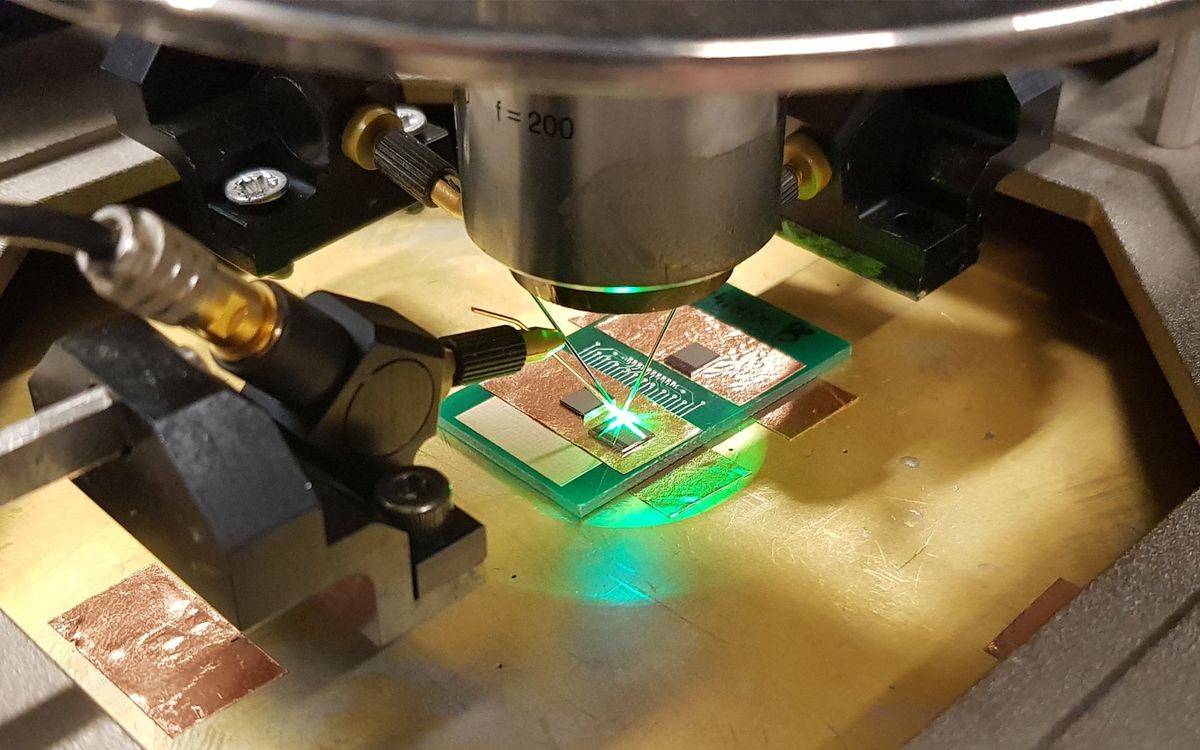
Now researchers at the National Institute of Standards & Technology (NIST) have added a new tool to the arsenal that should allow researchers to better user lasers in manipulating nanoparticles inside biological cells without damaging them. The researchers have developed a control and feedback system that lets the laser nudge nanoparticles to exactly where they are needed for analysis.
This week, however, researchers at the University of Maryland have offered up a technology that should be of keen interest to the dentists of the world, and those who visit them. The
Just four months after the
The researchers, led by University of Exeter Engineer Monica Craciun, claim that the material is the most transparent, lightweight and flexible material ever for conducting electricity. GraphExeter is actually two layers of graphene sandwiching molecules of ferric chloride. The ferric chloride increases the electrical conductivity of the graphene without compromising its transparency.
As good as graphene is at operating at terahertz frequencies, when single-layer graphene is used carrier concentration and resonant frequency are too weak for it to be used in photonics applications. This is where the IBM researchers' work began and they developed a multi-layer graphene/insulator superlattice that improved the carrier density and the resonant frequency.
Last Friday the
The latest entry into the nano-enabled nonvolatile memory sweepstakes comes from
The nanocoating uses hydroxyapatite nanoparticles that not only initially secures the implant to the bone, but also encourages faster bone tissue growth. The bone cement currently used, to fix the replacement hip to the femur, can harden to a consistency like glass—and, like glass, sometimes cracks and detaches from the implant, leaving the patient in chronic pain.
The researchers wanted to be able to image this hybrid material as it was in the process of sensing. In order to do this they approached Carol Hirschmugl, who had developed an infrared imaging technique. But in order to see more molecules attaching themselves to the CNT, Chen and his colleague Marija Gajdardziska realized that they needed to unroll the CNT, thereby making it graphene.