
Jordan is in a tight spot. The virtually landlocked country is 80 percent desert, and the remaining 20 percent loses most of its rainfall to evaporation. The Dead Sea and the Jordan River, which feeds it, are drier than ever. With its population swelling with Iraqi migrants, water is Jordan’s foremost concern.
Most of the country receives water service once a week at best, and unexpected disruptions force the Ministry of Water and Irrigation to deliver water by truck. ”When a country has its back against the wall, you take the least damaging solution,” says Munther Haddadin, the country’s former water minister.
The water ministry has decided that the best way to get water to the capital of Amman is to mine it, tapping into what the department says is some of the cleanest, purest water in the world. The water sits in the pores and holes of the Disi aquifer, an expanse of sandstone some 500 meters beneath the desert in southern Jordan and northwestern Saudi Arabia.
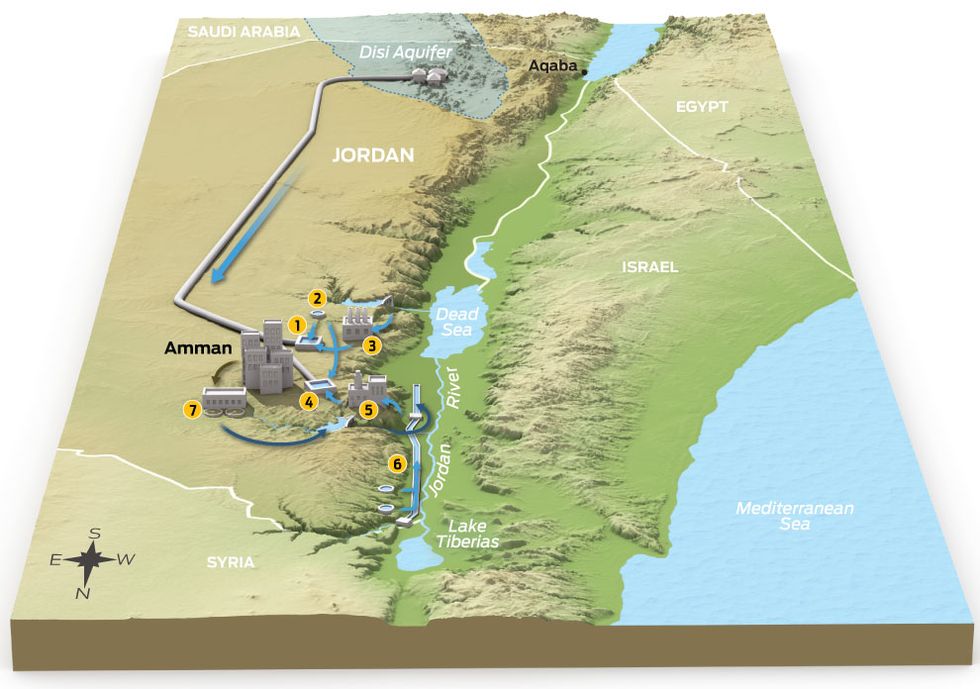
Having just secured the final US $200 million in loans needed from European development banks in May, the government will soon begin building a 325-kilometer pipeline across the country, from the heart of the desert to Amman. The plan is to pump 100 million cubic meters of water from 55 wells in Disi each year. The water will travel about 1300 meters uphill, requiring about 4 kilowatt-hours of energy to deliver each cubic meter, according to Othman Kurdi, the engineer in charge of the Disi Water Conveyance Project. At that rate, the power required to pump ayear’s worth of water is equivalent to the output of a 45-megawatt power plant, or about 4 percent of the country’s electricity production.
”It’s not rocket science, but it’s a megaproject and a challenge in every sense,” Kurdi says. Indeed, the Disi Water Conveyance Project is riddled with complications. Recent research has revealed that the water may not be as pure as project planners had said, and that could make the scheme more complex and costly—and even take a toll on public health. Further, the pipeline project is just a stopgap measure that will leave Jordan permanently poorer in natural freshwater resources while the country pursues an even larger, costlier, and more energy-intensive solution that remains decades away.
By pumping the Disi aquifer, Jordan will be depleting its only strategic reserve of water, a move also being considered by other developing nations that are poor in both energy and water resources. Unlike rivers and lakes that refill with rainfall or melting snow, once this so-called fossil water is pumped, it leaves Jordan forever. Much of the water in the Disi aquifer essentially hasn’t moved since it began dripping into the ground during the Pleistocene era, some 30 000 years ago. ”For developing countries in that region, they have no other choice—using this water is the only way to survive the water crisis,” says Avner Vengosh, a geochemistry professor at Duke University, in Durham, N.C.
Policymakers and water experts had been debating the merits of draining Disi through much of the project’s planning. But in February the debate suddenly shifted, when Vengosh published a report in the journal Environmental Science & Technology describing the Disi water as highly radioactive. He and his coauthors collected samples from 37 wells in the Disi area used mostly for agriculture and mining activities. They found that in all but one well, the concentrations of radium-226 and radium-228 isotopes exceeded the levels considered safe by the World Health Organization and even the more relaxed European Union and U.S. water standards. In some spots, the radiation levels were observed to be 30 times the WHO’s thresholds. Long-term exposure to radium is believed to increase the risk of developing bone cancer.
Click to enlarge image
Illlustration: Emily Cooper
JORDAN'S WATER CYCLE:
After the Disi pipeline is built, 100 million cubic meters of water will travel from the desert to two reservoirs each year. About 40 million cubic meters will go to the Abu Alanda reservoir (1) and mix with some surface water from Wala (2) and treated brackish water from the Zara Ma’en desalination plant (3). The other 60 million cubic meters will go to the Dabouq reservoir (4) and blend with Wala surface water and the output of the Zai Treatment Plant (5), which treats water from the King Abdullah Canal (6). Amman’s used water is sent to the As Samra Wastewater Treatment Plant (7) and later used for irrigation.
Vengosh theorizes that the isotopes entered the water from the surrounding sandstone through a physical process known as recoil. Thorium-232 and thorium-230, the parents of radium-228 and radium-226, respectively, exist naturally in the porous sandstone that holds the Disi water. When one of those thorium atoms radioactively decays to emit an alpha particle (two protons and two neutrons bound together), some energy is also released that causes the new atom to move in the opposite direction of the ejected particle. In some cases, the recoil can cause this new atom to get pushed out of its host material into a surrounding medium—in this case, from sandstone into water.
The Ministry of Water and Irrigation contends that the radiation is not a problem. The Disi pipeline will send the water to two large reservoirs outside Amman, where the fossil water will be diluted with 105 million cubic meters of treated surface water, Amman’s current supply. According to Susan Kilani, a ministry official in charge of water quality, the quantity is ”in excess of what we need for blending.”
Judging by Vengosh’s data, this doesn’t appear to be the case. Dilution would double the total volume of water, which means that the Disi water’s radiation can be no more than double the desired threshold in order to comply with international benchmarks. Very few of the wells tested by Vengosh and his colleagues met that criterion. Relying on blending would limit the amount of usable water in the aquifer and curtail the life span of the pipeline project—or expose the population of Amman to heightened levels of radium.
Aqaba, Jordan’s small port city, has had an instructive experience with Disi water. The city has been pumping 15 million cubic meters of water from Disi each year to a collection reservoir outside Aqaba. Samples taken at the wells come out radioactive. But without any diluting or further treatment of the isotopes, the water is somehow pristine by the time it reaches the city, according to Aqaba’s utility.
Imad Zureikat, the Aqaba Water Co.’s general manager, maintains that Aqaba’s water is tested at several international laboratories and adheres to international standards. ”My kids are drinking water from the tap,” Zureikat says. ”We don’t play with people’s health. Everywhere you go in Jordan, you can drink from the tap.”
The locations and depth of the wells likely play a role in Aqaba’s good fortune [see ”Jordan’s Red Sea Desalination Plan,” IEEE Spectrum, July 2009]. Near Aqaba, at the southern tip of Jordan, the aquifer lies closer to the surface. Vengosh’s samples from these shallower wells showed much more variability in their radium content. So cautiously choosing well sites may indeed bring the water ministry within sight of international standards for the Amman project.
Elias Salameh, a professor at Jordan University, in Amman, has been monitoring the elevated alpha-particle activity in Disi water. His data is unpublished, because the presence of radium in groundwater is just not news, he says. In the United States, for example, New Jersey has relied on water from a radium-tainted aquifer for many years. He points out that should blending fail to neutralize the water, the ministry can treat it using reverse osmosis, by forcing the water through a membrane that prevents the passage of radium. Ion-exchange purification, in which the water is fed through columns of porous materials whose pores work as capture sites for the radium, is another option. ”We can’t choose another land, another country, so we have to do our best,” Salameh says.
Of course, any purification treatment would come at a price. Haddadin, the former water minister, studied the cost of the Disi project, along with the collection and treatment of its wastewater, and concluded the cost of water service would reach 10 percent of the income of the average Amman resident. Adding a treatment facility, and the needed disposal of radioactive waste, would drive the cost up even more.
Whatever the price, Jordan will almost certainly find a way to use the Disi water. As Nizar Abu-Jaber, a geology professor at Yarmouk University, in Irbid, Jordan, sees it, the ”availability of water takes precedence over radioactivity.” Water-stressed countries are frequently forced into difficult, or at least expensive, choices. In Libya, a massive project known as the Great Man-Made River delivers fossil water from the Sahara Desert and distributes it along entirely new waterways, while Saudi Arabia has plowed money into becoming the world’s largest producer of desalinated seawater.
Amman, for its part, is undergoing a population boom, spurred by an influx of an estimated million immigrants from Iraq. ”The Disi project will not solve the problem of water in Jordan,” says Kurdi, the project’s leader. ”It will just maintain the status quo.” With any luck, the project will at least enable the government of Jordan to increase each person’s share of the kingdom’s water, to meet what it considers to be the daily demand of 120 liters per person per day. (Abu Dhabi residents, by contrast, go through an average of 550 L per day.)
By early 2013, Kurdi estimates the water should be flowing to Amman. The aquifer will be pumped for about 25 years, he says, until a subsequent water project is in place. That project, known as the Red-Dead Canal, would send water north from the Red Sea, with half of the water replenishing the shrinking Dead Sea and the other half to be desalinated for consumption.
To get within sight of the ballyhooed canal, Jordan must first find a way to keep its population—and economy—humming along for the decades the country will need to build it. ”We are going to implement this project, insha’Allah, God willing, as we say,” Kurdi says. ”Because this is what we need.”