24 February 2009—Just down the road from Advanced Micro Devices’ gigantic US $2.5 billion ”Fab 36” CPU plant, a more modest facility is prototyping a revolutionary breed of plastic electronics. Comparatively cheap and low-power polymer-based transistors may someday drive computing applications such as animated product packaging and ”smart” signs, appliances, and clothes.
More imminently, though, Plastic Logic, a company based in Cambridge, England, is hard at work on what it hopes will be a breakthrough 7-millimeter-thick electronic book, magazine, newspaper, and document reader. Now slated for commercial release next year, the Plastic Logic Reader will read popular document formats, including PDF, EPUB, and Adobe’s DRM/eBook, and will feature content from such sources as Ingram Digital, LibreDigital, and the Financial Times .
Unlike other E Ink document readers, such as the Amazon Kindle, however, the transistors on the electronic backplane that switches each of the Plastic Logic Reader’s millions of pixels on and off is a pliable organic polymer, not brittle silicon.
Earlier this month, Plastic Logic opened its $100 million, 4000-square-meter automated-manufacturing clean room to IEEE Spectrum for a peek into the future of flexible electronics. In his corner office at the Dresden facility, Konrad Herre, Plastic Logic’s vice president of manufacturing, gave a simple demonstration highlighting one benefit of plastic electronics.
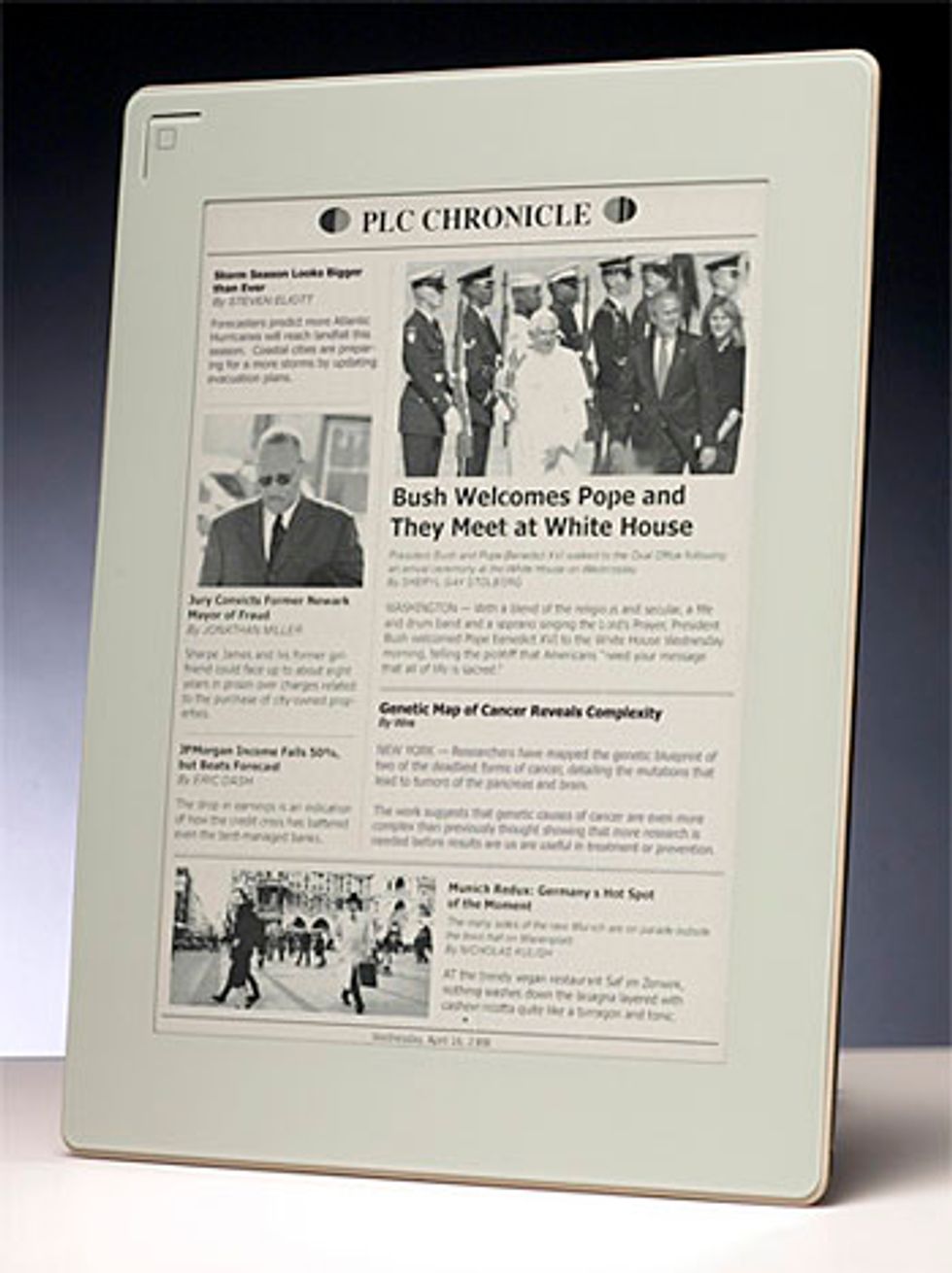
”You easily can do this,” he says as he smashes his fist onto the Reader’s 22-by-28-centimeter flexible screen and backplane, bashing it with a force that would shatter any liquid-crystal display or slice of silicon. ”It doesn’t break, although it’s a big display.”
Because these robust electronics are mostly printed or sprayed on, rather than etched using expensive photolithography systems, Herre says that organic transistors on plastic can be made more simply and therefore more cheaply than complementary metal-oxide-semiconductor (CMOS) transistors.
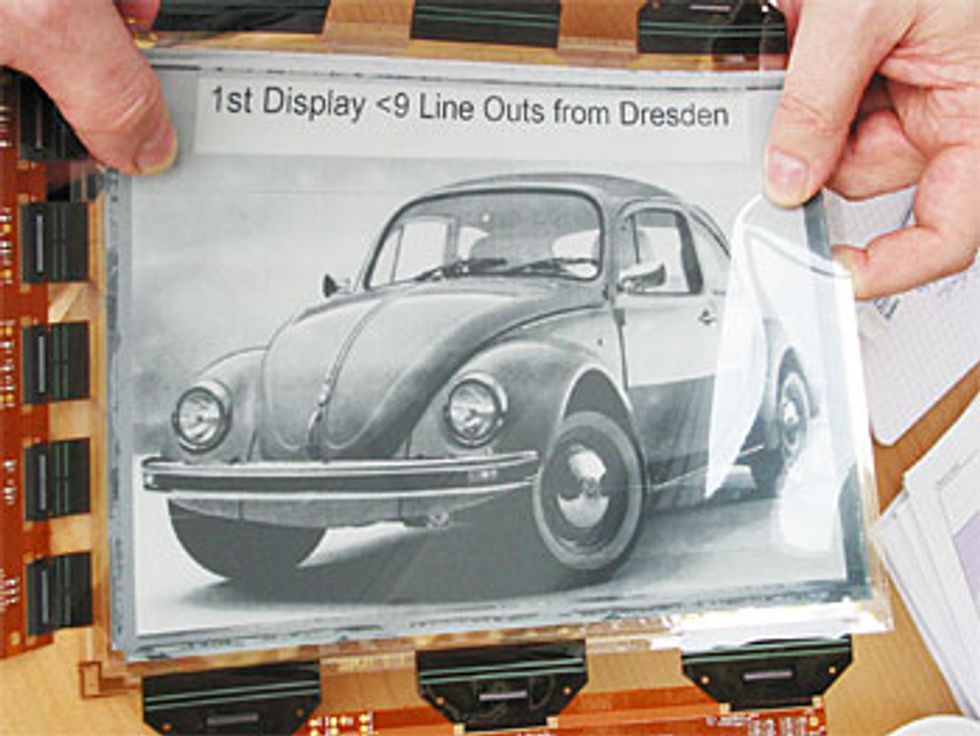
In the process being prototyped now in Dresden, a Plastic Logic Reader begins its life on a carefully cleaned sheet of glass. The bay-window-sized ”motherglass” serves as the platter onto which the electronic nerves of nine separate Readers are inked.
Perhaps most immediately conspicuous about Plastic Logic’s clean room is the fleet of boxy automatic guided vehicles (AGVs)—robots that lead each motherglass through some 55 of the approximately 80 steps it takes to make the Reader’s display module. Each AGV serves as the robotic shepherd that brings its batch of motherglass from automated station to automated station. And whenever the AGVs are in motion—down ”the Autobahn,” as the workers call the clean room’s main drag—the robots play bleepy melodies that warn workers to stand clear. (The dozen or more people inside the clean room at any given time monitor the automated manufacturing processes and inspect the product as each layer of electronics is printed on.)
Atop the motherglass, a plastic substrate goes down first. What follows are lithography and other proprietary printing steps that lay down the polymer semiconductor and the horizontal and vertical strips of conductor that criss-cross the backplane at 150 intersections (ultimately, pixels) per inch. An E Ink sheet, purchased preassembled from the Cambridge, Mass.–based E Ink Corporation, is laminated atop the plastic transistors. To activate a pixel, a transistor in the backplane generates an electric field that flips charged microscopic spheres inside the adjoining E Ink sheet from black to white or white to black. After step 55, the Reader’s innards are peeled off like an omelet, and the motherglass gets sent back to step one to crank out more.
The total time from empty motherglass to a fully formed Reader prototype—minus the external case and packaging, which is assembled off-site—is now a few days, says director of manufacturing Marc Witzke. He hopes to see the manufacturing time shaved down to 16 to 20 hours.
By contrast, Witzke says, CMOS silicon chip manufacturing typically involves 300 to 400 steps over the span of 8 to 12 weeks. Plastic Logic employs some initially shell-shocked CMOS veterans, he says, who ”have to get used to starting a lot on Monday and seeing the results on Wednesday.”
Francois Ladouceur, associate professor of electrical engineering at the University of New South Wales, in Sydney, Australia, says that Plastic Logic is helping to pioneer an entire new industry that could help to heave computers off the desktop—or laptop or palmtop.
CMOS, Ladouceur says, is very good for making fast, tiny, expensive, and fragile silicon chips. ”But there are plenty of applications that don’t require speed,” he says. ”Plastic Logic is the beginning of a revolution of supercheap, slow [megahertz] electronics.”
Ladouceur, who is now collaborating with Plastic Logic scientists on a research project funded by the Australian government, says manufacturing techniques like those now being developed at Plastic Logic’s Dresden fab will probably also be developed by companies around the world over the coming decade.
”It’s inevitable that cheap electronics based on plastic will rise, just because of the economics of it,” he says. ”The future [of this technology] will become really broad, as opposed to only fabricating an e-reader—which is cool. But it doesn’t ultimately have the same scope.”
About the Author
Mark Anderson is an author and science writer based in Northampton, Mass. In October 2008, he wrote for IEEE Spectrum Online about the bailout of the controversial physics experiment Gravity Probe B.