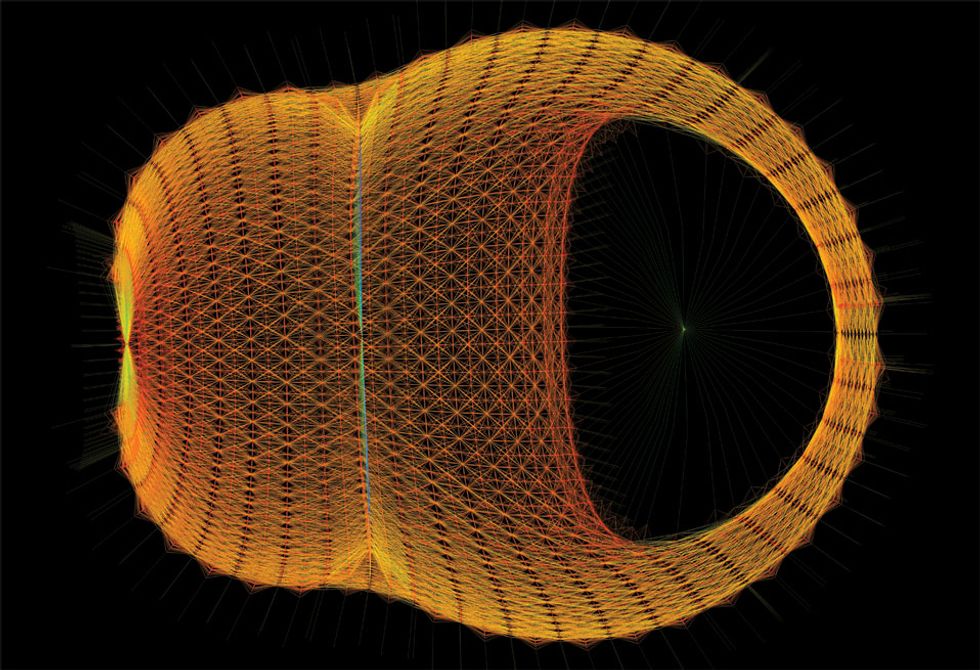
You're looking at the solution to a computational fluid dynamics problem. It is one of thousands of math-based artistic renderings stored in a database maintained by computer scientists from the University of Florida, in Gainesville, and AT&T Labs Research, in Florham Park, N.J. But what you don't see makes all the difference. The matrix, or table of values, is sparse, meaning that the number of zeros it contains far outweighs the number of nonzero values. This sparsity allows for a type of data compression that lets engineers working on a simulation store the data without taking up too big a chunk of memory.
Time To Make Plans For June’s National Day of Civic Hacking
They may look like block parties, but these June 1-2 hackathons around the country aim to do some real work for good.
Eye-Tracking Software Goes Mobile
Umoove aims to bring hands-free control to phones and tablets
Demo Mobile Conference Embraces The Internet Of Things
And a Pittsburgh design lab's new tool makes it simple to connect all those things together
Movea’s Data Fusion Transforms Sensors Into Indoor Navigation
Software company Movea helps app developers corral the data from the sensors that pack today’s mobile devices
Have Researchers Computed the Complete Neanderthal Genome?
New high-quality draft is about as good as human or Neanderthal genome can get, its developers say
Sunday Is Oscar Night—Can Anyone Beat the Prediction Algorithms?
Microsoft researcher David Rothschild has all the data, but little first-hand knowledge
CES 2013: Standout Start-ups Spotted
A list-based social networking site and 3-D virtual reality modeling system distinguish themselves from the crowd
Teaching Computers to Hear Emotions
New research can detect five different emotions with 81 percent accuracy
IBM’s Watson Goes to Med School
This AI program mastered “Jeopardy!” Next up, oncology
Harvard’s Alternative to Google Books
Universities launch a digital public library
Computers: It's Time to Start Over
Computer scientist Robert Watson, putting security first, wants to design with a “clean slate”
Is Windows 8’s Lack of Windows a Mistake?
Usability guru Jakob Nielsen says Microsoft’s new OS takes a giant step backward
New King of Security Algorithms Crowned
A five-year hunt for a new cryptographic hash scheme leads to the discovery that the old one was really good
Brain Model Connects Neurons to Behavior
Researchers are bridging the gap between brain and behavior with a new large-scale neural model
An IEEE Standards Group Wants All Election Computer Systems To Speak The Same Language
A voting systems standard will allow the computers to talk to each other, and maybe even to iPads.
Predicting Hurricane Sandy
Last year’s hurricane models were quite accurate in their predictions of the track of Hurricane Irene, and algorithm changes earlier this year give forecasters even better tools for predicting Hurricane Sandy.
A Recommendation Engine for Politics
The ElectNext recommender takes on politics just in time for the November Elections.
Deconstructing Recommender Systems
How Amazon and Netflix predict your preferences and prod you to purchase
Where Will You Be December 18th at 6 P.M.?
Long-term prediction is hard, but researchers are on the case
New Kinect Design Trick: Handy Potter
Handy Potter and the virtual vase
Comments