
5 April 2010—If you lose your sense of balance to injury or disease, you have to learn how to walk all over again. Rehab is a slow and cumbersome process, conducted on treadmills and parallel bars, and when you go home, you’re still liable to fall. Researchers at UCLA’s Center for Advanced Surgical and Interventional Technology (CASIT) are developing a vest that could improve the rehabilitation process while you’re at the clinic and then go home with you afterward. They presented their initial findings at last month’s 2010 Haptics Symposium, in Waltham, Mass.
Their vest measures how the upper body rotates and tilts as a person walks. If the torso wobbles, accelerometers on the shoulders detect those movements. Then a control system inflates various silicone balloons, which are 25 millimeters in diameter on the outer edge. One pair is attached above the rib cage, against the chest; another pair is on the back between the shoulder blades; and two more pairs, one each on the left and right midshoulders, rest over the trapezius muscles. By inflating with various pressures and on different sides of the body, the balloons give the wearer a physical cue that he is listing to port or starboard.
There are other such vest-based tactile feedback systems, but they’re mainly used for flight-based simulators or gaming applications, not for physical rehabilitation or balance problems, says Martin Culjat, one of the lead researchers on the project.
The key technology is pneumatics. The patented actuator has a specially bonded membrane that allows the balloon to be inflated with high pressure, ensuring that a wearer will feel the push. The pneumatic components are compact enough to fit on the vest, and the control system provides almost instantaneous feedback
Other types of actuators, based on liquids or servos, Culjat says, don’t react in 60 milliseconds, which is how fast they would need to operate to provide real-time feedback for patients to stay upright. Still other actuators, which send vibrational signals to various parts of the body, are more common than pneumatic balloons, but because the skin can become accustomed to vibrotactile cues, a person’s perception of those signals can decrease over time, Culjat says.
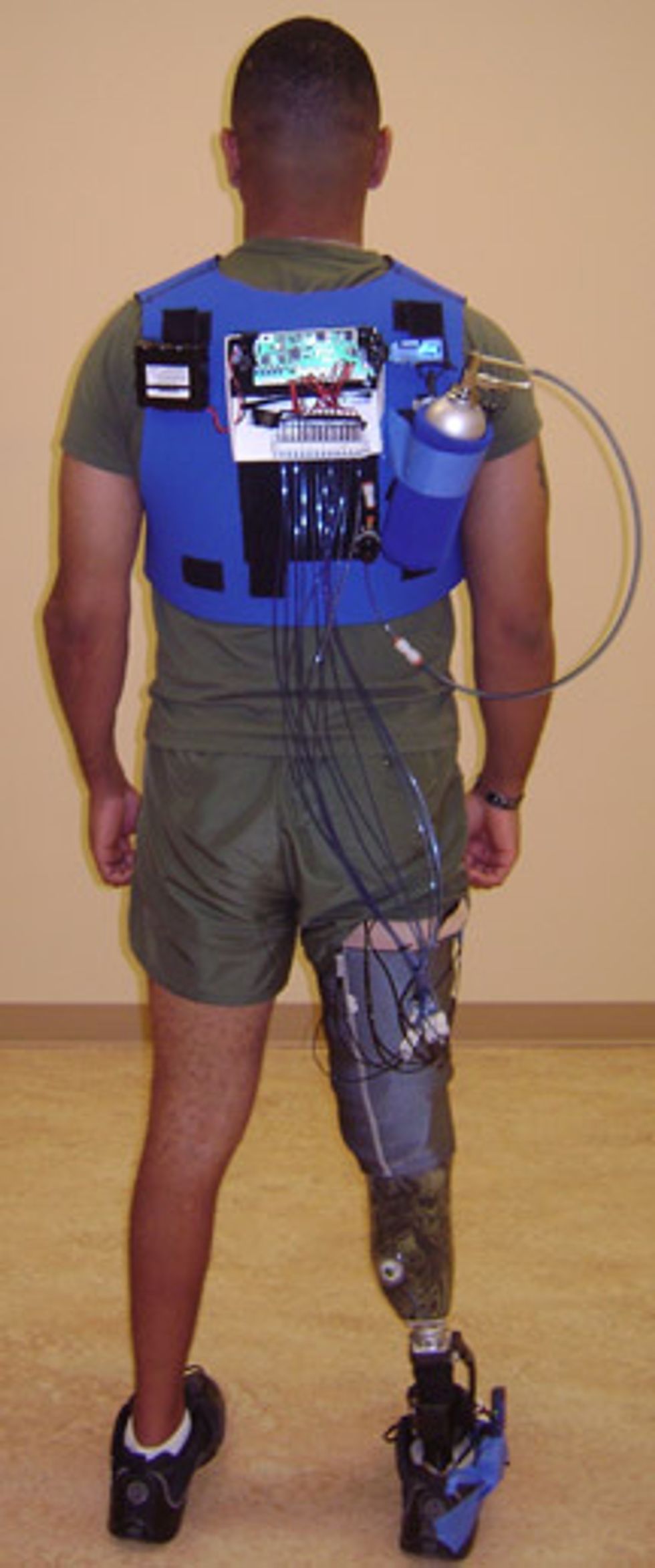
The CASIT team is also using its pneumatic actuators to provide physical feedback to leg amputees as they walk with prostheses. Using force sensors in a shoe insert, plus a set of the pneumatic actuators worn in a cuff around the upper thigh, the device adds sensation to an otherwise unfeeling prosthetic by prodding the thigh as the foot moves.
The beauty of the system in a prosthesis, Culjat says, is that it’s a direct transfer of ”touch to touch, pressure to pressure.” In other words, instead of using auditory or vibrational cues to alert the user as to how hard his foot is pressing on the ground, and in what direction, the balloons simply press on the leg with proportional forces. It’s a more natural cue.
That could help improve the walking of new amputees, such as those injured in roadside bomb blasts or car accidents, says Marilynn Wyatt, who’s running clinical trials of the system at the Naval Medical Center in San Diego. Although it’s too early to draw conclusions from the trials, Wyatt says, initial feedback from her patients has been positive. Some, she says, are hoping the device can be perfected to help them get back to activities like skiing, snowboarding, and swimming.
As for balance patients, the CASIT researchers are still working out the best way to signal a tilt, with the corresponding poke from a balloon that would best help a person regain balance. They are applying for approval to work with brain injury and stroke patients at the Naval Medical Center, as well as with elderly subjects at UCLA.