
This is part of IEEE Spectrum’s Special Report: Why Mars? Why Now?
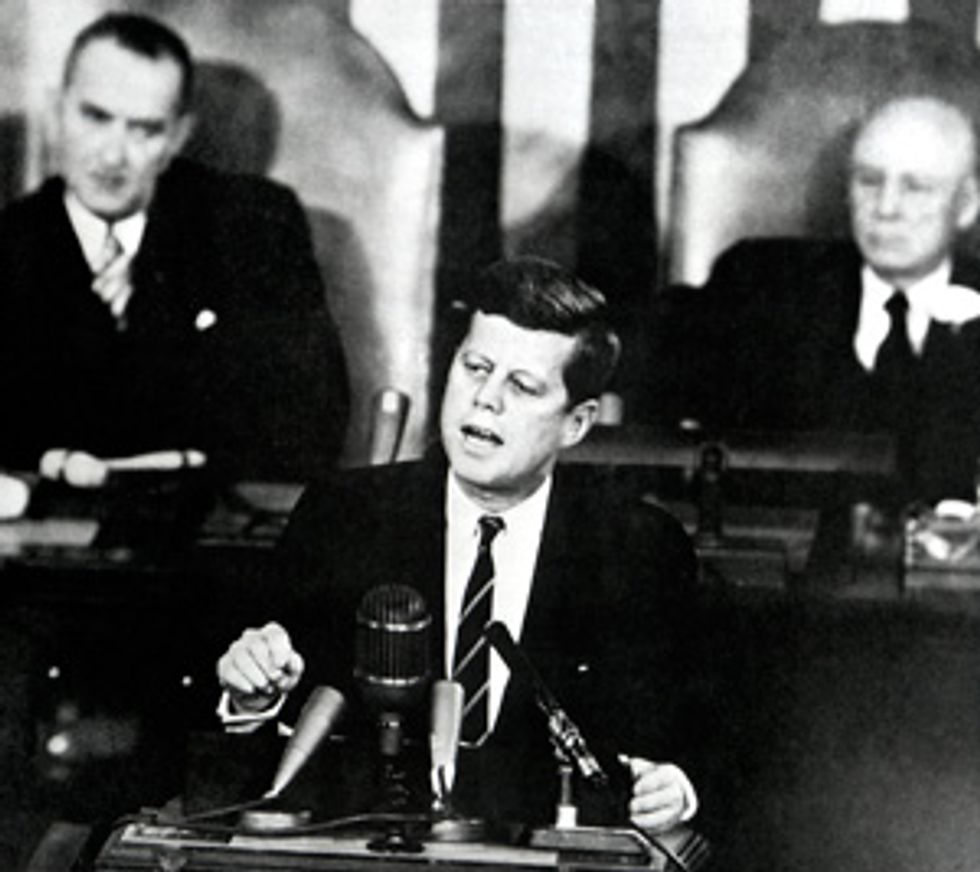 Moon Shot: President Kennedy’s 1961 speech launching the Apollo program helped set in motion a wave of technological advancement.Photo: NASA
This past autumn, I met with all 1700 first-year engineering students at Purdue University. I asked them what their generation’s greatest technological legacy might be. Repeatedly, they told me: sending people to Mars.
I was surprised, but I shouldn’t have been. Human achievement takes countless forms, and none has proved more revolutionary than space exploration. It energizes engineering, resuscitates research, and galvanizes new generations. After all, fearless optimism and an accompanying willingness to do what’s hard are what set great engineers apart. As U.S. President Dwight D. Eisenhower once said, engineers “build not merely for the needs of men but for their dreams as well.”
Ironically, it wasn’t dreams but rather fear that triggered the race to space. The October 1957 launch of Sputnik set in motion a wave of technological advancement unsurpassed in history, the ripples of which are still being felt today. For more than a decade, policy-makers and the public genuinely believed that the future depended on engineers and scientists and that education would have to inspire young people to pursue those careers.
In the United States, Congress provided loans for college students and funded improvements in science, mathematics, and foreign-language instruction at elementary and secondary schools. In Europe, NATO set up a science committee, which proposed to launch “a satellite for peaceful outer space research…and circling the earth by 1960.”
Glorious things came out of that era. On 25 May 1961, President John F. Kennedy delivered his legendary man-on-the-moon speech, and eight years later, Apollo 11 made good on it. It was one of the United States’ finest hours, and for a time, at least, virtually anything seemed possible. And so the impact continued to reverberate through the rest of the 20th century and on into this one, albeit as an increasingly weakened echo.
Nevertheless, innovation and technology directly or indirectly inspired by the space race still shape the way we live and work. And I’m not talking about Tang or the Space Pen: Satellite communications, satellite navigation, photovoltaics, fault-tolerant computing, and countless specialty materials and biomedical sensors all came out of the space program.
The International Space Station demonstrated that after the Cold War, industrialized nations could work together in space without requiring the motivation of fear or nationalism. That’s important, because fear and nationalism can’t get us to Mars. It’s too big an undertaking for any one country, and the commitment will have to persist despite changes in world politics. It’s an undertaking on a scale that will require many of the world’s best minds.
Yet developed nations are seeing far too many of their best and brightest shunning engineering as a career. Countless panels and study groups have lamented the problem and proposed solutions. Common to all these solutions is the conviction that engineering once again needs to inspire—that we need to harness the power of dreams with projects like a human mission to Mars.
Here at Purdue, I get to see some of those dreams made real. Hundreds of our engineers now work in the aerospace industry, among them William H. Gerstenmaier, who directs NASA’s human exploration program. And 22 Purdue graduates have become astronauts, including Neil Armstrong, the first man to walk on the moon, and Eugene Cernan, the last—or as he would say, “the most recent.”
Cernan, who earned a bachelor’s degree in electrical engineering from Purdue in 1956, finds my students’ vision of reaching for the Red Planet not at all far-fetched. “As long as we give them the tools, as long as we give them the education and the inspiration, there’s no question in my mind that they will take us to Mars,” he says. “Where it’s going to lead, who knows? But I can tell you this with absolute certainty: It’s going to happen.”
For more articles, go to Special Report: Why Mars? Why Now?
About the Authors
LEAH H. JAMIESON is the John A. Edwardson Dean of Engineering at Purdue University, in West Lafayette, Ind. She served as president of IEEE in 2007. JOHN NORBERG, a senior writer at Purdue, is author of Wings of Their Dreams: Purdue in Flight (Purdue University Press, 2003).