IEEE.orgIEEE Xplore Digital LibraryIEEE StandardsMore Sites
    Sign InJoin IEEE
    5G Bytes: Massive MIMO Explained
    Share
    FOR THE TECHNOLOGY INSIDER
    Explore by topic
    AerospaceAIBiomedicalClimate TechComputingConsumer ElectronicsEnergyHistory of TechnologyRoboticsSemiconductorsTelecommunicationsTransportation
    IEEE Spectrum
    FOR THE TECHNOLOGY INSIDER

    Topics

    AerospaceAIBiomedicalClimate TechComputingConsumer ElectronicsEnergyHistory of TechnologyRoboticsSemiconductorsTelecommunicationsTransportation

    Sections

    FeaturesNewsOpinionCareersDIYEngineering Resources

    More

    NewslettersSpecial ReportsCollectionsExplainersTop Programming LanguagesRobots Guide ↗IEEE Job Site ↗

    For IEEE Members

    Current IssueMagazine ArchiveThe InstituteThe Institute Archive

    For IEEE Members

    Current IssueMagazine ArchiveThe InstituteThe Institute Archive

    IEEE Spectrum

    About UsContact UsReprints & Permissions ↗Advertising ↗

    Follow IEEE Spectrum

    Support IEEE Spectrum

    IEEE Spectrum is the flagship publication of the IEEE — the world’s largest professional organization devoted to engineering and applied sciences. Our articles, videos, and infographics inform our readers about developments in technology, engineering, and science.
    Subscribe
    About IEEEContact & SupportAccessibilityNondiscrimination PolicyTermsIEEE Privacy PolicyCookie PreferencesAd Privacy Options
    © Copyright 2025 IEEE — All rights reserved. A public charity, IEEE is the world's largest technical professional organization dedicated to advancing technology for the benefit of humanity.

    Enjoy more free content and benefits by creating an account

    Saving articles to read later requires an IEEE Spectrum account

    The Institute content is only available for members

    Downloading full PDF issues is exclusive for IEEE Members

    Downloading this e-book is exclusive for IEEE Members

    Access to Spectrum 's Digital Edition is exclusive for IEEE Members

    Following topics is a feature exclusive for IEEE Members

    Adding your response to an article requires an IEEE Spectrum account

    Create an account to access more content and features on IEEE Spectrum , including the ability to save articles to read later, download Spectrum Collections, and participate in conversations with readers and editors. For more exclusive content and features, consider Joining IEEE .

    Join the world’s largest professional organization devoted to engineering and applied sciences and get access to all of Spectrum’s articles, archives, PDF downloads, and other benefits. Learn more about IEEE →

    Join the world’s largest professional organization devoted to engineering and applied sciences and get access to this e-book plus all of IEEE Spectrum’s articles, archives, PDF downloads, and other benefits. Learn more about IEEE →

    CREATE AN ACCOUNTSIGN IN
    JOIN IEEESIGN IN
    Close

    Access Thousands of Articles — Completely Free

    Create an account and get exclusive content and features: Save articles, download collections, and post comments — all free! For full access and benefits, subscribe to Spectrum.

    CREATE AN ACCOUNTSIGN IN
    TelecommunicationsVideo

    5G Bytes: Massive MIMO Explained

    With massive MIMO, future 5G networks will be able to cram more data onto the same amount of spectrum

    Amy Nordrum
    Kristen Clark
    IEEE Spectrum
    17 Jun 2017
    5G Bytes: Massive MIMO Explainedplay icon
    type:videomimotelecommunicationsnetworks5gmassive mimowireless

    Today’s mobile users want faster data speeds and more reliable service. The next generation of wireless networks—5G—promises to deliver that, and much more. Right now, though, 5G is still in the planning stages, and companies and industry groups are working together to figure out exactly what it will be. But they all agree on one matter: As the number of mobile users and their demand for data rises, 5G must handle far more traffic at much higher speeds than the base stations that make up today’s cellular networks.

    Watch: Everything You Need to Know About 5G

    loyaltyshopping_cartlocal_librarydelete Everything You need to know about 5g

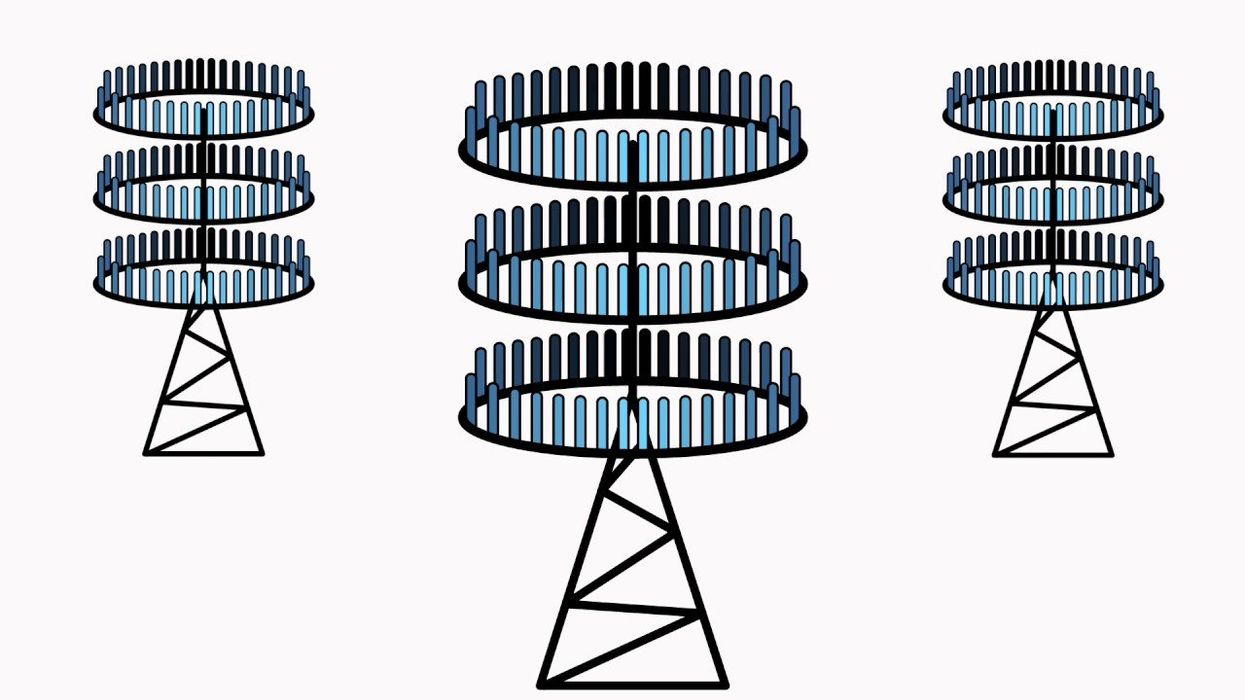
    Today’s 4G base stations have a dozen ports for antennas that handle all cellular traffic: eight for transmitters and four for receivers. But 5G base stations can support about a hundred ports, which means many more antennas can fit on a single array. That capability means a base station could send and receive signals from many more users at once, increasing the capacity of mobile networks by a factor of 22 or greater.

    This technology is called massive MIMO. It all starts with MIMO, which stands for multiple-input multiple-output. MIMO describes wireless systems that use two or more transmitters and receivers to send and receive more data at once. Massive MIMO takes this concept to a new level by featuring dozens of antennas on a single array.

    MIMO is already found on some 4G base stations. But so far, massive MIMO has only been tested in labs and a few field trials. In early tests, it has set new records for spectrum efficiency, which is a measure of how many bits of data can be transmitted to a certain number of users per second.

    Massive MIMO looks very promising for the future of 5G. However, installing so many more antennas to handle cellular traffic also causes more interference if those signals cross. That’s why 5G stations must incorporate other new technologies, such as millimeter waves, small cells, full duplex, and beamforming.

    With these 5G technologies, engineers hope to build the wireless network that future smartphone users, VR gamers, and autonomous cars will rely on every day. Already, researchers and companies have set high expectations for 5G by promising ultra-low latency and record-breaking data speeds for consumers. If they can solve the remaining challenges, and figure out how to make all these systems work together, ultrafast 5G service could reach consumers in the next five years.

    The Conversation (0)

    Trending Stories

    The most-read stories on IEEE Spectrum right now

    History of TechnologyMagazineFeatureComputing

    The Untold History of the RESISTORS

    EnergyGuest ArticleClimate TechClimate Change

    How Virtual Machines Stabilize Power Grids

    EnergyNewsClimate Tech

    Virtual Power Plants Face New Turing-Like Test

    RoboticsHumanoid RobotsVideo

    Unitree Demos New $16k Robot

    Unitree's G1 robot is one of the cheapest—if not the cheapest—humanoid around

    IEEE Spectrum

    IEEE Spectrum is an award-winning technology magazine and the flagship publication of the IEEE, the world’s largest professional organization devoted to engineering and the applied sciences.

    30 Aug 2024
    Unitree Demos New $16k Robotplay icon

    IEEE Spectrum

    humanoid robotsunitreerobotics

    At ICRA 2024, Spectrum editor Evan Ackerman sat down with Unitree founder and CEO Xingxing Wang and Tony Yang, VP of Business Development, to talk about the company’s newest humanoid, the G1 model.

    Smaller, more flexible, and elegant, the G1 robot is designed for general use in service and industry, and is one of the cheapest—if not the cheapest—of a new wave of advanced AI humanoid robots.

    DIYVideo

    DIY: Classic 555 Timer Kit

    Follow along as we build and test one of our favorite kits of all time, the Discrete 555 Timer

    Stephen Cass

    Stephen Cass is the special projects editor at IEEE Spectrum. He currently helms Spectrum's Hands On column, and is also responsible for interactive projects such as the Top Programming Languages app. He has a bachelor's degree in experimental physics from Trinity College Dublin.

    23 Jul 2024
    DIY: Classic 555 Timer Kitplay icon

    IEEE Spectrum

    555hands onintegrated circuitstimerelectronics kitschip design

    Follow along as we build and test one of our favorite kits of all time, the Discrete 555 Timer! Build a huge version of one of the most iconic and surprisingly versatile integrated circuits of all time from transistor and resistors.

    The 555 chip has been used at one time or another by nearly every E.E. alive, and you can use it to detect pulses, make lights blink, debounce inputs, trigger alarms, and even make music (terrible music, but music nonetheless!). We first wrote up the kit in our Hands On column in Spectrum, and this is second version, which features some improvements over the original.

    Keep Reading ↓Show less
    RoboticsSpecial ReportsVideoEast Africa’s Big Bet On Drones

    360 Video: Zoom Over Zanzibar With Tanzania’s Drone Startups

    Come along for the ride as drones soar over the farms and schools of Tanzania

    Evan Ackerman

    Evan Ackerman is a senior editor at IEEE Spectrum. Since 2007, he has written over 6,000 articles on robotics and technology. He has a degree in Martian geology and is excellent at playing bagpipes.

    Michael Koziol

    Michael Koziol is the news manager at IEEE Spectrum. Previously, he was an associate editor covering telecommunications. He graduated from Seattle University with bachelor's degrees in English and Physics, and earned his master's degree in science journalism from New York University.

    Eliza Strickland

    Eliza Strickland is a senior editor at IEEE Spectrum, where she covers AI, biomedical engineering, and other topics. She holds a master’s degree in journalism from Columbia University.

    09 May 2019
    6:56
    360 Video: Zoom Over Zanzibar With Tanzania’s Drone Startupsplay icon
    Photo: IEEE Spectrum
    type:videodronestanzaniaeast africa dronesgadgetsafricamappingdelivery drones360 video

    With 360-degree video, IEEE Spectrum puts you aboard drones that are flying high above the Tanzanian landscape: You’ll ride along as drones soar above farms, towns, and the blue expanse of Lake Victoria. You’ll also meet the local entrepreneurs who are creating a new industry, finding applications for their drones in land surveying and delivery. And you’ll get a close-up view from a bamboo grove as a drone pilot named Bornlove builds a flying machine from bamboo and other materials.

    You can follow the action in a 360-degree video in three ways: 1) Watch on your computer, using your mouse to click and drag on the video; 2) watch on your phone, moving the phone around to change your view; or 3) watch on a VR headset for the full immersive experience.

    Keep Reading ↓Show less
    About IEEEContact & SupportAccessibilityNondiscrimination PolicyTermsIEEE Privacy PolicyCookie PreferencesAd Privacy Options
    © Copyright 2025 IEEE — All rights reserved. A public charity, IEEE is the world's largest technical professional organization dedicated to advancing technology for the benefit of humanity.