
A large communications network can be pictured as having two main parts: a transmission plant and switching facilities. The first transports traffic between network nodes, while the second routes traffic over the transmission plant to get it from its source to its destination. In recent years, optical transmission technology has progressed much faster than optical switching, with interesting consequences.
The equipment available for switching optical signals today is almost all of the hybrid optical-electronic-optical (O-E-O) type, which is expensive to build, integrate, and maintain. As a result, these switches have not been widely deployed. So, while telephone companies can carry tremendous amounts of information between fixed points, they have little ability to accommodate changes in traffic patterns in real time.
O-E-O switches separate incoming optical signals into individual wavelengths (optical demultiplexing), convert each wavelength into a single high-speed electronic data stream, and demultiplex the high-speed data streams into many low-speed channels. They then route each channel path digitally, combining (multiplexing) groups of low-speed channels into high-speed streams and modulating each high-speed stream onto an optical wavelength. Finally, through optical (wavelength-division) multiplexing, they place many of the optical wavelengths onto an optical fiber. Since there is no optical path from input to output, these switches are called "opaque."
The advantages of this approach are powerful. Since each data stream has been converted to electronic form, each stream can be monitored and dynamically routed independent of all the others. But the drawbacks are equally formidable. Not only are O-E-O switches expensive, they are also incapable of handling signals that do not conform to standard data rates and formats. They consume kilowatts of power. And, although an O-E-O switch can route individual packets, it requires a variable amount of time to read and interpret a received packet's header information, and then to deliver the packet to the correct output channel.
The result is a delay, or latency, that can range from microseconds to hundreds of milliseconds. This variable delay may constitute a fatal shortcoming in the future, when even real-time traffic like voice and video will be carried over packet-switched networks. Certainly it can be devastating to streaming multimedia communications.
What the telecommunications industry is crying out for are all-optical (also called photonic, or transparent) switches in which optical signals are routed without intermediate conversion into electronic form. Of course, those switches should be cheap and capable of dealing with the thousands of inputs and outputs that traditional electronic switches handle so well.
Several approaches are being explored for making the necessary devices. These include arrays of tiny movable mirrors, known as microelectromechanical systems, or MEMS, and units based on holographic crystals, liquid crystals, total internal reflection, and polarization-dependent materials. The problem is to figure out which all-optical switching technology to use in what application.
Unlike O-E-O switches, present all-optical switches (often referred to as O-O-O switches) are not by themselves capable of separately routing each of the low-speed data streams carried by a single input wavelength. Fortunately, though, that capability is not an immediate requirement for many applications. Today, O-O-O switches can direct individual wavelengths (and, of course, multiplexed groups of wavelengths) and are therefore best suited for fault recovery--that is, automatically switching in a good fiber link to replace one that has been cut or otherwise rendered inoperable--and switching fibers and wavelengths from one link to another as traffic patterns vary with the time of day or season of the year.
As for the future of O-O-O switches, experiments under way at Southampton Photonics in the UK, among other places, show that it is possible to recognize individual packet headers while signals are in the optical domain. So all-optical routing is right around the corner. Once the missing link of optical memory (or buffering) is provided, it should not be long before transparent switches have most--if not all--of the capability of their opaque brethren while greatly exceeding them in performance.
Comparing technologies
Many possible technologies are being applied to create optical switching systems. In fact, any physical process that will affect some property of light without causing too much loss can be used. Affected properties can include propagation speed, polarization, and direction. Any changes in them are exploited to redirect light beams as desired from an input to an output.
The most mature approach available is precision bulk optics, which creates robust connections. The technology takes many forms--for example, having a motor move a precision mirror surface to direct an input light beam from one output to another. Examples are Lucent Technologies' original direct beam-steering technology (implemented in various forms by Astarte Fiber Networks and Creo Products), DiCon Fiberoptics' moving prisms, and Lightpath Technologies' rotary switches.
These switches can have exceptional optical performance (low loss, reflection, and crosstalk) because they rely on highly mature manufacturing techniques. Yet there are three pronounced limitations in bulk optics that prevent the technology from sweeping the all-optical infrastructure. They are too expensive, too large, and too slow.
Mach-Zehnder interferometers (MZIs) form the next most mature O-O-O switching technology. The MZI method splits incoming light into two beams, routing each beam along a different path, and then recombining them to form two outputs. If the phase is varied on one of the two paths by changing the speed of light along that path, the fraction of the input light sent to each of the outputs can be controlled. Changing the phase from 0 to 180 degrees shifts all the light from one output port to the other.
How can the speed of light along a path be changed? By having the path traverse a material in which the speed of light is a function of temperature or of the strength of an applied electric field. Varying the temperature or the field strength creates what are known, respectively, as thermo-optic or electro-optic switches.
There are several advantages in using an MZI switch. It's reliable; the electro-optic version, at least, is quite fast; and it integrates well with other functions. On the market today are many of the two-input, two-output (2 x 2) switches based on MZI, such as those from JDS Uniphase's PIRI subsidiary. Large switches have been built by integrating many of these 2 x 2 building blocks. Yet the drawbacks of the MZI have serious implications for future use in optical infrastructure.
For starters, the paths must be fairly long--on the order of a centimeter--because the speed of light can be changed only slightly (less than 0.01 percent) by reasonable changes in electric field strength or temperature. This size constraint restricts the technology's scalability, limiting it to about 40 ports.
The fundamental operational principle also limits the isolation and crosstalk performance for wideband channels because the two paths will cancel perfectly only at a single wavelength, and modulating a carrier broadens its spectrum--the higher the modulation rate, the broader the spectral line.
Most waveguide devices are also polarization dependent. The use of dielectric waveguides, therefore, leads to losses and coupling issues. Note that since almost all materials are thermo-optic to some extent, the temperature of the switch must be regulated, adding cost, bulk, and power consumption.
Microelectromechanical systems lead the way
Microelectromechanical systems (MEMS) are small mechanical devices built using semiconductor fabrication technologies that provide small size, precision, repeatability, and low cost in high volume. All-optical switches can be built using MEMS in many configurations. The simplest use a single microscopic moving mirror to redirect the light. This creates a single-pole, double-throw (1 x 2) switch. These states can be implemented in two ways: by covering and uncovering the beam path using a sliding, fixed-orientation mirror or by swinging a tilting mirror between two precision angular stops.
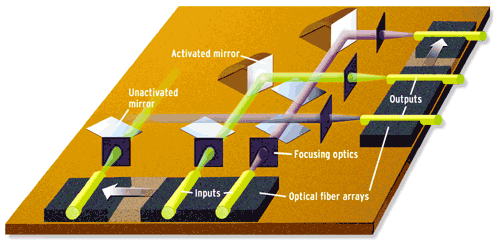
The next level of complexity is built using a two-dimensional array of these mirrors to form a matrix switch, with rows of inputs and columns of outputs (or vice versa) [see drawing, above ]. Switches with eight inputs and eight outputs are readily implemented using this technique, which can be extended to about 64 x 64. In these cases, control of the mirror is digital--that is, the mirror is swung between fixed stops, and tight control of its motion between the stops is not needed. However, precision manufacturing and packaging are required to ensure that the stops are positioned properly.
The substantially different lengths of the optical paths through various switch configurations limit the scaling. The approach leads to a very cost-effective medium-scale matrix switch, as all of the packaging is planar. The optical paths between the individual mirrors can be through free space or via waveguides. Combinations of MEMS and waveguides are extremely promising for the next generation of medium-scale switches, and are currently being investigated by several companies such as Nanovation Technologies and Kymata.
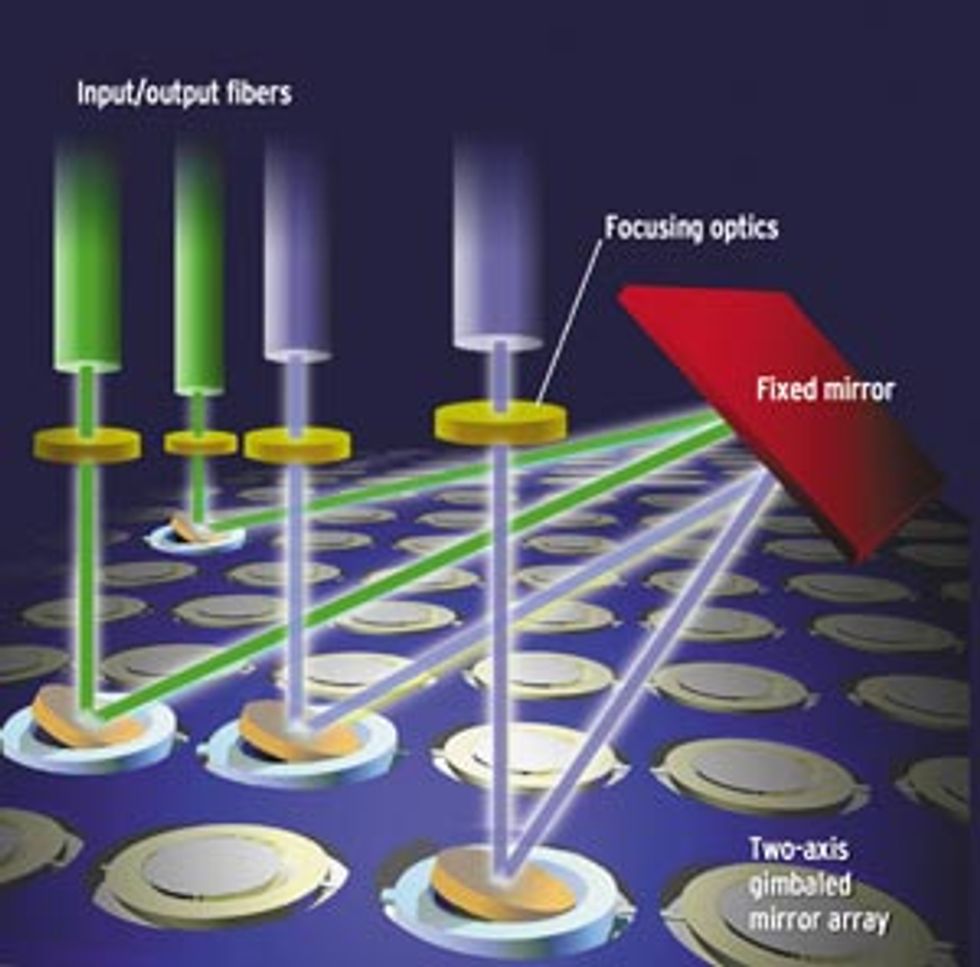
Substantially more complex are the 3-D switches built using two-axis mirrors to steer the optical beams [see figure, right]. Prime examples are those coming from Agere (formerly Lucent Microelectronics) and XROS (now part of Nortel). These require extremely fine analog control to align their optical beams because the beams must be accurately directed along two angles and then stop at precise intermediate positions, not just at fixed end-points. Three-dimensional switches scale well because the number of mirrors required equals just the total number of ports. It appears today that sizes as high as 4096 x 4096 are feasible and could become available as soon as the economic climate improves enough for demand to develop.
Another key contributor to the scaling is that the optical path length depends little on which ports are connected, as opposed to 2-D matrix switches, leading to more uniform switch behavior. Limits to the scaling include the diameter of the mirrors and their maximum tilt angle. The mirrors should be about 50 percent bigger than the optical beams to avoid excessive loss; and tilt is limited by both the method used to build the switch and the technique used to actuate the mirror.
Another challenge is the electrical drive for the mirrors. At least four electrical connections per mirror are needed. Thus thousands of electrical interconnects must come off the MEMS chip unless the addressing, control, and drive electronics can be integrated under the mirrors. That integration will be far from easy, because high-voltage analog circuitry that must function with great precision is required--hundreds of volts must be controlled to within about 10 mV.
In their present form these switches are limited to large port counts because their costly 3-D packaging makes them too expensive for smaller switches. Although suitable tests are not yet available for establishing 20-year life for telecommunications applications, noncontact MEMS have a proven track record of high reliability in many industrial and consumer applications, such as airbag accelerometers, pressure sensors, and inkjet printheads. The robustness and reliability of MEMS switches was recently proven when switches from OMM Inc. passed the demanding Telcordia qualification tests.
Many other MEMS approaches to switching are being investigated, including moving fibers, bending waveguides, sliding shutters, and curling mirrors. Each approach has unique features that have promise in applications for small- and medium-scale switching.
Liquid crystals--not just for displays
Another method for achieving all-optical switching is by means of liquid-crystal (LC) technology, which can be used to control the polarization of a light beam. Liquid crystals are used in conjunction with polarization-dependent materials, which absorb or reflect light with a specific polarization. When a voltage is applied to an LC device, the individual crystal elements align with the applied electric field. If the elements are orthogonal to the optical beam polarization, the light will be reflected. On the other hand, if the elements are lined up with the optical polarization, the light passes through the liquid crystal.
While liquid-crystal technology is well-characterized and has been proven reliable in many years of display applications, it has three noted disadvantages. It is fairly slow (especially at low temperatures, where switching times can be hundreds of milliseconds); is difficult to integrate with other optical components; and has relatively high light losses from the liquid crystal itself, the polarization splitters, and imperfections in the fairly complex optical path.
One of the most challenging aspects of applying liquid crystals to optical switching directly relates to their use of polarization. The optical polarization of any input signal is completely uncontrolled. Therefore, the signal must be split into two known orthogonal polarizations using polarization splitters and switching done separately on each. The results are then recombined to form the output.
This approach is troublesome and costly to implement and could cause unacceptable polarization mode dispersion (PMD), in which short pulses are spread out in time because different components of the pulses propagate at different speeds, depending on their polarization. In addition, compensating for the liquid crystal's temperature dependence renders it too costly for all-optical switching needs in the metro and access networks.
Total internal reflection
Total internal reflection--known as TIR, the phenomenon that makes light propagate down an optical fiber--can, with an added twist, also serve as the basis of a switch. The way the principle works, if light attempts to cross from a medium of higher refractive index (Dielectric 1) to one of lower refractive index (Dielectric 2) at too shallow an angle, all of the light is reflected from the interface back into the high-index medium [see top left part of figure]. The trick to exploiting the phenomenon in a switch is to turn the effect off (or on) by replacing (or not replacing) the second medium with one whose index of refraction matches that of the first.
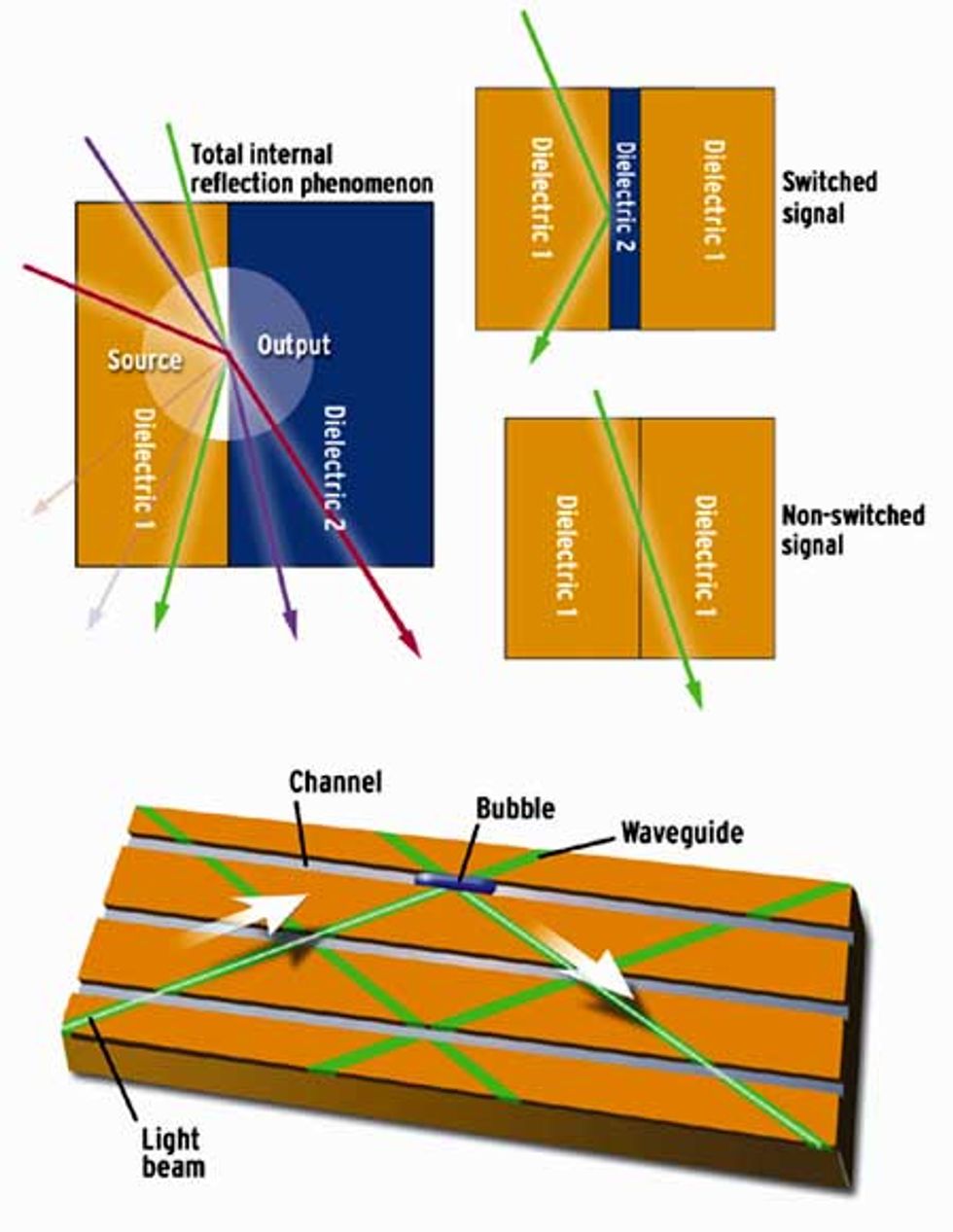
The best-known product based on this phenomenon is the Agilent Champagne switch, in which sections of waveguide intersect with fluid-filled channels [see bottom part of figure]. The fluid has nearly the same index of refraction as the waveguide, enabling the light to cross the intersections with fairly low loss. When a bubble (vaporized fluid in this case) is introduced at the intersection, its low refractive index causes the light to be reflected--or switched--onto another waveguide because of total internal reflection. The Agilent design builds on the company's unparalleled experience in ink-jet printing and has great promise for low-cost manufacturability.
However, the waveguide intersection creates several optical challenges. In the unswitched case, when fluid fills the intersection, the waveguide cross-section is not maintained perfectly across the intersection--some loss does occur. If there were only a single intersection, this would present no problem, but a light beam may have to cross many intersections in a TIR switch (possibly as many as the total number of ports) and the losses are cumulative. Also, some of the lost light finds its way into the output waveguide, thereby causing crosstalk. To minimize these detrimental effects, the intersection should be kept as small as possible.
In the switched case, when a bubble is present, a different problem rears its head. Light reflects off the bubble into the output waveguide, but, owing to the nature of TIR, also extends some distance into the bubble. To ensure that very little continues across the intersection, the bubble should be made as large as possible. Designers of TIR switches are therefore faced with a pair of conflicting requirements: low loss must be traded off against high isolation.
An additional problem in TIR switches of this type is that the reflected wave undergoes a wavelength-dependent phase shift because of energy storage in the bubble. This causes amplitude variations and dispersion in the switch's output, lowering its usefulness for some applications.
Creating and removing the fluid in the intersection can be done in two basic ways: either by vaporizing some of the fluid to create a bubble and then condensing it to reverse the process, or simply by moving a liquid-air interface into and out of the intersection. A bubble can be created in a few milliseconds by applying heat and then continuously applying just enough heat to maintain the bubble; the reverse condensation process is slower. The moving interface approach has the potential for being faster than the bubble approach, but has yet to be realized in practice.
To make larger switches, the waveguides are arranged to form a matrix of switching intersections. Note that because this is a matrix switch, the number of intersections equals the product of the number of inputs and the number of outputs. As mentioned above, each intersection traversed by the light contributes to the loss and crosstalk, limiting the scaling of the matrix to less than 100 ports because the number of intersections to be crossed by a light beam in the worst case may equal the total number of ports.
Emergent electroholography
Electroholography is the newest all-optical switching technology. This method features a solid-state switch matrix created from rows and columns of ferroelectric crystals such as lithium niobate or potassium lithium tantalate niobate [figure]. Rows correspond to individual fibers, and each column is for a different wavelength. Each crystal is laser etched with a Bragg grating (which causes a quasi-periodic modulation in its dielectric properties) to create a hologram in which the crystal's optical properties are changed when it is energized, for example, by the application of an electric field.
In current implementations, such as those by Trellis Photonics, individual crystals are manually assembled, and thus must be greater than 1 mm on a side. As the technology evolves, the holographic elements may be able to be written more densely into a single crystal; then patterning will be required only for the electrodes through which the energizing electric fields are applied to each crystal or holographic element.
When a crystal is not energized, light goes through it. Energized crystals, on the other hand, deflect a controllable portion of the incident light to the appropriate fiber. Holographic switches are quite fast and claim instant signal restoration. They, along with other switches made from electro-optic materials, will be fast enough for the long-term application of optical packet switching. Because it is an emerging technology, no data about its long-term reliability is available, but past holographic applications like high-density storage have shown lifetime issues with the holograms themselves.
On the plus side, electroholographic switches may be easily integrated with other network functions like equalization and monitoring. Being electrostatically controlled, they consume negligible power. The technique allows a single crystal to be used for switching and for variable attenuation, since the fraction of light reflected is controllable by an applied signal.
Yet, from an application viewpoint, the technology is not the ideal solution it is sometimes represented to be. The approach is that of a wavelength-selective matrix switch. The hologram blocks are analogous to the mirrors in a 2-D MEMS switch. The number of matrix elements in an electroholographic switch, therefore, increases as the product of the number of input and output ports, and will not scale well.
As the switch matrix size is increased to the sizes needed for core network switching, the required optical beam size will expand and optics for collimating and focusing the beams will be required. Non-energized blocks in the optical path will contribute to the loss and crosstalk of the switch. Also, holograms are diffractive elements that are inherently polarization and wavelength dependent, leading to dispersion and polarization-dependent loss (PDL) issues.
All things considered, the mirror-based MEMS approach seems to be best poised to fill the near-term need for large optical switches, first in long-haul (core) networks, then in metropolitan-area nets, and later, perhaps, at the access level. With its low loss, adequate switching speed, demonstrated ability to scale to large port counts, and high reliability, MEMS technology offers the best combination of crucial qualities needed to produce an effective transparent switch.
Michael J. Riezenman, Editor
About the Author
ARTHUR S. MORRIS III (M) is senior manager, advanced optical and RF MEMS (microelectromechanical systems) development at Coventor Inc., Cary, N.C., where he specializes in physical electronics and electromagnetics and directs the development of optical and RF behavioral model libraries. He is also an adjunct professor of electrical engineering at North Carolina State University.
To Probe Further
For overviews of optical switching technologies, see Photonic Switching Technology, edited by Hussein T. Mouftah and Jaafar M.H. Elmirghani (IEEE Press, 1998), and "Optical Cross-Connects for Optical Networking," by Neil A. Jackman and others, in the January-March 1999 issue of the Bell Labs Technical Journal, available at https://www.lucent.com/minds/techjournal/jan-mar1999/pdf/paper14. pdf.
A good overview of optical microelectromechanical systems (MEMS) is presented in the Naval Research Laboratory report "Optics & MEMS" by Steve Walker and David T. Nagel. It is downloadable from https://mstd.nrl.navy.mil/6330/6336/moems.html.
As its name implies, An Introduction to DWDM Technology (DWDM stands for dense waveform division multiplexing) by Stamatios V. Kartalopoulos (IEEE Press, 2000), is useful for getting oriented on such topics as optical componentry, switching, and transmission.
A group of articles that focused on optical switching was published in the January 2001 issue of Scientific American. The lead article, "The Triumph of the Light," by Gary Stix, can be found at https://www.sciam. com/2001/0101issue/0101stix.html.
For lively discussion and timely information on optical networking technologies and business issues, see https://www.lightreading.com.