
Schools of small fish follow them for company or shade, but sharks, less friendly, have on occasion chomped on their elongated bodies. These new arrivals to the underwater world are small submersible robots known as gliders because they thrust themselves through the water not with propellers but by simply changing their buoyancy. Thanks to this neat trick, gliders consume just a trickle of power and can remain at sea for several months at a time, surfacing only to get a GPS fix and beam data to satellites. A mission using a conventional autonomous underwater vehicle (AUV) lasts only hours.
Now it seems gliders have caught the attention of some other big fish. This month, the U.S. Navy plans to announce the winner of a contract for 154 gliders, plus spare parts, launch-and-recovery equipment, and monitoring systems. The order, valued at tens of millions of dollars, sent defense contractors racing to gobble up the leading glider technologies.
In June, iRobot, in Bedford, Mass., best known for its Roomba vacuum cleaner and bomb-disposal PackBot, became the exclusive licensee of Seaglider, developed at the University of Washington, in Seattle. In July, defense industry giant Teledyne Technologies acquired Webb Research, in East Falmouth, Mass., creator of the Slocum glider. General Dynamics had earlier subcontracted Bluefin Robotics, in Cambridge, Mass., a licensee of the Spray, a glider jointly developed by the Scripps Institution of Oceanography and the Woods Hole Oceanographic Institution.
The Navy solicitation, part of a larger program called Littoral Battlespace Sensing, Fusion, and Integration, involves using fleets of gliders to gather data on ocean currents and on acoustic properties that may affect military sonar systems. The Navy deal “got a lot of attention because right now people are buying gliders in ones and twos and threes, so it's a big increment," says Russ Davis, an oceanographer at Scripps, which is part of the University of California, San Diego. Gliders are enticing, he says, because of their relatively low cost: a fully equipped unit sells for about US $100 000 and can go for six months; a data-gathering mission using a ship can cost over $30 000 a day.
Up to this point, however, AUVs have been a cottage industry. “The challenge now is making the transition from this very hands-on build-and-test kind of manufacturing to commercial production mode," says Tom Curtin, chief knowledge officer at the Association for Unmanned Vehicle Systems International, a trade organization in Arlington, Va.
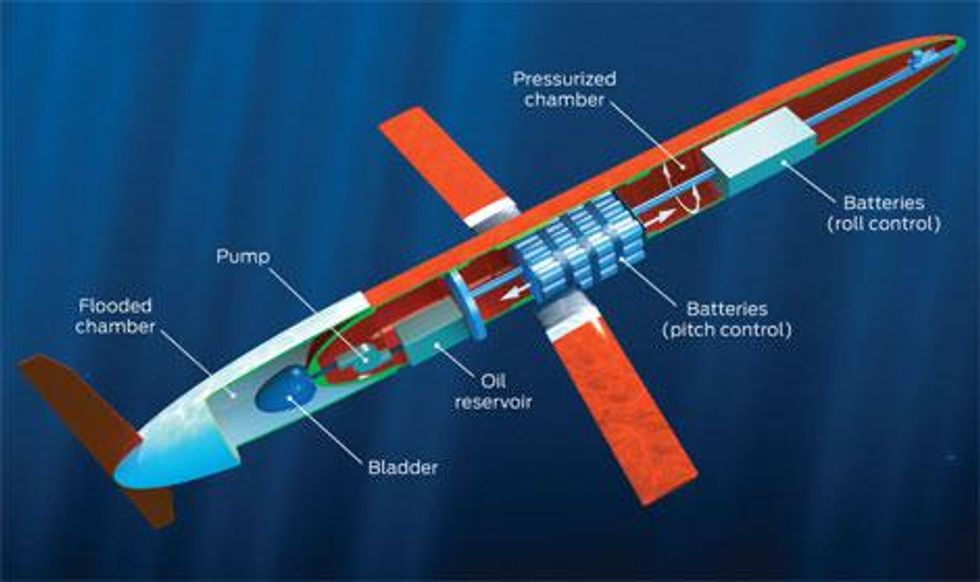 Power, sans Propellers: A glider rises by inflating a bladder with oil and sinks by deflating the bladder. The fixed wings convert vertical motion into horizontal, and the glider displaces its batteries to control roll and pitch.John MacNeil
The Navy contract will pit the three main glider designs against one another. As it happens, they all emerged from the same Office of Naval Research program in the mid-1990s. Similar in design, each is a torpedo-shaped aluminum hull about 1.5 to 2 meters long crammed with sensors, batteries, and electronics. To move, the glider uses a pump to inject or remove oil from a bladder located in a flooded part of the hull. To ascend, a robot expands the bladder, displacing water and increasing its buoyancy; to descend, it empties the bladder out. A pair of fixed wings converts part of the vertical displacement into horizontal motion, causing the glider to travel in a sawtooth trajectory.
To change pitch while climbing or sinking or to turn left or right, the gliders change their center of mass by shifting the position of their battery packs. “There are no external moving parts—no propellers or jets or moving fins—to push this thing through the water," says Tom Frost, iRobot's program manager for the Seaglider. “It's really elegant."
And even though their original designs are alike, their makers boast of unique capabilities. iRobot claims the Seaglider has the longest range and battery lifetime, being the first glider to complete a mission of more than 3750 kilometers and lasting six months. Bluefin, which is also supplying an offshore oil and gas contractor, says the Spray glider can go about 50 percent deeper—1500 meters—than its competitors and has more durable sensors. And Teledyne says the Slocum's rudder gives it better shallow-water maneuverability and that a new system that harvests energy from temperature variations in the water could allow its gliders to stay at sea for years at a time.
For researchers like Scott Glenn, a professor of physical oceanography at Rutgers University, in New Brunswick, N.J., any extension of a glider's time at sea is welcome news. In the past few years, Glenn and others have turned to gliders to study ocean circulation, climate events, and marine life. One of his projects involves tracking the flow of sediments off New Jersey's coast during storms. He and his colleagues can't go out on research boats in those conditions, but with gliders they can be anywhere there's an Internet connection to monitor—or “fly"—the vehicles. “I do a lot of flying from McDonald's or Starbucks," Glenn says. “Anywhere, anytime, you can go to sea."