
This is part of IEEE Spectrum’s SPECIAL REPORT: WINNERS & LOSERS 2009, The Year’s Best and Worst of Technology.
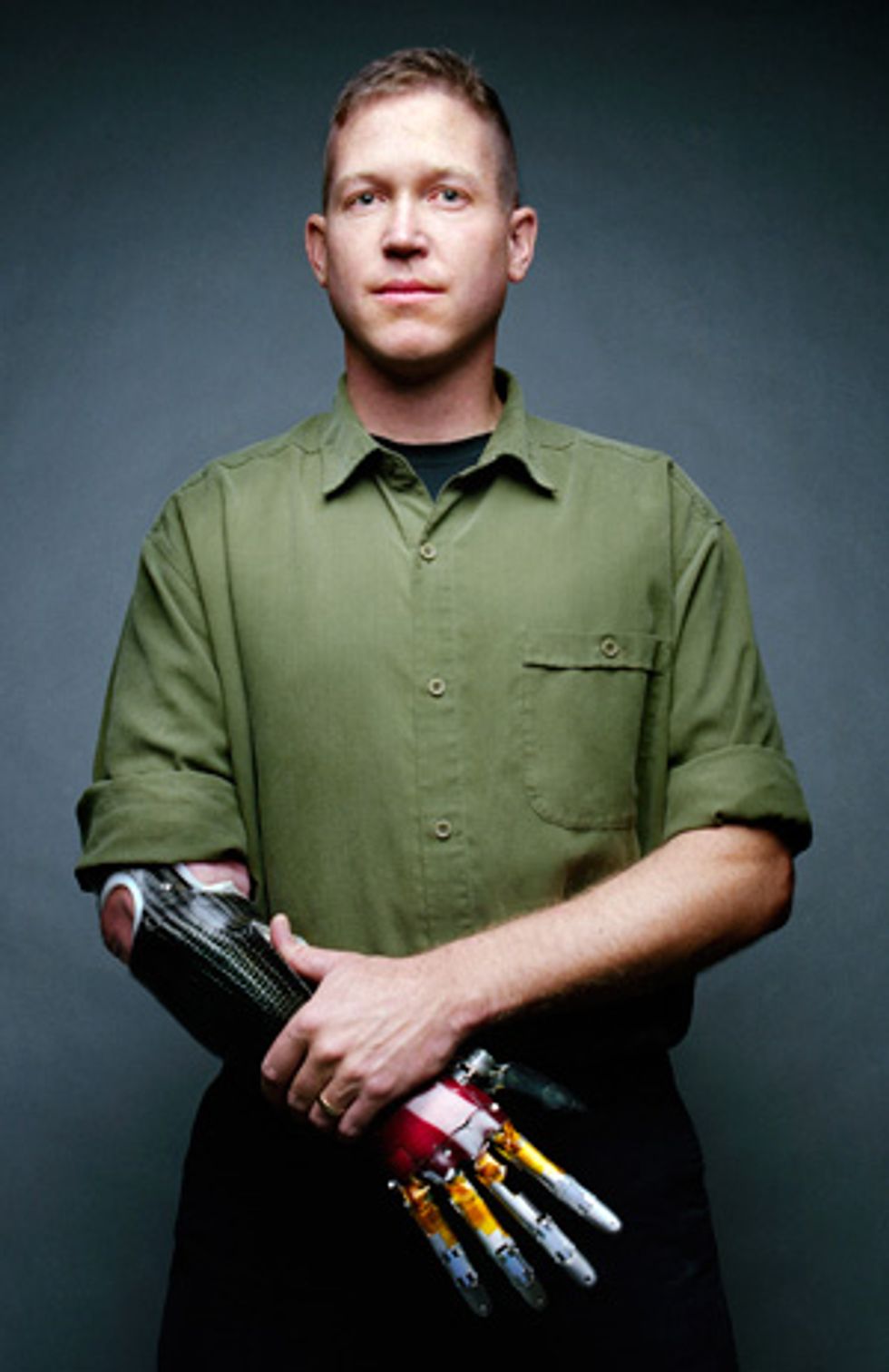 Armed and Ready: Jonathan Kuniholm wears a prototype of the prosthetic arm created by the DARPA Revolutionizing Prosthetics project.Photo: Mike McGregor
It’s October at Duke University, in Durham, N.C., and Jonathan Kuniholm is playing “air guitar hero,” a variation on Guitar Hero, the Nintendo Wii game that lets you try to keep up with real musicians using a vaguely guitarlike controller. But the engineer is playing without a guitar. More to the point, he’s playing without his right hand, having lost it in Iraq in 2005. Instead he works the controller by contracting the muscles in his forearm, creating electrical impulses that electrodes then feed into the game. After about an hour he beats the high score set by Robert Armiger, a two-armed Johns Hopkins University engineer who modified Guitar Hero to train amputees to use their new prostheses.
Armiger’s research is part of a nationwide effort to create a neurally controlled prosthetic arm. That arm has been the focus of much media attention, but that focus obscures the truly groundbreaking research typical of the Revolutionizing Prosthetics 2009 (RP2009) program.
The U.S. Defense Advanced Research Projects Agency (DARPA) is pouring at least US $71.2 million into the program in the hope that it will let amputees do what most people take for granted: make gestures, test the water in a teacup, turn a key, even peel the shell off an egg. Words like bionic and thought-controlled have been thrown at the project, but they don’t do justice to the sheer ordinariness of its purpose. DARPA isn’t looking for a superstrong “Six Million Dollar Man” arm; it just wants an arm that moves exactly like a real one does.
Yet even making just a garden-variety arm requires a herculean effort, not only in the field of mechatronics but in neuroscience, electrical engineering, cognitive science, signal processing, battery design, nanotechnology, and even behavioral science. This four-year project is wildly ambitious even by the standards of the Pentagon’s mad-science wing. After the program concludes at the end of 2009, many of the arm’s various technologies will go into FDA clinical trials and then out into the world.
But some of the RP2009 technologies have already begun to filter out. In October, a Canadian hospital announced that it had used part of the control mechanism of the DARPA arm to steer regular, nonrevolutionized prosthetic arms in two patients. Simply borrowing that one technology has made huge improvements in commercially available prosthetic devices.
DARPA’s device is the world’s first truly neurally controlled prosthetic arm. To keep it from being the last, its designers are explicitly creating it with other designers in mind. The program’s engineers want a quasi–open source platform for hardware and software, so that the RP2009 specifications will replace the Babel-like confusion of scattered prosthetic-arm designs with a platform everyone can use to finally push the technology into the 21st century.
The Revolutionizing Prosthetics program has been testing control technologies on volunteers around the country: at the Rehabilitation Institute of Chicago; at OrthoCare, in Oklahoma City; and at the Johns Hopkins University Applied Physics Laboratory (APL), in Laurel, Md. RP2009 team leader Stuart Harshbarger says the investigations will likely extend later this year to the Salt Lake City Veterans Affairs hospital, one of the military’s major rehab centers for amputees.
Such centers are reeling under the burden posed by the wars in Iraq and Afghanistan, where improvements in body armor have saved the lives but not always the limbs of many soldiers who would have died in earlier wars. The number of such amputees stood at 1214 on 1 August 2008, compared with 4809 deaths and 33 116 injuries, making for a ratio of amputations to deaths that’s roughly twice as high as in any previous war.
Those numbers have turned amputee research from a backwater to a high priority. In 2005, DARPA set up the prosthetic-arm project and put it in the hands of Geoffrey Ling, a neuroscientist trained at Georgetown University, in Washington, D.C., who is also a colonel in the U.S. Army.
Ling split the program into two distinct parts. The part headed by Dean Kamen’s New Hampshire–based Deka Research and Development Corp. had a 2007 deadline for creating a sophisticated mechanical limb by making the most of existing technologies, using noninvasive control mechanisms.
The complementary four-year program has a 2009 deadline to reinvent prosthetics from the ground up so that they can be biologically controlled. The goal is to restore sensory feedback to amputees so that they can again perceive heat, cold, pressure, and the position of a limb in space. All these faculties must fit inside a package that has the look, weight, strength, dexterity, natural movement, and toughness of an arm [see illustrations, "Custom Built"].
Ling tapped APL to oversee this nationwide “Manhattan Project” for prosthetic arms. Over 30 universities and research institutions are collaborating on the project, all of them leaders in their fields. “I thought it was going to be like herding cats,” says Harshbarger, Ling’s APL counterpart, who directs the 2009 effort. But countering stereotypes of academic competitiveness, these 300-odd researchers have been working together in lockstep, project first and egos last, to make the endeavor succeed.
Creating an arm that actually interfaces with an amputee requires an encyclopedic understanding of countless disciplines including power management, neural integration, and anatomy. APL built two mechanical prototypes, both of which were marvels of modern engineering. The Rehabilitation Institute of Chicago (RIC) developed surgical techniques to reroute existing nerves in amputees so that they interface with the electronics in the prosthetic arm. Chicago-based Sigenics developed implantable electrodes to wirelessly transmit the electrical signals from residual muscles directly to the prosthetic limb. Researchers at the University of New Brunswick, in Canada, developed signal-processing algorithms to decipher the noisy biopotentials from the reinnervated muscle in real time. Researchers at the University of Utah developed brain-penetrating electrodes to tap nerve impulses at their source. Johns Hopkins University has developed what it calls the Virtual Integration Environment, in which an amputee can practice by “driving” a virtual arm with nerve signals.
The result is a system that will patch together delicate nerve surgery, signal-processing algorithms, injectable electrodes, and a virtual-reality training environment to connect an amputee to an artificial arm that he can control intuitively with his own nerves and muscles, as intuitively as you control your own arm. By the end of 2009, two crucial components of the technology should be in clinical trials: injectable myoelectrodes that let amputees wirelessly use the signals from their residual muscles to drive the limb, or if they choose a more invasive path, drive it using electrodes implanted directly into peripheral nerves.
At the end of the 1979Star Wars sequel The Empire Strikes Back , a deft stroke of Darth Vader’s light saber slices off Luke Skywalker’s hand. In the next scene, Luke is on a medical ship, and a robot is putting his new prosthetic hand through its paces: a needle pricks each of his fingers in turn, and each time Luke winces in response. The throwaway scene shows a state of the art in prosthetics that in 1979 was out of the question. Even then it was relatively easy to make a prosthetic hand look convincing, but if you were to stick a needle in one—or chop it off—the wearer wouldn’t know unless he was watching you do it. Prosthetics were designed for form, not function. Mechanical designs for futuristic robot arms have been floating around for at least half a century. Yet despite years of sci-fi promises, prosthetic-arm research has stagnated.
Upper-arm prosthetics got their last big overhaul in 1912, in the form of a hook that could be opened by shrugging against a strap across the back. That turned what had been a purely cosmetic sleeve-stuffer into a machine with a limited ability to manipulate objects. Another big investment, after World War II, gave the world the myoelectric hand, but it did not change the fact that prosthetics were unintuitive and cumbersome. Today the hook has been prettied up with a molded plastic hand and semirealistic skin tones, and the arms are lighter and stronger. But they can’t do a whole lot more.
Traditional upper-body prosthetics provide at best three degrees of freedom: you can open and close the hook, bend and straighten the elbow, and on sophisticated models you can rotate the wrist. And even those simple movements require training, concentration, and effort, which is why the resulting motion is neither fluid nor precise. Contrast that with the human arm’s subtle dexterity and more than 25 degrees of freedom of movement, not to mention its ability to discern hot from cold. With three degrees, you can’t even open a door—a doorknob requires what’s called off-axis rotation, and that requires two extra degrees of freedom in the elbow and wrist—and you can completely forget about tying your shoes or checking your e-mail. Within a year of being fitted, many amputees put their artificial limbs in closets to collect dust and learn to live without them.
Why so few advances? In part it’s because upper-body amputations are rather uncommon, unlike lower limb amputations. That’s why there’s been far greater demand for high-tech leg prostheses (notably the carbon-fiber transtibial artificial limbs on which sprinter Oscar Pistorius recently threatened to break records set by able-bodied men). The disparity has led Deka’s Kamen to grouse that today’s prosthetic arms use “Flintstones” technology.
But the main problem is that it’s just harder to make a really useful artificial arm than it is to make a comparably useful leg. To fulfill the minimum requirements of daily living, a leg needs springiness and four degrees of freedom; an arm-and-hand system needs about 22 degrees of freedom, as well as the ability to feel heat, texture, and force and to use that information to make dexterous movements.
In 2003, Ling was stationed with the 44th Medical Brigade in Afghanistan, where he soon found himself bandaging many more children than soldiers. “Every day some little Afghani kid came in missing part of his limb,” Ling says, often after the child had inadvertently found one of the many land mines still littering much of Afghanistan, some of them dating back to the Soviet occupation. Between surgeries, Ling developed his own ideas of what a prosthetic arm should be—a system that could replace a hand, a forearm, even the entire limb and shoulder, to restore to the amputee a fully functional arm. When he returned to the United States, Ling created the Revolutionizing Prosthetics program.
Making the arm is the easy part, and it’s not at all easy. Microprocessors have become small and powerful enough, and research has yielded materials light enough, to meet the limb’s 3.6-kilogram (8-pound) specification, the weight of an average female’s arm. But even that might be too heavy—the natural arm is connected to the bone, but an artificial limb relies on sockets and straps, which make even a “normal” weight feel awfully heavy by the end of the day.
But at least that’s a problem an engineer can tackle—how to make something lighter. “When you’re working on the neural system,” says APL director Richard Roca, “you’re doing scientific discovery at the same time you’re doing engineering.” It doesn’t even have to be neural system integration: consider a problem as apparently straightforward as power. Power consumption has improved but not enough to allow a lightweight battery to indefinitely power a mechanical arm. Harshbarger’s goal is a battery that can last for 18-hour shifts.
The research was going ahead at full speed before it became clear that no one knew how much power an actual arm requires per day. Convinced that the answer had long since been published in someone’s doctoral thesis, APL systems engineer James Burck searched the literature, only to come up empty-handed.
So before they could continue their work, the APL team had to determine the daily power usage of an average arm. They asked for volunteers from a wide range of occupations—a self-described APL “keyboard jockey,” an auto mechanic, a machinist, and a bricklayer. They brought in a Johns Hopkins Bayview Medical Center researcher to monitor each person’s daily activity to determine the range of arm power an average person uses to open and close a refrigerator, drive a car, cook dinner, and perform the more idiosyncratic functions of his trade, like fix a car, pick up heavy tools, and type on a keyboard (answer: more than you’d think). This information in hand, the team was able to determine a specification for a battery that would last 18 hours and be recharged as easily as a cellphone.
But the most power-efficient arm in the world is no good if you can’t control it. So APL partnered with RIC to develop a groundbreaking technique for controlling a mechanical arm with an amputee’s own nervous system.
Todd Kuiken, director of RIC’s neural engineering center, created a portal to the nervous system by rewiring the shoulder. The procedure, called targeted muscle reinnervation surgery, redirects the residual nerve bundles that once connected the spinal cord to the 70 000 nerve fibers in the arm. After an amputation, these nerves remain in place, and they continue to work—they just aren’t connected to anything functional. The pectoral muscles also remain intact, but they too are no longer driving an arm. So Kuiken surgically threaded the residual nerves from their original locations into the chest, where they innervated, or grew into, an area of pectoral muscle slightly smaller than a compact disc.
Next, Kuiken taped electrodes over the chest patch, where they could pick up the electromagnetic signals from muscles and send them to paired electrodes inside the prosthesis. There, signal-processing algorithms could translate the signals into the user’s intended movements. With Kuiken’s surgery, amputees were able to control the DARPA prototype with their own muscles, as if it were an extension of their own flesh.
Then came an unexpected and very lucky break: the researchers found that the redirected nerves restored not only muscle function but also sensation. The skin on that patch had been rewired with the nerves from the arm and hand; therefore, the patients sensed a touch on their chests as if someone were touching their missing hands—even if it was just a tap. The Hopkins team exploited this discovery with a device called a tactor, built at Northwestern University. By placing the tactor on the chest next to the electrodes, they created a complete feedback loop. In the end, the combination of Kuiken’s complex rewiring scheme and the brain’s natural plasticity simulated a real arm’s ability to sense touch, heat, and cold.
But soon the researchers found themselves with an intractable problem. The goal is to create an arm for unconstrained daily use—ideally, Ling says, you’d want to just “strap it on and go.” But few people would submit every day to the punishing routine of having 20 electrodes and an array of tactors taped to areas of the chest, then having those electrodes connected to the correct wire. It would take hours to suit up. Also, Kuiken wants more electrodes than that CD-size patch of skin can accommodate. “I’m running out of real estate,” he says.
To solve all these problems, the researchers figured it was time to get some of those electrodes under the skin and to make the control mechanism work wirelessly. To that end, they plan to implant rice-size devices called Injectable MyoElectric Sensors (IMES) into the muscles, to magnify the electromagnetic signals from muscle twitches. Pending FDA approval, these devices, developed by RIC researchers Richard Weir and Jack Schorsch and Illinois Institute of Technology biomedical engineering professor Philip Troyk, will go into clinical trials at the end of 2009. Also in the queue for clinical trials are much more invasive needlelike implants that bypass the muscles by going directly into the peripheral nerves. The ultimate goal is penetrating brain electrodes to tap the signal directly at the source. But that’s still a few years away.
DARPA is often accused of funding science-fair research projects that fail to find real-world applications. This isn’t one of those projects. The fruits of the Revolutionizing Prosthetics program are already improving existing prosthetics. Targeted reinnervation surgery has already been adopted in Canada, where in October Jacqueline Hebert, clinical director of the adult amputee program at the Glenrose Rehabilitation Hospital, in Alberta, announced that two patients had successfully undergone the surgery and were now starting to control their prosthetics with the newly innervated muscles. “The patients have visible muscle contractions in their arms when they think of opening and closing their hands,” Hebert says. One patient is beginning to have sensory reinnervation as well.
The success of the procedure suggests that it could soon be a mainstay of rehabilitation. Otto Bock Healthcare Products, in Vienna, is the transition partner for DARPA, meaning that it will manufacture the devices after DARPA has stopped funding.
But the eventual, overarching goal is more than just an arm or even a system of devices that includes an arm. It is to give shape to the new generation of prosthetic arms. Take the game of air guitar hero, for example: later in 2009, the software that let Kuniholm play Guitar Hero will go open source. Harshbarger thinks DARPA will eventually make all or most of the RP2009 software and hardware interfaces open source. Within the next year or so, the Johns Hopkins Virtual Integration Environment hardware specifications should be available, so that down the line, as Kuniholm says, “anyone can build a better elbow without having to build a whole new arm.”
For more articles, go to Winners & Losers 2009 Special Report.
Snapshot: Arms Race
Winner: Robotics/Neurointegration
Goal: To create a neurally controlled prosthetic arm with 22 degrees of freedom.
Why: it’s a winner It has accomplished every goal so far, and even though the project is incomplete, its associated technologies have begun to improve existing prosthetics.
Who: U.S. Defense Advanced Research Projects Agency; Johns Hopkins University Applied Physics Laboratory (systems integrator); Rehabilitation Institute of Chicago; 30 research institutions around the world
Where: Laurel, Md., and 30 other locations around the world
Staff: 300 and counting
Budget: US $71.2 million to date
When: Third-generation prototypes under development, scheduled for clinical trials late 2009; commercially available (in some form) the following year