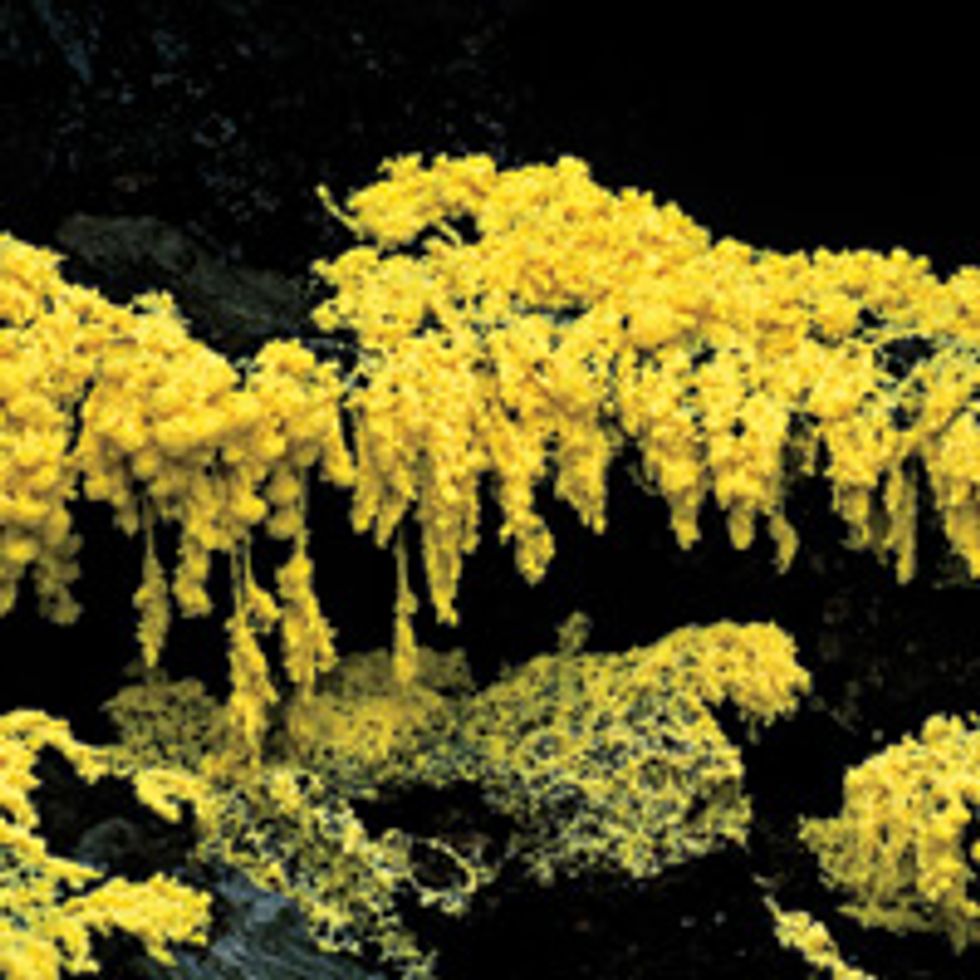
 Slime Remembered: Slime mold avoids its own tracks.Photo: Audrey Dussutour
There are a lot of similarities between the popular home robot and the forest-floor goop you wish you hadn’t stepped in. Following a combination of programmed cues, an iRobot Roomba responds to its environment, detecting dirt and vacuuming it up. Slime mold, or Physarum polycephalum, functions in a similar way, behaving in accordance with a list of genetically inherited rules. It’s a simple, single-celled organism that digests detritus and leaves behind a trail of slime wherever it goes. What makes slime mold remarkable is that when threatened, all the individual cells in the area combine, creating a larger organism—a collective entity capable of solving problems that a Roomba would find challenging.
So, is slime mold smarter than a Roomba? We’ll lay out the arguments. You be the judge.
| SLIME MOLD | ROOMBA |
|---|---|
|
|
| Slime mold can design a transportation network. In two different experiments, it re-created massive transit systems in miniature. Researchers set out tasty treats to represent population centers, and slime mold spread out to find them, duplicating the Tokyo rail system and the Canadian highway system. | Roomba can’t compete at urban planning, but it can identify particularly gritty spots on a floor to do some focused cleaning. |
| Slime mold doesn’t have a brain, but it can sense and react to its surroundings without one. | A Roomba’s brain is made up of an ARM processor core and thousands of lines of software code. The CPU is coupled to infrared, piezoelectric, and RF sensors. |
| Slime mold has been inspiring computer scientists since the 1960s. Some of the math underlying the workings of video games, the Internet, and robots stems from studies of slime mold. | Roomba helped inspire the creation of a household robotics industry worth hundreds of millions of dollars. |
| Slime mold evolves. | Roomba gets updated, with a new generation of robots arriving every year or so. |
| Slime mold can control a robot. In 2005, Japanese researchers engineered an interface that let a slime cell control a hexapod robot. | Roombas control themselves. |
| Slime mold makes things slimy. | Roomba makes things sparkling clean. |