
"I became an engineer," begins John Hersey's 1956 novel, A Single Pebble. The book, which describes an American engineer's search for potential dam sites on the Yangtze River, mightily captivated a then-31-year-old engineer named Samuel C. Florman, a vice president at the Kreisler Borg Construction Co., in Scarsdale, N.Y. "For the first time in my experience I was conscious of viewing my profession through a prism of fictional imagination," explains Florman, now a partner in that firm.
Florman went on to devour all the novels he could find with engineers as protagonists; that experience led him to write a magazine article in 1959 about the engineer as a character in fiction. It was the first piece of a literary sideline that now encompasses some 250 articles and six books.
Not many engineers can claim Florman's literary credentials. But our survey of 14 eminent technologists shows that all of them were powerfully affected at some time in their lives by a work of fiction. We asked them which single novel had had the most impact on them personally or professionally. Surprisingly, nearly half of our respondents mentioned books that had no obvious thematic connection to science or technology. Vinton Cerf, for example, picked The Lord of the Rings series because it "tells us to look beyond the surface to what is inside each person." Virtual-reality pioneer Jaron Lanier remembers being "haunted" as a teenager by James Joyce's A Portrait of the Artist as a Young Man.
A Single Pebble, which does have technology as a backdrop, was cited not only by Florman but also by Henry Petroski, of Duke University, in Durham, N.C. Yes, two civil engineers with literary careers were moved by the same book, 43 years apart. Gravity's Rainbow was also the choice of two respondents—Steven W. Squyres of Cornell University and David Mindell of MIT. Published in 1973, Gravity's Rainbow was written by Thomas Pynchon, a one-time engineering student at Cornell and technical writer at Boeing. (According to legend, Pynchon wrote the book's manuscript on graph paper.)
Not surprisingly, works of science fiction are well represented on our list. But, notably, most of them are by a single author: Robert A. Heinlein. Vernor Vinge (himself a successful sci-fi author), Danny Hillis, and James Isaak all fondly recalled how works by Heinlein fired their youthful imaginations.
Science fiction probably did as much as anything else in the 20th century to push youngsters into engineering. So it's natural to look at the genre today and wonder if, amid the electronic clutter of modern adolescence, paper books still retain their power to enthrall and inspire. If they haven't, it certainly isn't for lack of material. Sci-fi is enjoying a mini-renaissance lately, as authors like Vinge, Alistair Reynolds, John C. Wright, and Tony Daniel have ingeniously resuscitated the space opera by giving it modern themes and a harder, more plausible technological edge. And a British writer, Neal Asher, has forged a steamy, contemporary version of pulp sci-fi, with a big dose of tech—one of his short story collections, published in 1998, is titled The Engineer. And let's not forget Wil McCarthy, who is an engineer, and whose novels are known for their deep-tech themes.
Vinge and Reynolds, too, have serious tech credentials: Vinge is a former computer science professor at San Diego State University, and Reynolds, an astrophysicist, worked on a superconducting optical detector for the European Space Agency. And though Wright, Daniel, and Asher lack degrees in engineering or science, the physics and technology in their books ring true almost all the time.
They all portray a more morally nuanced universe than Heinlein usually did. But they also share the master's enthusiasm for vivid, gripping adventure and for the role of technology in humankind's ultimate diaspora.
If you're young, give one or more of these books a try: you may find the pictures in your head even better than the ones on your game or TV screen. If you're older, you may find something even better: the familiar fizz that comes from idly pondering the possibilities of technology and humanity's future.
Here are our technoluminaries' book choices, together with some of their comments.
Vinton Cerf
Chief Internet Evangelist, Google
Founding father of the Internet, helped develop TCP/IP standards
Novel: The Lord of the Rings, J.R.R. Tolkien (3 volumes, 1954–1955)
First read it: 1965, age 22
"I think I would have to say that The Hobbit and The Lord of the Rings trilogy takes the top prize for me. Certainly I have read and reread these volumes many times since I first read them in 1965. The richness of Tolkien's imagination and expression still resonates with me no matter how many times I reread his work. The detailed history, the language and especially the poetry create depth beyond the norm in my opinion. I can hear the music in the poetic verses, as I imagine do many of his avid readers. The Good versus Evil theme with Good triumphant is, or course, very satisfying but perhaps even more so is the unexpected courage of the hobbits, especially Frodo and Sam but the others as well. The theme tells us to look beyond the surface to what is inside each person. I think I like most two scenes in the third volume. The first, after the war is essentially over, and the hobbits have come to Gondor, and the crowds proclaim, 'Praise them with great praise!' and the second, when the Hobbits return to the Shire and clean out the evil that has lodged itself there (Saruman/Sharkey and his gang)."
Donald Christiansen
Former editor, IEEE Spectrum; President of Informatica
Novel:War and Remembrance, Herman Wouk (1978)
First read it: 1978
"Not an easy call. Considering his complete output, my favorite novelist is John P. Marquand, and I have collected first editions of all his work (So Little Time, Point of No Return, The Late George Apley, etc.). But the unique book that comes to mind is Herman Wouk's War and Remembrance, published by Little, Brown in 1978. Fictitious naval officer Victor Henry helps bring to life the World War II years from Pearl Harbor (1941) to Hiroshima (1945). My own stint in the Navy during World War II made this book of particular interest to me, and I read it soon after its publication.
"It is neither short (1042 pages) nor an easy read. Familiarity with the geography of the Pacific (and Europe), and some acquaintance with naval terms and acronyms, e.g., TDC (torpedo data computer) and Is-Was (a backup instrument for the TDC) will help.
"Historically accurate events and locales become background for the plot. FDR, Churchill, and Stalin, and also well-known naval figures like Nimitz, King, Halsey, Kinkaid, Spruance, Mitscher, Yamamoto, Kurita, and Ozawa appear with regularity and historical legitimacy. The following, referred to in the text by Wouk, are real, not invented: the Wannsee Protocol, the Bermuda Conference, and FM sonar ("Hell's Bells"). Except for three fictitious submarines, all the naval vessels are real and their actions accurately portrayed.
"In Wouk's own words, his purpose in writing War and Remembrance 'was to bring the past to vivid life through the experiences, perception, and passions of a few people caught in the war's maelstrom . . . by scrupulous accuracy of locale and historical fact, as the background against which the invented drama would play.' "
"In his foreword to the first edition, Wouk concluded that 'war is an old habit of thought, an old frame of mind, an old political technique, that must now pass as human sacrifice and human slavery have passed,' optimistically adding "I have faith that the human spirit will prove equal to the long heavy task of ending war." Rereading this nearly three decades later, I'd say it appears that his encouraging optimism was, at the least, premature."
David Mindell
Frances and David Dibner Associate Professor of the History of Engineering and Manufacturing, MIT
Expert in deep-sea archaeology and the technology that makes it possible; author of War, Technology and Experience aboard the USS Monitor (Johns Hopkins, 2000).
Novel:Gravity's Rainbow, Thomas Pynchon (1973)
First read it: In college
Comment: "It's a wonderful mix of technology and history, a smart use of technology and rocketry as a metaphor for larger issues in the age of large technological systems, and a unique use of technical topics—spectra, feedback control, chemical processes—as literary metaphors."
James Isaak
Assistant professor of information technology, Southern New Hampshire University, in Manchester
Directed information standards at Digital Equipment Corp., acquired by Compaq and now part of Hewlett-Packard; member of IEEE Internet standards group.
Novel:Stand on Zanzibar, John Brunner (1968)
First read it: 1968, as a college student
"Oh, my—just one?
"John Brunner's Stand on Zanzibar is one of the most interesting (I have always been a sci-fi fan). It projects a world we have fortunately not entered, but not as far away as we might like, one where population factors, specialized warfare training, culture and pervasive 'personalized' television play significant roles. One point of view is the analysis stream of a conscious computer, something the author never explains. And the best concept is the reply of that computer to the question 'Are you conscious?' It says: "You would not have any way to verify my answer.' I first read it in 1967 as part of a college course.
"But wait, there's more:
"Robert Heinlein's Stranger in a Strange Land, which considers some of the absurdities of our culture; I read it in the mid-1960s.
"Neil Stevenson's Snow Crash, in which the KGB and CIA join forces to provide a rather highly intrusive set of surveillance services, and the 'software viral' infection of humans by computers is considered; I read this in the 1989 time frame.
"Zen and the Art of Motorcycle Maintenance: An Inquiry Into Values, by Robert Pirsig [editor's note--not a novel, but what the hey], which delves into the difference between the 'engineering' and the "artistic" ways of thinking, a concept that we all need to consider in more detail. I read it first circa 1976 and reread it a few weeks ago."
Samuel C. Florman
Principal and owner, Kreisler Borg Florman General Construction Co., Scarsdale, N.Y.
Author of The Existential Pleasures of Engineering (St. Martin's, 1976)
Novel:A Single Pebble, John Hersey (1956)
First read it: 1956, age 31
" 'I became an engineer.'
"Thus begins John Hersey's novel, A Single Pebble, in which the protagonist travels to prerevolutionary China seeking a site for a dam along the Yangtze River. As he encounters a civilization little changed since the Middle Ages, the young man finds his faith in technology giving way to awe and self-doubt. I read the book when it was published in 1957, and although in many respects I didn't share the author's worldview, I found the work totally absorbing. For the first time in my experience I was conscious of viewing my profession through a prism of fictional imagination.
"In the months that followed, with the help of a friendly librarian, I sought out novels with engineer characters, first heroic tales such as Zane Grey's The U.P. Trail, eventually more complex works such as Willa Cather's Alexander's Bridge and stories by Kipling, Chekhov, and Strindberg. The single book that made the deepest and most lasting impression on me was Roll Back the Sea by the Dutch novelist A. den Doolaard. Based upon the rebuilding of the dikes that had been destroyed during World War II, the novel captivated me in two ways. First, the drama of the work itself: 'An atmosphere of drawing boards and tide tables, of megaphones and jingling telephones; of pitching lights in the darkness, of sweat and steam and rust and water, of the slick clay and the wind. A dike in the making, the greatest dike that the world had ever seen, built straight through sea water.' More subtle, but equally compelling, is the topic of professional motivation. The engineers and contractors, superficially, are attracted by monetary considerations. But, says the author, their fundamental role is to participate in a life-enhancing enterprise: 'Profit is merely the bait that destiny has offered to these calculators.'
"As for bait and destiny, after two years of reading such works, I was moved to write an article about the engineer as a character in fiction. It appeared in the August 1959 issue of Civil Engineering and marked the beginning of my writing 'career.' (I put the word in quotes because I have continued to practice as a construction engineer.) Now, some 250 articles and six books later, I find it hard to say 'which novel had the most impact on me personally or professionally,' to repeat the question posed by IEEE Spectrum. Was it A Single Pebble, with the wakeup call of its opening sentence and its challenge to our ideas about progress, or Roll Back the Sea, with its evocation of engineering exploits and musings about engineering motivations?
"Happily, I don't feel under great pressure to make a choice."
Vernor Vinge
Retired professor of computer science, San Diego State University
Author of science-fiction books, including A Fire Upon the Deep (Tor Books, 1992) and A Deepness in the Sky (Tor Books, 1999
Novel:Between Planets, Robert A. Heinlein (1957)
First read it: Around 1989
"Between Planets, by Robert A. Heinlein, was the first novel I ever read to completion; I was probably seven years old at the time. I reread Between Planets a couple of years ago. It still looks excellent (and I probably noticed good things now that I didn't when I was seven). Granted the astronomy that was known at the time (circa 1950), the science in the book is solid and the insights—both cynical and naive—about politics and conflict are still good. As a whole, hard science fiction has been a wonderful inspiration for many young people who went on to become engineers and scientists, and this is probably more true of Heinlein's stories than of any other writer's (fiction or nonfiction). Most of the books he wrote before Starship Troopers are about as good as Between Planets."
Danny Hillis
Cochairman, Applied Minds, Glendale, Calif.
Cofounded Thinking Machines, pioneer of massively parallel computer architectures
Novel:Have Spacesuit, Will Travel, Robert A. Heinlein (1958)
First read it: As a kid
Comment: "At the end of the book the boy saves the world, wins the girl's heart, and gets admitted to MIT. So I decided that's where I wanted to go, too. And I did."
Barrett Hazeltine
Professor of engineering emeritus, Brown University, Providence, R.I.
Teaches legendary management-for-engineers course; coauthor of Field Guide to Appropriate Technology (Elsevier, 2003).
Novel:The Great Gatsby, F. Scott Fitzgerald (1925)
First read it: 1951, age 20
Comment: "Never mind that Gatsby never married Daisy; he had a fulfilling life pursuing her. Life is best when one dreams big and does what one can to realize the dream."
Nick Tredennick
Editor, the Gilder Technology Report, Great Barrington, Mass.
Member, technical advisory boards for many start-ups, editorial advisory board for IEEE Spectrum; author of Microprocessor Logic Design: the Flowchart Method (Digital Press, 1987)
Novel:Atlas Shrugged, Ayn Rand (1957)
First read it: In high school
"I generally don't read fiction, there being only one in the last 50 books. I suppose it would be Ayn Rand's Atlas Shrugged or The Fountainhead. Its reasoned arguments left a lasting impression. In the 'any book' category, I recommend Julian Simon's The Ultimate Resource 2 and Henry Hazlitt's Economics in One Lesson."
Steven W. Squyres
Goldwin Smith Professor of Astronomy, CornellUniversity, Ithaca, N.Y.
Heads the group that planned the Mars Exploration Rovers Mission
Novel: Gravity's Rainbow, Thomas Pynchon (1973)
First read it: Late 1970s, in graduate school
Steven W. Squyres: "Most people either love Pynchon's work or hate it; I love it. The thing that left a lasting impression about Gravity's Rainbow was the sheer richness and complexity of the book. It's not an easy read by any means, and the plot, if you can call it that, is sketchy at best. But on almost every page you can find wonderfully evocative prose, or a scene described so vividly it's almost cinematic, or some cultural reference that'll stretch your brain, or just some goofy pun that'll make you smile. It's a book you can reread multiple times, and that actually demands rereading."
Jaron Lanier
Artist, composer, and Fellow, International Computer Science Institute, Berkeley
Composer, artist, inventor; created the PowerGlove virtual reality interface; helped make gadgets and scenarios for the Steven Spielberg's 2002 science-fiction movie Minority Report.
Novel:A Portrait of the Artist as a Young Man (1916), James Joyce
First read it: As a teenager
"I find this to be the hardest sort of question, because thought of lasting value doesn't lend itself to creating outputs in the form of condensed, pecking-order-like rankings of things. Furthermore. I suspect that our fascination with ranking is a genetic disease resulting from pecking-order dynamics in our evolutionary history.
"Anyway, one way to answer is with [Herman] Hesse's glass bead game—it is the most eloquent asking of the question of whether any amount of information by itself amounts to anything. One interpretation of the book is that Hesse introduces us to characters who live infinitely dull lives within a cage made of a perfected semantic web--an echo of [E.M. Forster's short story] 'The Machine Stops.' Literature was reacting against what the Internet might bring about, before there were computers! I still think we technologists will do better, but I find these early visions to be immensely useful as a tonic for the hype we create and imbibe in order to maintain interest and funding in our adventures.
"As far as a novel that moved me, I was just haunted by Joyce's A Portrait of the Artist as a Young Man when I was a teenager, because it directly describes the fear of death—which is a surprisingly rare event in literature."
"For pure fun, maybe Twain?"

Henry Petroski
Aleksandar S. Vesic Professor of Civil and Environmental Engineering, Duke University, Durham, N.C.
Author of many books, including Success Through Failure: The Paradox of Design (Princeton University Press, 2006) and The Pencil: A History of Design and Circumstance (Knopf, 1989)
Novel: A Single Pebble, John Hersey (1956)
First read it: 2000
"Among my favorite novels is A Single Pebble, by John Hersey, whose opening sentence is 'I became an engineer.' In the novel, the anonymous protagonist rides up the Yangtzee River in a Chinese junk pulled by trackers. The purpose of the trip was to identify possible locations for a dam. I read this book around the year 2000, in preparation for leading a delegation of engineers to China to visit the construction site of Three Gorges Dam and talk to engineers about the great project. Part of our journey included traveling up the Yangtzee [Chang]—from Sandouping to Chongqing—but in a powered riverboat. Hersey's novel gave me a preview of what landmarks we would encounter on that trip and put it and the engineering project in a broad cultural context."
Jon Rubinstein
Key developer of Apple's iPod, now chairman, Immersion Corp., San Jose
Instrumental in developing the iPod for Apple, his employer until last year.
Novel:The Mad Scientists' Club, Bertrand R. Brinley (1965)
First read it: As a child
Comment: It showed me that science, technology, and innovation could be fun, and that teamwork was a key element of success."
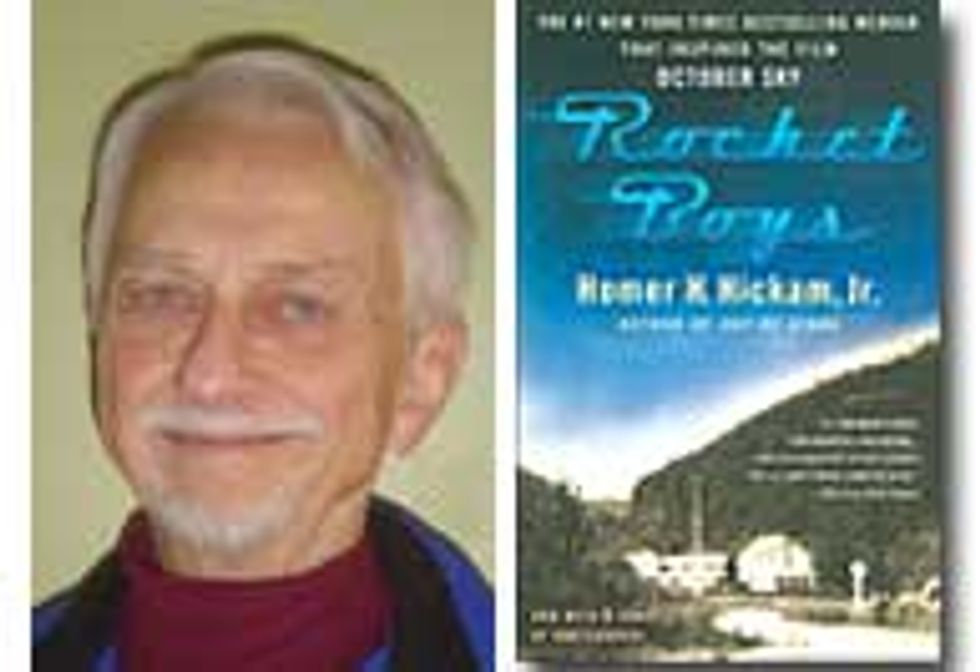
Owen K. Garriott
Engineer and former astronaut
A Ph.D. in electrical engineering, he was one of the first scientist-astronauts; in 1975 he spent 60 days in Skylab, doubling the previous record for duration.
Novel: Rocket Boys: A Memoir, Homer A. Hickam Jr. (1998)
"First of all, I think I'm a very poor candidate to be describing novels. I much prefer biography, autobiography, interpretations of our world (in what category do you place Thomas Friedman's The World Is Flat?), scientific and technical publications, and then current events (several magazines). Most novels drop off the end of this list! But I will try." Among novels, I have read essentially every one of John Grisham's books, usually as soon as released. They describe so well the different perspectives, values, and motivations of different segments of society (and are seldom complimentary to the legal profession!). Then we can pick our own standards for ourselves!
"Also Homer Hickam's Rocket Boys (made into the movie October Sky) was both inspiring and also an indication of how small events in a youngster's life can often guide the entire course of their career. It happened to me some 60 years ago! It reminds those older among us how important our advice and guidance can sometimes be to young people.
"I am currently reading Friedman's The World Is Flat as it directly relates (as the author intends) to so many aspects of an interrelated world community. In the last few weeks alone, I have discussed issues raised in this book with friends from the academic, business, and technological communities in India, half way around the world."