
Any great nonfiction book combines education with entertainment. In drafting my A-list of general-interest books about technology, I considered impact and significance but gave still more weight to the reading experience. This is a collection where lay readers can appreciate each entry—and engineers, programmers, and other tech professionals can’t afford to miss a single one.
The Pencil: A History of Design and Circumstance
Henry Petroski (Knopf, 1989)
Early in his exhaustive study of the invention, refinement, production, and commercial history of this humble and indispensable writing implement, Henry Petroski claims, “It is by trying to understand simple ideas and principles in terms of the most complex of examples and issues that we tend to feel overwhelmed.... What might seem to be the secrets of engineering are in the common as well as in the uncommon, in the small as in the large, in the seemingly simple as in the indubitably complex.” The Pencil justifies this contention. Though the lead-pointed device seemingly sprang out of nowhere (it is first mentioned in a 1565 book on fossils), Petroski traces its origins and skillfully follows its progress from early appearances to a product of the emerging age of assembly-line industries. He is less interested in the cultural history of the pencil than in its steady evolution. The cast of characters is not necessarily the most colorful bunch. A notable exception is Henry David Thoreau, whose name is associated not only with Walden Pond but also the leading 19th-century pencil-making operation in America. The star here is really the stick of cedar and graphite we take for granted. Every aspect of the pencil—the graphite, the eraser, the shape, the color—is examined thoroughly. Maybe a little too much so, as Petroski can be long-winded and might have benefited from a more liberal application of an eraser. Nonetheless, The Pencil never loses sight of its point.
Mirror Worlds; or, The Day Software Puts the Universe in a Shoebox…How It Will Happen and What It Will Mean
David Gelernter (Oxford University Press, 1991)

William Gibson, in Neuromancer, introduced the concept of “cyberspace as place.” And another sci-fi writer, Neal Stephenson, in Snow Crash, took pains to explain how a computer-based world might work [see sidebar, "Favorite Fiction"]. But the prize for prescience goes to computer scientist David Gelernter, who in Mirror Worlds outlined how an alternative universe that reflected and interacted with physical reality would emerge. Though he knew that the picture he drew had elements of the cyberpunk to it, he bristled at the idea that his vision could be viewed as another version of Gibson’s matrix or Stephenson’s metaverse. “There is nothing science-fictionish about these programs,” Gelernter wrote. The book was written before the Internet exploded, and parts can seem dated. But time has proven it correct: our current connected state—always on, perpetually blogged, and geo-tagged—is beginning to look a lot like one of these mirror worlds. Consider this thought: “When you switch on your city Mirror World, the whole city shows up on your screen, in a single dense, live, pulsing, swarming picture.” Sound familiar? While assessing the direction of open services like Google Maps and Facebook, I keep returning to Mirror Worlds as the best way to understand how computational reality coexists and merges with the physical world.
A New Kind of Science
Stephen Wolfram (Wolfram Media, 2002)
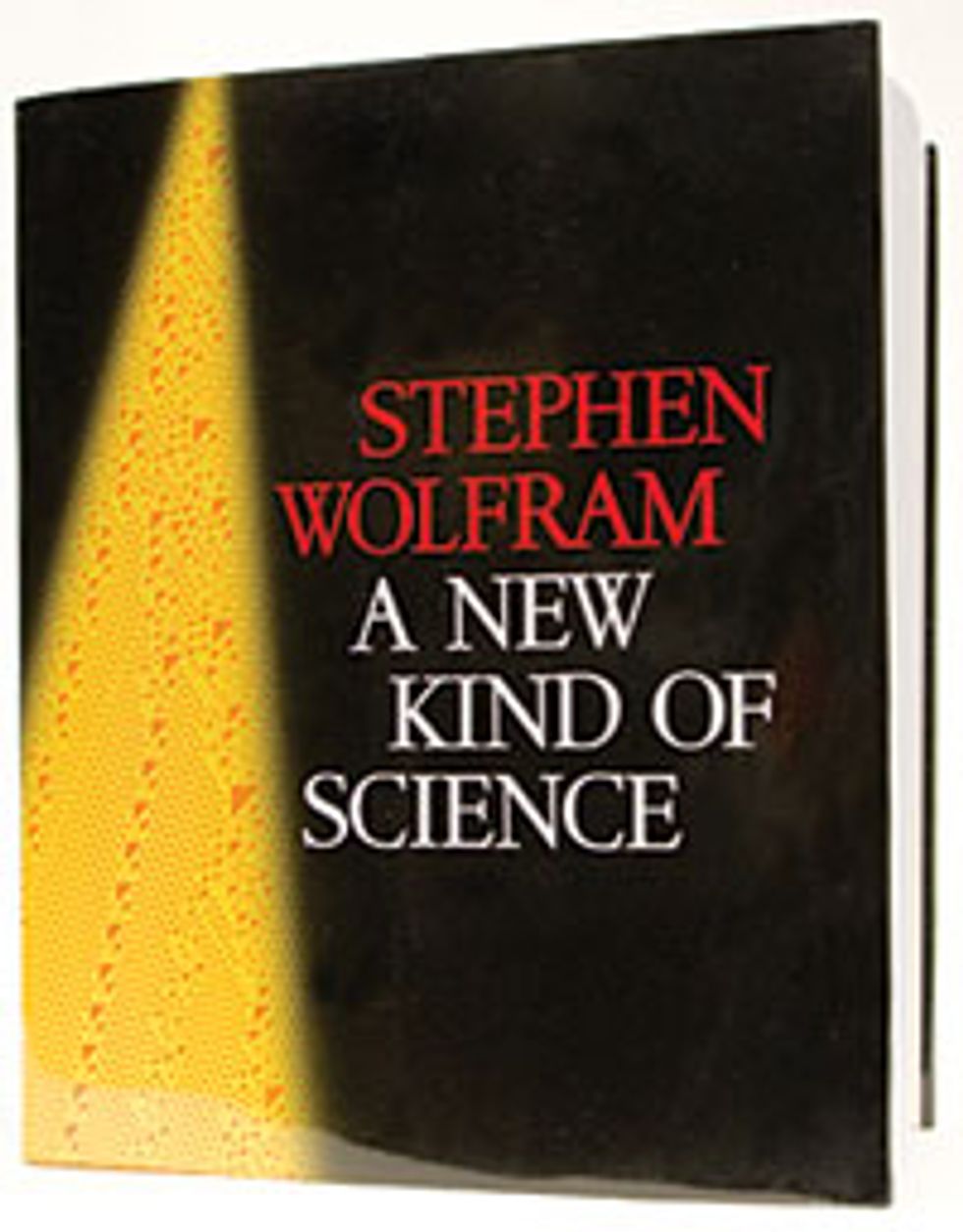
Stephen Wolfram was more or less a traditional particle physicist when he came across the mathematical backwater of cellular automata, or CAs—artificial, grid-based systems that “behave” according to a set of rules that provide a sort of local physics. Sensing that CAs would be helpful in answering some of the bigger questions he was pondering, he shifted his scientific work to the field. Meanwhile, he built a successful computer software business around a dazzling program that performed complicated math. Using his own software and funding his research with his commercial bounty, Wolfram produced A New Kind of Science, a 1200-page behemoth claiming that the lessons we can learn from CA provide (as the title implies) no less than a new, computation-based way to understand natural phenomena. His key point is that very simple cellular automata systems, using just a few basic rules, can often display stunningly complex behavior. That’s the basic melody running through Wolfram’s symphony of findings and claims, and variations on it lead him to explore the relevance of his computer-based CA experiments in fields ranging from biology to social sciences. He even speculates that “underneath all the complex phenomena we see in physics there lies some simple program which, if run long enough, would reproduce our universe in every detail.” Whether or not you buy this, the book is a lushly illustrated and clearly written immersion into the mind and theories of a brilliant iconoclast.
Gödel, Escher, Bach: An Eternal Golden Braid
Douglas R. Hofstadter (Basic Books, 1979)
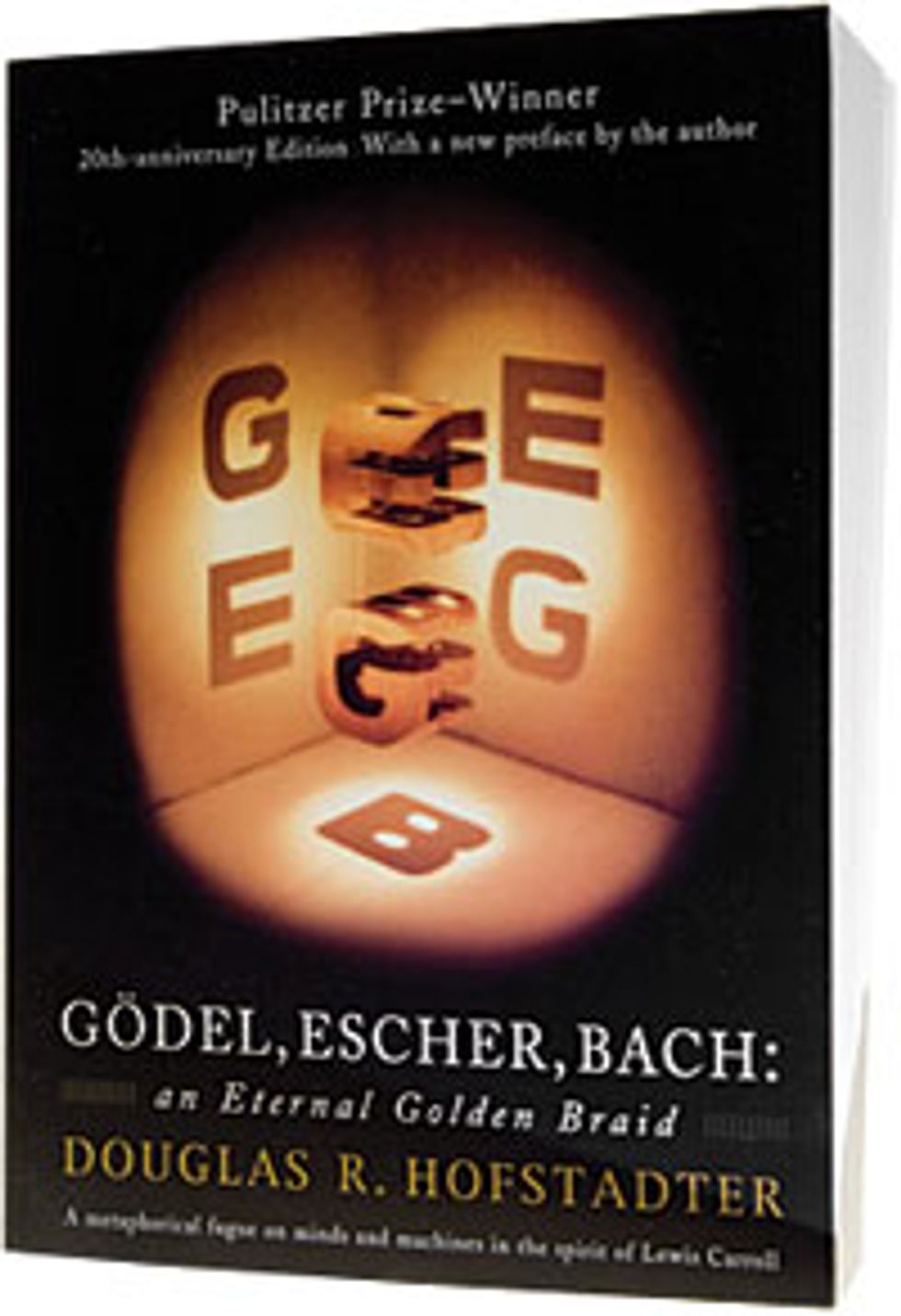
Though best-seller lists seem all too often dominated by celebrity memoirs, diet books, and partisan political rants, every so often there’s a marvelous exception that defies prediction. And what could be more unlikely than a philosophical ramble on the nature of computation and the possibilities of artificial consciousness built on the mathematical theories of Kurt Gödel, the intricacies of Bach’s fugues, and the graphic ambiguities of artist M.C. Escher—punctuated by a series of dialogues in the spirit of Lewis Carroll? What makes this a technology book is that while its soul is ineluctably human, Gödel, Escher, Bach is also a romance about what the computer has helped us uncover—a larger way of viewing who we are, fueled by the questions raised by universal computation. If this sounds complicated, that’s because it is, but Douglas R. Hofstadter is relentlessly instructional. (Digging out my old copy of GEB to reacquaint myself with it, I found it stuffed with scratch paper on which, 25 years ago, I worked out his various challenges.) As with James Joyce, Hofstadter’s ideal reader is one willing to devote massive energy to decoding his book. And as with Joyce, that energy is rewarded.
Hackers & Painters: Big Ideas from the Computer Age
Paul Graham (O’Reilly, 2004)
When I first discovered the amazing cohort known as computer hackers over 25 years ago, what impressed me most was their unfettered way of thinking. In order to come up with the coolest and most innovative programs, a hacker must sweep away preconceived notions to come up with something new. This way of thinking also offers a powerful way of approaching the larger world, one that has charmed and instructed me as I continue to interview and understand these wizards. Paul Graham’s small but power-packed collection of essays provides an inside view of that ultrainnovative mentality. Graham, a self-described computer nerd who made his fortune by writing the first Webâ¿¿based application and selling it to Yahoo at the height of the first Internet boom, is blessed with an ability to analyze his own mind-set and explain it to outsiders. To paraphrase a sentence in the book: even though he is the water, he can see the wave. Graham is so unabashedly geeky that, though he is a natural writer, he can’t help but express himself in metaphors drawn from what he calls “his native land, hacking.” (Typical sentence: “When you damp oscillations, you lose the high points as well as the low.”) The book really sings when he analyzes nonprogramming problems (building a business, understanding great design, mastering human interaction) through his hacker’s eye.
The Design of Everyday Things
Donald A. Norman (Basic Books, 1988; paperback reprint, 2002)

Design guru Donald A. Norman’s devastating critique of how engineers fail to make their creations comprehensible was originally called The Psychology of Everyday Things, a moniker he felt was clever, in that it was thought-provoking and acronymic (the first letters of each word spell out poet). For the paperback edition, his editors suggested the current title. Norman at first opposed it, but he changed his mind when the equivalent of a user study found that the original title was misleading (people thought it might be a self-help book). It was a great example of one of his big themes—creators should understand that their users are not necessarily the same as themselves. Writing at a time when such concepts were barely known to the general public, Norman, a world-class crank, instructively eviscerates the product design of doors, telephones, air-traffic systems, and computers by describing their design flaws and how those flaws found their way to market. Then he outlines how to solve those problems. In the two decades since this book’s appearance, Norman’s point of view has become widely adopted. Yet bad design still persists, and this book should still be read both by those who design products and those who use them.
The Soul of a New Machine
Tracy Kidder (Little, Brown, 1981)
At the time Tracy Kidder was collecting his National Book Award and Pulitzer Prize for this blow-by-blow account of the building of a Data General minicomputer, The Soul of a New Machine was heralded as a must-read for anyone who wanted to understand those strange and scary machines called computers. Indeed, in addition to the sharp portraits of the designers, engineers, and managers who burned the midnight fluorescent light to create the Eclipse MV/8000 (code-named Eagle), Kidder walks his readers through a series of painlessly embedded tutorials on how such machines work. Typically, these are scenes where our avatar, Kidder, is receiving a lecture from one of the designers or microcoders. In 2008, The Soul of a New Machine works as a fascinating snapshot of a suddenly distant past. In Kidder-land, Massachusetts Route 128 is the white-hot center of the digital action, time-sharing is king, and the concept of personal computers is worthy of but a single clause in one sentence. What hasn’t changed, though, are the corporate pressures and personal dramas that accompany almost every major project. By sticking to his narrative and rendering it in elegant prose, Kidder proves that unveiling the specific is still the best way to illuminate the bigger picture. It’s no accident that, long after Data General and the Eagle team’s ultimately undistinguished computer have faded into obscurity, the ultimate compliment to any book that chronicles a project is, “This is The Soul of a New Machine of... ”
The Codebreakers: The Story of Secret Writing
David Kahn (Macmillan, 1967; revised edition, Scribner, 1996)
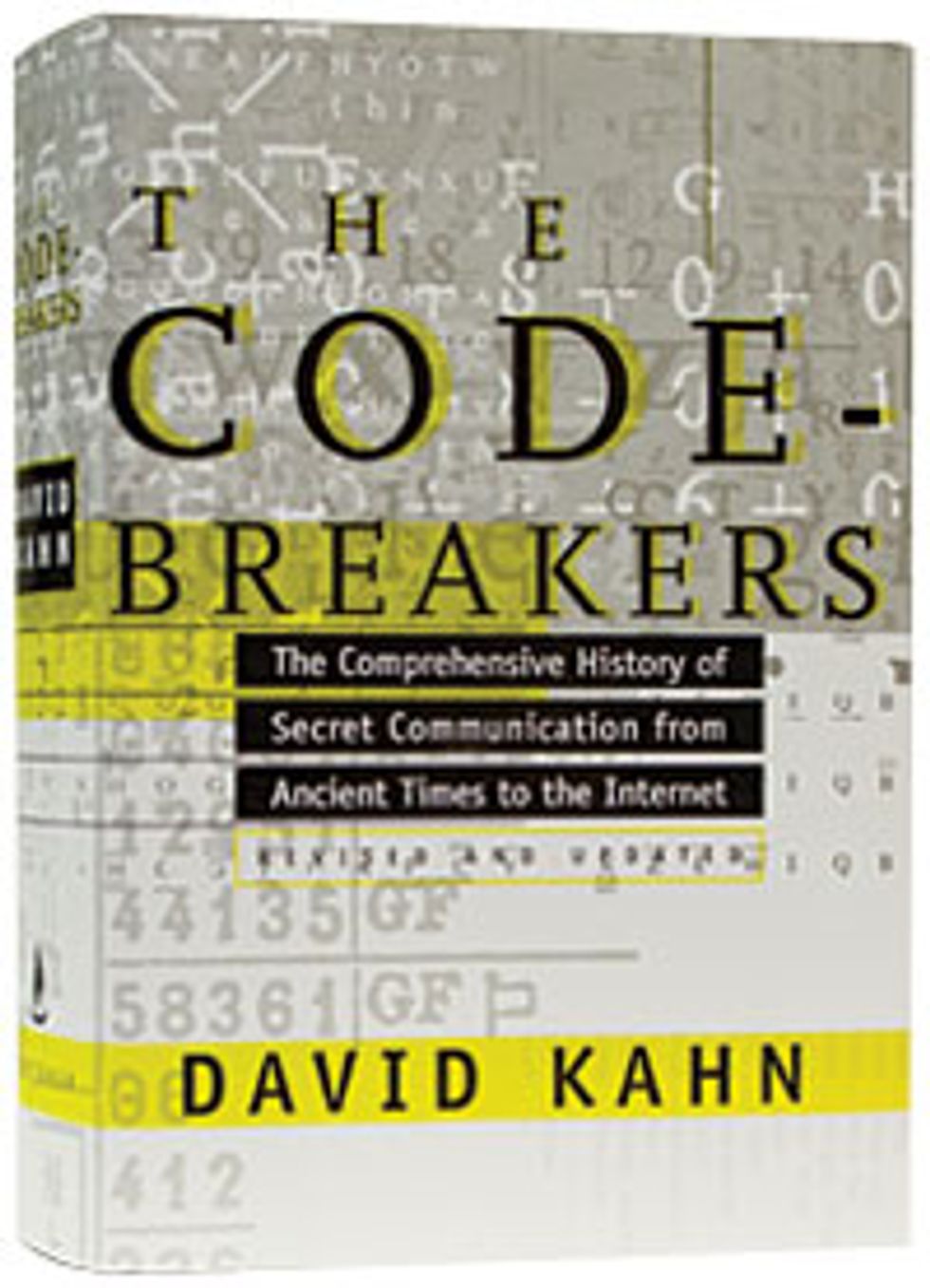
Writing a comprehensive history of cryptography would have been a daunting task even if much of the information had not been sequestered as national security secrets. But to do so while trying to dislodge the knowledge from the grip of the United States’ zipped-tight National Security Agency (NSA) must have seemed almost impossible. Yet in the mid-1960s, David Kahn, a newspaper editor with an interest in history, persisted in writing what will forever be the most authoritative account of cryptology. It’s also a rip-roaring read, starting with ancient times and following the field through the medieval Vatican catacombs to the age of electronic cryptography, including its crucial role in the world wars; the revised edition continues the narrative into the Internet era. His explanations of various codes are sound and expansive; the cryptosystems almost become characters in their own right. And his chapters on the NSA itself were groundbreaking. Published during the height of the Cold War, The Codebreakers provided such a wealth of information that the U.S. government attempted to suppress the book. (As a sign of the shift toward the public discussion of crypto that he helped set in motion, decades later Kahn served a stint as a visiting historian at the NSA.) The Codebreakers will make you an armchair expert in cryptography—while delivering the thrills normally found in a top-notch spy novel.
Longitude: The True Story of a Lone Genius Who Solved the Greatest Scientific Problem of His Time
Dava Sobel (Walker, 1995)
Dava Sobel’s straightforward and charming account of how “a lone genius…solved the greatest scientific problem of his time” (as the subtitle immodestly puts it) inspired copycat publishers to issue numerous brief narratives of other history-of-technology tales with similarly momentous consequences. But none surpasses Sobel’s unexpected best seller on the achievements of Englishman John Harrison (1693–1776). He was an autodidactic clockmaker whose brilliant timekeeping machines proved to be the breakthrough to the biggest challenge of the world’s economies—the lack of a reliable method for navigating the seas, specifically in determining a ship’s longitude. Latitude, in contrast, is easy because the imaginary horizontal lines that band the Earth can be located by the interaction of the sun and Earth’s rotation. In outlining early attempts to solve the problem, Sobel ushers in Renaissance superstars Galileo, Cassini, Newton, and Hooke. But the real drama begins with Harrison and his attempts to convince the Board of Longitude—an elite committee formed by Parliament to award a lucrative prize to the first person who solved the problem—that his seaworthy clocks provided a flawless means to determine location. In the hands of a more scholarly historian, this might have been a messier tale; Harrison might have been a less saintly protagonist, and the motives of his eternal foe, Royal Astronomer Nevil Maskelyne, might have been portrayed as less vile. Sobel wryly acknowledges that her narrative vessel lists toward caricaturization, noting that “a story that hails a hero must also hiss at a villain.” But her research is sufficiently sound to keep her storytelling on course.
The Making of the Atomic Bomb
Richard Rhodes (Simon & Schuster, 1986)

The creation of the world’s most fearsome weapon—perhaps the ultimate tale of how pure brainpower fused with engineering can lead to earth-shattering consequences—deserves no less than epic treatment. Richard Rhodes provides just that in a magisterial account whose first paragraph whisks us inside the head of physicist Leo Szilard, waiting in the rain at a stoplight outside the British Museum, as he grasps the possibility of a nuclear explosion. “A way to the future,” he mused, “death into the world and all our woe, the shape of things to come.” Then comes a painstakingly explicit account of the carnage that would follow. The narrative is sweeping but never sprawling, taking almost 300 pages to step through the advances in theoretical physics that made possible the desperate effort to build a bomb. Another 400 pages race through the development itself. Not many 700-page books can be called riveting, but this one can. By fully developing dozens of key figures—Bohr, Rutherford, Oppenheimer, Teller, von Neumann—and often focusing on their inner conflicts between the excitement of discovery and the dread cast by the knowledge of its consequences, Rhodes casts an operatic spell. His deft handling of the political and military circumstances surrounding the effort is spliced with sound science. In my edition, five Nobel winners endorse the author’s understanding. In an audacious pitch to pen the definitive account of a massively important development, Rhodes succeeds.