
Come to snake-infested, land-mine-strewn Laos! Watch rural villagers pedal onto the Internet via a bicycle-powered computer and an over-the-mountain Wi-Fi network! Witness the unveiling of a super-rugged, ultra-efficient Linux PC! Built from scratch! With no moving parts! Hang out in the sweltering jungle with a motley crew of tech geeks and do-gooders from around the globe!
Who could pass up an invitation like that? Not me.
And so last February, shivering with cold and anticipation, I began the 18 000-km journey to the Lao People’s Democratic Republic. Starting with an early morning drive past grimy snow banks to New York City’s John F. Kennedy International Airport, the trip took an exhausting 24 hours, via Los Angeles, Tokyo, and Bangkok. Upon landing in Vientiane, the capital city of Laos, I was delighted to walk through warm sunshine into the small modern airport.
Thinking ahead to the project’s scheduled launch the next day, I considered the particulars: a hand-built, bicycle-powered PC in the village would send signals, via an IEEE 802.11b connection, to a solar-powered mountaintop relay station. The signal would then bounce to a server in the nearest town with phone service and electricity, 11 km away—and from there to the Internet and the world. If it worked, such a system had global possibilities. Already, project leaders had fielded inquiries from 40 countries.
A volunteer with the Jhai Foundation, the nonprofit group sponsoring the information technology (IT) project, gave me a warm welcome, ushered me into a van, and handed me a press release. As I read it, my heart sank: at 4:30 that morning, the hard drive on the foundation’s development computer, which contained all the software to be loaded onto the village’s new PC, had crashed, along with the only backup. The launch was dead in the water.
The story begins
I knew enough about engineers to realize that this would not be the last word. And indeed, when the van pulled up to the foundation’s office in Vientiane, I was quickly shooed away—everyone was hard at work trying to figure out what went wrong and how to fix it.


The sight of Western engineers working alongside their Laotian counterparts drove home the fact that this was a grass-roots, all-volunteer effort [see bottom photo]. What’s more, the end users of the wireless Internet—the 440 inhabitants of a rice-farming village called Phon Kham [top photo]—had been involved from the start: defining their needs, helping explore possible technologies, and training for the day when they would operate and maintain the system. The project was by no means the first to try to bridge the digital divide, but it was mercifully free of the top-down approach that characterizes many such efforts.
Still, what they were attempting to do was, technically speaking, no mean feat. Laos is one of the world’s poorest countries, but even by Laotian standards, Phon Kham has very little—no electricity, no phones, no running water. Ambitious young people tend to head to Vientiane, or someplace farther.
The inhabitants of Phon Kham are all refugees from the Plain of Jars, so named for the hundreds of enormous Bronze Age stone urns scattered across the 1000-km2 region [see map below]. During the Vietnam War, the plain became the most bombed spot on earth, part of the U.S. government’s covert, and ultimately futile, effort to prevent men and munitions from reaching the Viet Cong. For nine years, an average of eight planeloads of bombs fell there every eight minutes, eventually releasing a half-ton of ordnance for every man, woman, and child in Laos.
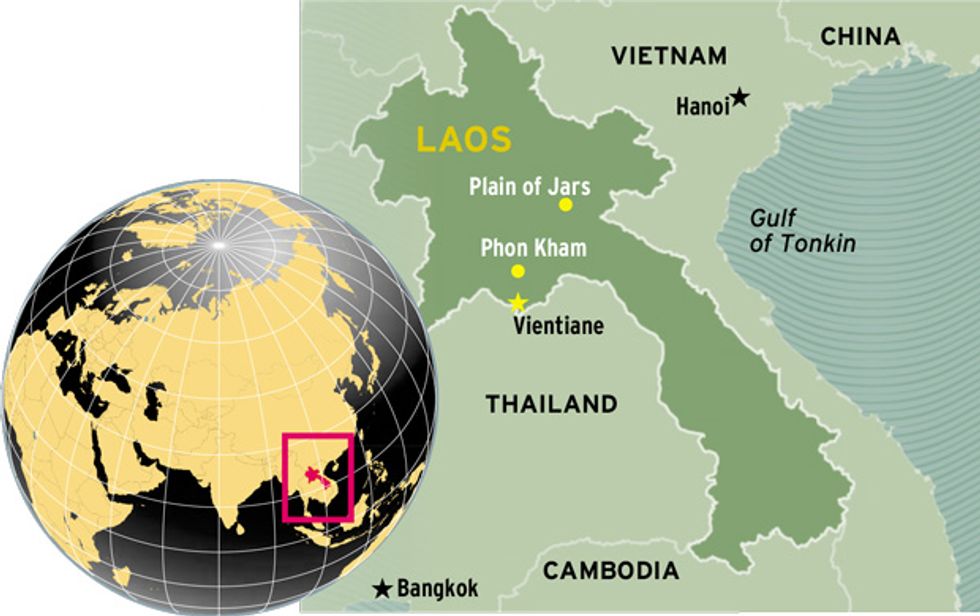
In 1976 the government resettled the Plain of Jars refugees in and around Phon Kham. Now a palm-fringed collection of thatch- and tin-roofed houses, at the time it was just a clearing in a snake-infested jungle. “Many people got malaria,” recalls Bounthanh Phommasathit. The disease claimed her oldest brother and a younger sister. Phommasathit escaped that fate when, as a teenager, she was sent to live in the United States. (About 10 percent of the Laotian population emigrated after 1975.) Now a grants manager for the state of Ohio, she maintained close ties to her family and eventually started a letter-writing campaign to solicit medical supplies for Phon Kham. One of those letters found its way to Lee Thorn [see sidebar photo].

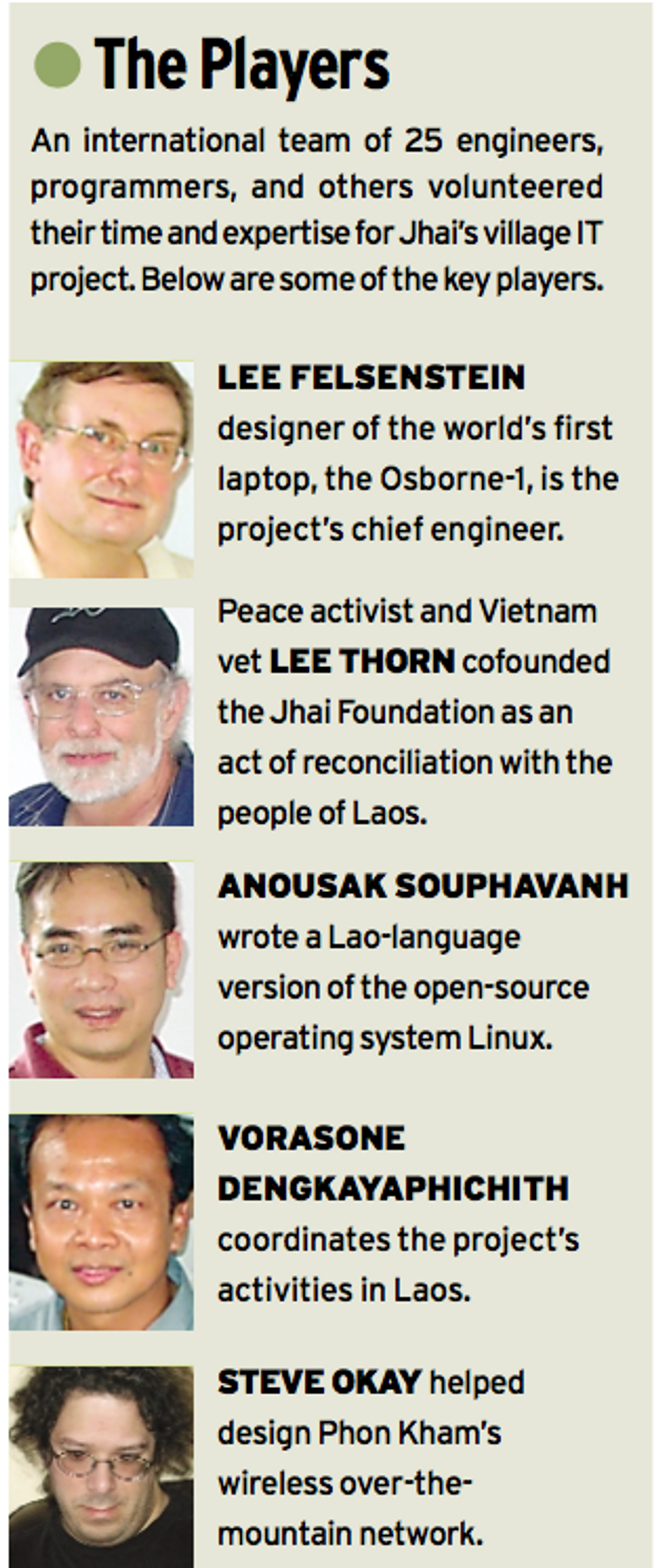
Grizzled and gap-toothed, Thorn was tied to Laos for very different reasons. Back in 1966, he was a 21-year-old sailor stationed on an aircraft carrier off the coast of Vietnam, loading bombs onto A4 fighters. Many were destined for the Plain of Jars. After getting out of the Navy, Thorn cofounded Veterans for Peace (now a national organization in St. Louis, Mo.), and he’s been a peace activist and community organizer ever since.
But his military past still haunted him. Phommasathit’s letter prompted Thorn to return to Laos in 1998, and upon his return, the two cofounded the San Francisco-based Jhai Foundation. “Jhai” means “hearts and minds working together” in Lao, Thorn notes. The foundation has since helped villagers build schools and computer labs, install wells, organize a weaving cooperative, and raise and sell organic coffee.
But what the villagers told Thorn they needed most was to communicate with the outside world. This wasn’t about multiplayer gaming or bargain-hunting on eBay; it was about making a phone call. “You can’t even talk to the other side of the mountain on a cellphone unless you climb to the top,” Phommasathit’s mother, who still lives in Phon Kham, says.
The villagers knew they’d get a better price for their rice and handicrafts if they could check prices in the market town 30 km away. More significantly, they wanted to call and e-mail relatives living abroad. “A lot of these families have been split up for 25 years or longer,” Thorn points out. “That’s really serious, because here the family, not the individual, is the basic unit.”
From such basic needs, the Jhai Remote Village IT Project was born.
Blueprint on a napkin
Figuring out the system’s design was the first step. Working with the villagers, Thorn researched, and rejected, several options. Existing Web-enabled cellphones struggled to get a signal in the hilly terrain. Radio phones didn’t fare much better, and they couldn’t handle the data.
In search of answers, Thorn returned to California to see Lee Felsenstein [see sidebar photo]. He found the engineer “literally inside a computer, fixing a mainframe,” Thorn recalls with a chuckle. Actually, though, that was true to form. Felsenstein is a legend in tech circles for designing the world’s first laptop, the Osborne-1, and moderating Silicon Valley’s Homebrew Computer Club, whose members spearheaded the PC revolution.
Thorn laid out the problem: the machine had to be dirt cheap (the annual per capita income in Laos is US $241), be easy for villagers to maintain and operate, draw less than 20 W, and withstand Laos’ blistering heat (40 ℃ in the summer) and drenching monsoons. The closest phone and power lines were 11 km away. And did I mention that there’s no commercial software available in the Lao language?
Felsenstein sketched out a rough design for the Jhai computer on a napkin. Given the constraints, he decided to build the hardware and software from scratch. That meant literally reinventing the computer, but Felsenstein was drawn by the creative challenge and the project’s grass-roots nature. He also admired Jhai’s track record. Its Internet Learning Centers, set up to teach Laotians computer skills, “weren’t simply a bunch of computers dumped in a locked room and shown to foreign dignitaries. They were being used,” Felsenstein said.
Simple elegance
In November 2000, Felsenstein signed on as the project’s chief engineer. The next spring, as Thorn began fundraising, Felsenstein began building.
First came the village’s PC, to handle e-mail, word processing, and voice-over-Internet protocol (IP) telephony.
The machine was elegant in its simplicity. From the outside, it looked like a simple steel box. Inside were rugged, industrial-grade PC104-embedded circuit boards [see group photos]. To reduce the heat and risk of breakdowns, it contained no fan, disk drive, or other moving parts. Felsenstein opted for the ultralow-power MachZ PC-on-a-chip, which its manufacturer, ZF Micro Solutions Inc. (Palo Alto, Calif.), had designed to run in Internet appliances. “Even if [the MachZ] was comparatively inefficient and less powerful in some ways”— equivalent to a 133-MHz 486 processor—“pretty much any software that runs on a PC could be precompiled for it and dumped in in object form,” Felsenstein explained.
For mass storage, the PC used a 96-MB DiskonChip, a flash memory device made by M-Systems Inc. (Newark, Calif.) that reads and writes data just like a hard drive. The PC also sports two PCMCIA slots to accommodate an IEEE 802.11b wireless local-area network (WLAN) card and a Quicknet voice-over-IP card from Quicknet Technologies Inc. (San Francisco).
Taking a cue from the computers used on racing yachts, Felsenstein housed the electronics inside a 20-by-25-by-15-cm steel case; elastomer gaskets seal out dust and moisture, and a replaceable canister of silica gel further ensures that the interior stays dry.
To complement the CPU, Felsenstein selected a 12-inch liquid-crystal display color monitor housed in a steel frame and protected by an extra Plexiglas faceplate, a sturdy Okidata dot-matrix printer (with re-inkable ribbon), a Lao-language keyboard, and a trackball.
Power would be supplied by a car battery charged by a villager pedaling away on a stationary bike nearby. One minute of pedaling generates about five minutes of power: 12 V at 4 to 10 A, depending on the pedaler’s effort. Solar power was rejected because of the four-month monsoon season and the cost: the bike scheme was only a third as expensive, and village children were ready to pedal.
Getting the PC to talk to the world was the next step. For this, Felsenstein recruited Mark Summer and Steve Okay [see photo] two volunteers from the Bay Area Wireless User Group. The three fleshed out the details: a high-gain, parabolic antenna in Phon Kham would boost the PC’s signal and send it to a patch antenna on the hilltop relay station. From there, the signal would be relayed to another high-gain antenna mounted on a water tower in Phon Hong. A server equipped with a modem and an interface card for converting voice into and from digital format would be the final link to the Lao phone system and the Internet.
The Jhai team continued to grow, as more volunteers heard about the project through word of mouth. In July 2002, they tested their handiwork. They positioned an antenna on the roof of a nightclub in San Francisco’s Castro District and another in Summer’s house, 4 km away. Using the Jhai PC prototype, they e-mailed Okay’s ponytailed image to funders and enthusiasts assembled in Summer’s kitchen.
Early on, Felsenstein had decided that the PC’s operating system had to be Linux. “This system had to run for 10 years, and open-source software brings with it a human infrastructure of people who know how to maintain it,” he explained.
 Bottom: Ed Gaible; Remaining Photos: Ashton Applewhite
His thinking meshed perfectly with that of another Jhai volunteer, Anousak Souphavanh [see sidebar photo]. A Laotian programmer with IBM Corp. in Rochester, N.Y., Souphavanh had been working nights and weekends on “localizing” the Linux operating system into Lao—a project he dubbed Laonux. Similar to Thai, Lao has an alphabet with 27 consonants and 28 vowels. When finished, Laonux would be the first program entirely in Lao. (A program called Lao Script allows users to input Lao characters into Microsoft applications like Word, but its menus are all in English.)
Working with computer science and electrical engineering students and teachers at the National University of Laos in Vientiane, Souphavanh was also developing a Lao-language version of the Linux-based graphical desktop called KDE. Its suite of business tools would let Lao speakers browse the Web, send e-mail, and create simple documents.
Thorn called the localization into Lao “probably the hardest part of the whole thing.” In order to generate fonts in Lao, for example, Souphavanh’s team had to create its own Unicode, a standard for encoding letters and other characters in any language.
After the programmers finished Laonux in late October 2002, Jhai set the end of January 2003 for the official network launch.
Much work remained. On a ridge behind Phon Kham, villagers constructed the relay station for the antennas, installed the electronics to route the data packets between the village PC and the server in Phon Hong, and set up the solar panels and batteries that would feed them. On 23 January, Jhai volunteer Liam Helmer, a programmer from Canada, mounted a couple of antennas onto the relay station, and from a laptop in Phon Kham, the team’s local coordinator, Vorasone Dengkayaphichith [see sidebar photo, above], sent e-mail and made Internet phone calls, one to Felsenstein in San Francisco. “That proved the wireless network worked,” Felsenstein said.
The launch date slipped to 13 February, partly the result of coordinating an all-volunteer team of brilliant but willful techies, most of whom still had day jobs. In early February, about 15 team members assembled in Vientiane to load the Lao-language software onto the Jhai PC and do a final system check.
And then, one day shy of the launch came the crash that wiped out the foundation’s development computer.
Spin control, Jhai style
Despite their best efforts, the Jhai team could not restore the corrupted data. Here’s what happened: less than two weeks before the launch, humans and equipment landed in Laos in various states of readiness. The hardware and software had been developed largely independently, and when it came time to integrate them, the Laonux files proved so large that the Jhai PC’s storage space had to be expanded.
Anticipating the storage shortage, Felsenstein had various fixes on hand—a couple of 576-MB DiskonChip flash memory devices and extra 512-MB Compact Flash cards. But the driver software for the flash memory refused to work. The Compact Flash cards, on the other hand, refused to boot the computer. After frantic appeals to the circuit board manufacturer, Tri-M Systems and Engineering Inc. (Port Coquitlam, B.C., Canada), and the open-source community, the team devised a work-around by connecting the cards to one of the boards rather than to the PCMCIA interface.
The computer crash was the last straw. Felsenstein suspects the culprit was a power sag or failure. Unlike the office’s other computers, the development PC was not on an uninterruptible power supply. “We hadn’t thought to bring them,” he admits. “That’s what nailed us.”
Now came the hard part: breaking the news to the villagers. The day after arriving, I found myself piling into a Toyota van for the 90-minute drive to Phon Kham. Vientiane’s wide streets have no traffic signals. Instead, intersections become a mellow game of chicken, pitting dilapidated buses against shiny SUVs, three-wheeled tuk-tuks (the yellow cabs of Southeast Asia), and countless motorbikes and bicycles.
We headed onto Highway 13, a paved, two-lane road that serves as Laos’ main north-south route. Blocks of two-story buildings, a few with rooflines reflecting their French-colonial origins, yielded to brown dry-season fields brightened by green rice paddies. Food stalls lined the roadside in each village, filling the air with fragrant wood smoke. Even the humblest dwelling boasted a TV antenna or satellite dish. Some structures sat on the bare earth, but my interpreter, Chantha Mon, held that “a house on stilts is better—no snakes, no scorpions.”
We shared the road with the occasional cow and clouds of white-shirted schoolchildren on foot or bike. After an hour or so, the flood plain gave way to foothills and forest. Then we lurched onto a red dirt road. Spine-rattling in the dry season and impassable when the rains come, this road is Phon Kham’s only connection to the world.
A few kilometers from the village, we passed a crew stringing electric wire between concrete poles. Perhaps goaded by the attention Phon Kham and Jhai were garnering from the international press, the government had just promised power by summertime. Skepticism was rampant. ”That’s raw wire, not electrical cable. There’s no insulation on it,” Thorn pointed out. Whenever electricity does come, he added, the Jhai PC would simply switch from the bike generator to alternating current.
Giggling children at the communal water pump looked up as we drove into the village center. Along one side stretched a long, one-story brick schoolhouse, with a small room at one end built to house the computer.
Inside, the Jhai team sat soberly on rough wooden benches. A good portion of the village’s inhabitants filled the remaining seats, and others clustered at the windows.
The heavy lifting went to Felsenstein, with Dengkayaphichith translating. Drawing the system on the blackboard, Felsenstein described the hardware as “a series of structures that rest upon each other like a building” and the software as “a set of instructions without which computer will do nothing.”
“If you consider this to be building an invisible building, you can imagine the difficulty: you can’t see the problems till it falls down,” he continued. “It’s like if you had a tractor, and a spark plug died and so did the only replacement. That’s what happened the night before last. We have to take the Jhai PC to America, fix it, and bring it back to you.”
I hadn’t spotted any tractors on the way in, and wasn’t sure the invisible-building metaphor would clear things up, but the villagers nodded and murmured among themselves. The next day, on what would have been the launch, they still planned to throw a feast, complete with roasted water buffalo, to thank the volunteers.
“They understand delay,” Thorn said later. “They’re less forgiving of failure.” But the mutual respect that had developed over the years between the middle-aged, sunburned war vet and the copper-skinned rice farmers seemed likely to survive this latest trial.
That afternoon, I accompanied an ad hoc team up to the relay station, escorted by two Laotian soldiers toting AK-47s. Just who was protecting whom wasn’t clear. A week earlier, though, ”brigands” had shot up a bus 100 km to the north, killing a dozen people, and Jhai had hired guards to patrol the village perimeter during the launch.
Sweat-drenched mosquito magnets, we arrived at the top, and I got my first look at the relay station: a giant, near-leafless teak tree rigged with two platforms—one for the solar panels, 15 meters up, and a second, smaller one, 8 meters higher, for the antennas. Both were reachable by a ladder of branches casually nailed to the trunk. The overall effect was Rube Goldberg meets the Flintstones.
The team had come to remove the solar panels lest they be stolen. Organization, though, isn’t necessarily a Jhai forte: no one had brought proper tools. Among the 11 of us, we had only a Swiss Army knife, a screwdriver, and a nylon clothesline borrowed from the brothel down the hill.
With Felsenstein directing from below, Souphavanh and Karen Gray, who had left Microsoft Corp. to become Jhai’s IT project manager, gamely climbed up. An hour and a half later, after much fiddling and some pining for the soft corporate life back home, the two duly lowered the panels. The soldiers then handed their guns to Souphavanh and Dengkayaphichith, tied the panels together, and carted them down the hill, the rest of us trailing behind.
Back in Vientiane that evening, I spotted a sign at an Internet café: ”Cool Work for Linux Programmers: Help set up wireless in Lao villages. A couple of days help needed, starting 7 February...ask for Steve or Karen.” Only then did it hit me what a truly seat-of-the-pants operation this was and, in spite of that, how incredibly far the group had come.
More changes, more delays
Back in the United States, Felsenstein still hoped to launch before the rainy season began in May, and so he altered the original design in several ways. Given the problems with the Compact Flash, he installed a 1-GB IBM Microdrive removable hard drive. He also added a voice-over-IP phone card, into which the user can plug a standard phone. In tests, all worked flawlessly.
Thinking beyond the launch, Felsenstein hoped to spend the rainy season transforming the prototype into an operational machine: replacing the Microdrive with the more durable Compact Flash cards and swapping out the MachZ chip for a more powerful TransMeta Crusoe chip, the better to run Laonux. Once the Phon Kham PC was connecting reliably, four other nearby villages would be similarly equipped.
But there would be another wrinkle, this one political. On 27 May, just four hours before the rescheduled launch, the Lao Ministry of Defense informed the Jhai team that it wanted to meet with them “to clarify our purposes and to seek [the ministry's] formal cooperation and permission for our activities,” as a Jhai press release put it.
At press time, the project was still in bureaucratic limbo, the rains had started, and the launch would now have to wait until the fall, at the earliest. Meanwhile, though, the Jhai IT Project has sparked inquiries from India, Indonesia, and 38 other countries where telecommunications and power distribution are still not ubiquitous. Felsenstein intends to continue refining the Jhai approach for use elsewhere.
“This is my way of building a future for myself, and hopefully, if it works well, building a future for a lot of other people,” he says. “We’re on to something here.”
To Probe Further
The Jhai Foundation’s Web site, https://www.jhai.org, describes the group’s information technology project and its other activities.
The Web site of the Digital Divide Network, at https://www.digitaldividenetwork.org, has articles and other resources that address how to bridge the gap between IT “haves” and “have-nots.”