
This is part of IEEE Spectrum’s Special Report: Why Mars? Why Now?
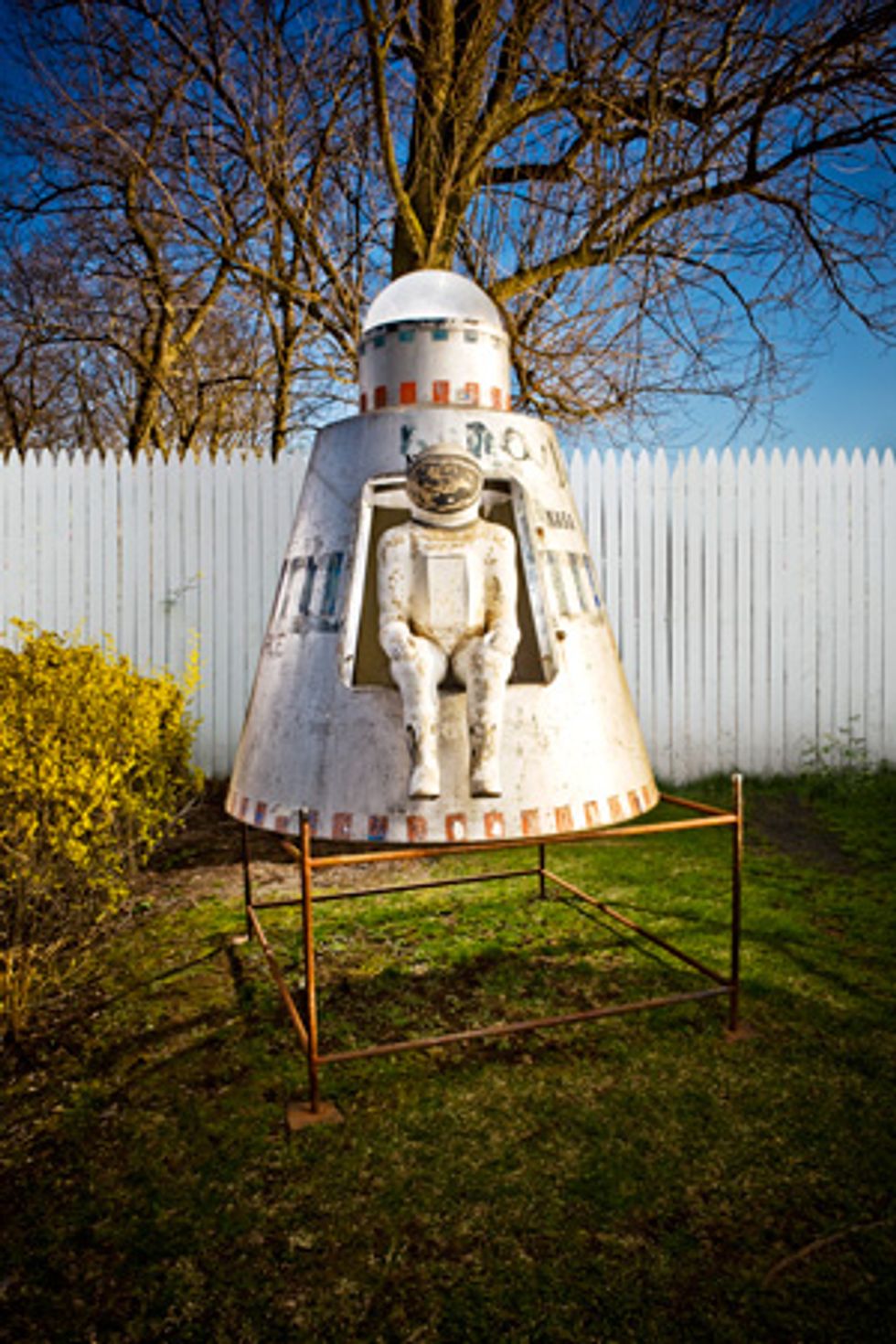 Photo: Bill Cramer; Fence: Megan Maloy/Getty Images
Wernher von Braun would be so disappointed. The German-born rocket pioneer accomplished great things in his life, including overseeing the design of the Saturn rockets, the most powerful launch vehicles ever built. But he never saw the thing he yearned for most: people walking on Mars.
He did try mightily to make it happen. Shortly after World War II, when he was living at Fort Bliss, Texas, he wrote his only novel, Project Mars, about an expedition to the Red Planet. The book is packed with detailed explanations of orbital physics and unintentionally hilarious mission directives: “The landing is to be carried out, if possible, with avoidance of any hostile contact with the inhabitants of Mars.” Ultimately, the lead spaceship ski-lands onto the Martian snow, and its crew of 18 befriends the underground-dwelling Martians. The year is 1985.
Through the 1950s and ’60s and into the ’70s, von Braun tirelessly propounded his Mars vision, in a group of articles for Collier’s Weekly and later in a series of television specials for Walt Disney. During the Nixon administration, he was still pleading for a Mars landing by 1982.
Most of the other pieces of the von Braun dream eventually came to pass: A permanent space station orbits Earth, for example, and 12 men have walked on the moon. And yet, a Mars trip seems no closer now than it did in 1977, when von Braun died.
Turns out that going to Mars is a lot harder than he let on. It’s expensive, for one. In his novel, von Braun figured that a Mars expedition would cost US $2 billion—about $18 billion in today’s dollars. By 1989, NASA estimated such a trip would come to half a trillion dollars; if you correct that figure for inflation, you get the current U.S. fiscal stimulus package, give or take a hundred million.
Spooked by those numbers back in 2007, when a trillion dollars still seemed like a ridiculous amount of money for even the U.S. government to spend, Congress stipulated in a NASA appropriations bill that “none of the funds...shall be used for any research, development, or demonstration activities related exclusively to the human exploration of Mars.” The Red Planet has undeniable cachet, but nowhere near the geopolitical punch that the moon had in the early 1960s, in the frigid depths of the Cold War. It’s hard to imagine a Mars project ever getting a presidential exhortation on the order of John F. Kennedy’s 1961 speech launching the Apollo program. And with the global economy on life support, you have to wonder if we’ll even get there before the century is out.
If going to the moon is a day hike, going to Mars is the Lewis and Clark expedition—a journey too long and too complex to carry everything that’s needed. Earth and Mars ride along in their concentric orbits, getting within striking distance of each other only for a brief window every two years. The shortest one-way trip, using conventional chemical propulsion, would take six months. If you include the time spent on Mars waiting for the two planets to move back into optimal alignment and also the trip home, the total mission would last at least two and a half years. The crew would have to endure extremes of boredom, isolation, and radiation, and they would require a vast amount of fuel and rations packed into a vessel sturdy enough to shield them from the harshness of space. Simply landing a spacecraft safely on a planet with an atmosphere and substantial gravity poses stunning challenges. And then there’s the matter of keeping the crew alive on the Martian surface.
In other words, the physical, technical, and economic demands of a Martian mission are too great to be overcome in a decadelong, Apollo-like sprint. The only solution is to chip away at the problems. And that’s just what’s happening.
Despite the congressional directive, NASA engineers have continued to move the agency slowly but inexorably in the general direction of Mars. Along with its counterparts in Europe and Asia and legions of academic researchers around the world, the space agency has spent years laying the groundwork for such a mission. The International Space Station, for example, hasn’t yielded much in the way of basic science, but it’s letting astronauts learn how to deal with issues like weightlessness, equipment failures, and the day-to-day routine of life beyond Earth. A lunar base will teach spacefarers and mission planners lessons about running an extraterrestrial outpost and will also push the development of NASA’s Ares V booster, which will likely be needed to loft the capsules, crew, and supplies for a Mars mission, unless better alternatives come to fruition.
Meanwhile, orbiters, landers, and rovers continue to gather vital information about the Red Planet, including the best places to find water and minerals. Upcoming sample-return probes to Mars, like Europe’s ExoMars and Russia’s Phobos-Grunt, will let researchers back on Earth touch Martian soil for the first time. All of these efforts will help set the stage for an eventual human mission.
When that happens—if it happens—it will be the most difficult and complicated undertaking in human history.
The list of challenges is long and sobering, and it starts with propulsion. Chemical rockets are only marginally capable of getting people to Mars and back, but the main alternative, the plasma drive, is at least a couple of decades away from the day when it’ll be ready to ferry folks to that red dot in the sky [see “Rockets for the Red Planet,” in this issue].
Even after the propulsion problem is solved, there are at least five other really big ones: cosmic rays, muscle and bone loss, psychological stress, landing on the planet, and feeding the crew for the long haul. All of those challenges are harder with chemical rockets, because a chemically fueled trip would last much longer than one with a more advanced propulsion technology.
That time sensitivity is acute with cosmic rays, the combination of energetic protons ejected by the sun during solar storms and gamma-ray bursts from distant galaxies. You’re not at risk on Earth’s surface, because you’re shielded by the planet’s atmosphere and magnetic field. But out in space, you don’t have that protection. Of particular concern are solar storms, which can toss out deadly particle showers that can kill you quickly or slowly, depending on the storm’s severity. And both types of cosmic radiation can damage DNA, raising your long-term risk of cancer. Gamma rays might even make you stupid; regular doses can wreak havoc on brain cells, among other things.
Apollo astronauts were fortunate in not encountering a solar storm during their missions, none of which lasted longer than 12 days. But a Mars crew would almost certainly experience at least one solar storm and regular doses of gamma rays. Scientists estimate that astronauts on a 1000-day mission will be exposed to just over 1 sievert of radiation, equal to about 26 000 dental X-rays.
Nobody really knows exactly what such a dose would do to a crew or to what extent high-energy particles correlate to cancer rates. Officially, NASA rules dictate that any manned mission have a fatality risk below 3 percent. On paper, at least, a Mars mission isn’t too far off: For a 40-year-old male astronaut, the space agency puts the mean fatality risk due to cancer at 4 percent. But few physiologists put much stock in that number, and besides, variation among individuals makes it impossible to say who will develop cancer and who won’t.
One way to lower the radiation risk is to build your spacecraft with thick walls. The astronauts’ sleeping quarters on the International Space Station, for instance, are lined with polyethylene, which helps block the incoming protons during a solar storm. The station is also always within the confines of Earth’s magnetic field, which offers additional protection.
The 10-centimeter-thick walls of most current spacecraft block about 25 percent of cosmic rays, but there’s no good way to keep out much more without making the walls so thick they’d add greatly to the weight. “The amount of material you need is enormous,” says Francis Cucinotta, chief scientist in the radiation department of NASA’s human research program, in Houston. You might think a lining made of lead would be effective, but when the high-energy electrons in cosmic rays hit the lead, they can trigger secondary radiation that’s just as damaging.
One possibility is to re-create the physics of Earth and use a magnetic field. Last year researchers from the Rutherford Appleton Laboratory in Didcot, England, built a magnetic shield in the lab that was able to block a beam of heavy ions and protons, says physicist Ruth Bamford, who led the research. Bamford borrowed the technology from nuclear-fusion research, in which high-intensity magnetic fields are used to contain the energetic plasma where the fusion takes place. Now her team is trying to scale up their shield so that they can test it in space. She estimates that the field could be as small as 100 meters long, just large enough to form a protective bubble around the habitable parts of the spacecraft. This bubble would require a 1-tesla magnet and about a kilowatt of electricity to maintain.
Researchers are also considering new radiation-blocking materials, new drugs to treat cancer and other illnesses caused by radiation exposure, and even genetic tests that would identify cancer risk. Or maybe the answer is to choose only older male astronauts: The older you are, the less likely you are to live long enough to develop cancer, and men are less likely than women to develop breast cancer, one of the most common types of cancer linked to radiation.
“For a manned mission to Mars, I don’t think there’s a magic bullet,” says Cucinotta. “But I think a combination of things will make it allowable.”
The ravages of space aren’t confined to radiation; the lack of gravity is arguably even more vexing. Astronauts on average lose 1.5 percent of their bone mass for each month they spend in a weightless environment, and the rate of muscle loss can be much higher. On short excursions, astronauts can lose up to 20 percent of their muscle mass; during multimonth missions, the figure can reach 50 percent. Some astronauts and cosmonauts have returned from long missions without enough musculature to walk and had to be removed from their reentry craft on stretchers.
Exercise on Earth brings back the muscles and bones. A much better solution is to do regular workouts in space that limit or even prevent the loss in the first place. That’s why NASA now requires visitors to the International Space Station to spend between 30 minutes and 2 hours a day exercising. On the ISS, they have access to an exercise bicycle, a treadmill with a harness that provides a downward force, and also an Interim Resistance Exercise Device. This machine provides resistive force by means of a system of pulleys and elastomers. U.S. astronaut Daniel Tani, who spent four months on the space station in 2007, says that exercise helped him maintain most of the muscle strength in his arms and legs. Other muscles, though, like the ones needed to hold his head up, had atrophied. “If I turned my head too quickly, I’d lose my balance,” he says.
Another option may be to simulate gravity by using centrifugal force. In a memorable scene from the motion picture 2001: A Space Odyssey, an astronaut jogs within a large spinning compartment, as the spaceship in which it is mounted streaks toward Jupiter. It’s a neat idea, but it could be tricky to pull off. If the habitat rotates too quickly, for instance, crew members may get dizzy or sick when they turn their heads. And if it’s too small, they may feel a “gravity gradient” between their heads and feet. Studies indicate that you’d need a 56-meter-radius structure turning at 4 rotations per minute to supply about 1 g of artificial gravity. Alternatively, you could build a human-size centrifuge inside the spacecraft to provide short, high doses of artificial gravity—say, 1 hour a day at 2 or 3 g’s. But neither concept has been vetted in the microgravity environment of space.
Whatever form it takes, exercise will be vital for keeping crews healthy for the months-long journey to Mars. Peter Cavanagh, professor of orthopedics and sports medicine at the University of Washington, in Seattle, thinks crews will have to augment their exercise by taking drugs normally used to treat osteoporosis. And before they land on the Red Planet, they will have to prep themselves intensively by doing exercises that focus on reactions, quick movements, and fine motor control. “All the reflexes we depend on are gravity based, and we’re going to need them again when we get back to the gravity of Mars,” says Cavanagh.
Maintaining bone and muscle mass won’t do much good if, in the meantime, the space travelers lose their minds. And that, unfortunately, is an all-too-real possibility.
Russia’s Mir space station, which remained in orbit for 15 years before being deposited into the Pacific Ocean in 2001, is a case study in space stress. During one particularly troubling period in 1997, an onboard fire almost killed the crew. Shortly thereafter, cosmonaut Vasily Tsibliyev bungled a routine docking maneuver, sending an incoming supply ship crashing into the station; the collision knocked out power to half the orbiter. Tsibliyev soon developed an irregular heartbeat, which Russian psychologists attributed—no surprise here—to extreme stress. When his crewmates attempted to repair the power outage, someone—possibly the hapless Tsibliyev—mistakenly unplugged an onboard computer that sent the space station spinning. (Upon leaving Mir at the end of his six-month stint, the cosmonaut reportedly said, “Thank God.”)
Being cooped up for months in a tin can no bigger than a two-bedroom apartment won’t be easy. In Earth orbit, you at least have the comfort of knowing that you can get home, for example, by jumping into a Soyuz capsule for the hour-long descent back to Earth. A crew going to Mars would have no such easy escape from their cramped, hazardous, and isolated environment.
“Humans will experience an environment and conditions that are really unlike anything they’ve experienced before,” notes David Dinges, who is head of the neurobehavioral and psychosocial research team at the National Space Biomedical Research Institute, in Houston. “It’s not unlikely that they’ll become depressed or that there will be a conflict between crew members or that they’ll need to communicate with a family member,” he says. Should arguments arise or loneliness, stress, or anxiety set in, crew members would have to deal with it largely on their own.
So they’ll have to be chosen very carefully. The first step will probably be to weed out anyone prone to depression, anxiety, claustrophobia, or any other condition that could be a problem in deep space. After that, the criteria become more complex, in some cases even nonintuitive. For example, psychologists who’ve studied what types of people work best together have found that crews from different cultures tend to get along better than crews who are more like one another.
Could sexual tension doom a mission? Studies of mixed-gender crews on board space stations and submarines and at Antarctic bases, and also in simulations lasting weeks or months, have produced mixed results. On some missions, women have been credited for being peacemakers and contributing to a sense of calm. Sexual jealousies do arise, though: During a 110-day simulation in Russia in 1999, a female participant reported unwelcome advances from the team’s male commander, shortly after two other male crewmates got into a bloody fistfight; the episodes prompted another team member to quit.
But single-sex teams aren’t the answer either, says Jay Buckey, a former astronaut and now a professor at Dartmouth Medical School, in Hanover, N.H. Generalizations based on gender don’t begin to capture people’s individual differences. And in an attempt to avoid sexual rivalries, you’d exclude qualified people and limit crew diversity. “There’s been a lot of discussion about gender makeup, but ultimately what you’re looking for is people who can demonstrate a good ability to work together,” Buckey says. Any crew bound for Mars will spend months training together before departure, he adds, giving ample time to evaluate their cohesiveness.
Once the crew is chosen, computers might help them coexist. Yes, even the unpredictable realm of human emotion is likely to be parsed by software. Dinges is working on a face-recognition program that reads expressions and detects changes in emotion. At the start of a trip, an onboard computer would have a database of the range of facial expressions for each astronaut. During the voyage, cameras positioned around the ship would capture everyone’s facial expressions, which the computer would compare to its baseline images, constantly evaluating whether the astronauts are feeling emotions—happiness, sadness, anger, anxiety, or stress—strong enough to warrant a follow-up.
And if the computer spots a worrying trend? More software! (Specialization, it seems, is the trend for programs as well as professionals.) James Cartreine, a research psychologist at Harvard Medical School, is leading a group developing a multimedia program called the Virtual Space Station. It mimics behavioral therapy, a form of psychotherapy in which the patient is guided to resolve his own problem, whether it’s a crewmate who snores too loud or homesickness or profound boredom.
So will astronauts really pour out their innermost frustrations and fears to a bunch of microchips? Cartreine insists they will. “People are not as likely to reveal problems they are embarrassed about to a real person,” he says. A virtual therapist may even be more thorough, he argues, because it won’t forget to follow up and make sure that old problems have been dealt with.
Of course, the system could be easily thwarted: Astronauts could put on a happy face or lie about their problems. Mission planners would have to convince the crew beforehand that the technology could really help them, Cartreine says.
Better communications technology, too, will help bolster weary, lonely astronauts. To reduce the isolation, you’d want the crew to be able to send and receive audio and video in real time, reliably and whenever the mood struck them. But that would tax NASA’s current interplanetary communications system, known as the Deep Space Network.
NASA engineers had hoped to launch a dedicated telecommunications satellite sometime this year that would have demonstrated a laser-based technology capable of sending data at up to 30 megabits per second, about five times as fast as what’s currently possible. To work, the laser beam must be pointed with great accuracy, and it’s vulnerable to interruption by clouds and other obstacles. But those drawbacks aren’t what doomed the Mars Telecommunications Orbiter; NASA canceled the program in 2005 to free up money for other projects.
Assuming the crew survives the long voyage without being killed or killing one another, then yet another monumental challenge will come: landing safely on the Red Planet.
Even without a crew on board, the feat is hellishly difficult. When the rover Spirit descended to the Martian surface in January 2004, NASA scientists described the white-knuckle landing as “6 minutes of terror.” The spacecraft carrying the rover streaked into the atmosphere like a meteor, traveling at 19 000 kilometers per hour. A heat shield slowed the craft to 1600 km/h, still nearly twice as fast as a commercial airliner. Then followed a supersonic parachute deployment and a complex series of retro-rocket firings. Just 5 seconds before impact, the lander’s air bags inflated, and it hit the ground at 87 km/h, bouncing like a beach ball in a hurricane until it finally rolled to a stop. And all that was actually part of the plan.
Bear in mind that Spirit weighed 185 kilograms, a tiny fraction of what a manned module would weigh. Had a human crew been aboard, they would have been subjected to forces of 40 g’s. Most people black out at between 7 and 9 g’s, and that’s if they’re wearing antigravity suits; a force of 16 g’s can kill you if it lasts longer than a minute. (It’s also true, though, that race-car drivers have endured more than 70 g’s in crashes and lived to tell the story.)
The basic problem is that the Martian atmosphere is both too thin and not thin enough. It’s not thin enough to allow landing solely with retro-rockets. At supersonic speeds, retro-rockets create turbulence that would make the spacecraft difficult to control and cause it to shake so badly that it could break apart. That wasn’t a problem for the Apollo lunar landers, because the moon has no air and thus no turbulence. A thrusters-only landing on Mars would also consume a huge amount of fuel.
But the atmosphere is too thin (about 1/100th of what Earth has) for a craft to glide to a landing as the space shuttle does: There’s too little atmospheric friction to slow the vehicle down. A spacecraft would still be going thousands of kilometers an hour just 10 km from the surface. Maddeningly, though, Mars’s slight atmosphere is just enough to cause heat from friction, so the spacecraft needs an aerodynamic design and thermal shielding to keep from burning up as it descends.
NASA engineers think the best approach is a two-phase landing. In the first phase, the ship would slow itself down to about 1600 km/h, perhaps using small retro-rockets on the spacecraft’s belly. To avoid creating turbulence, the rockets could be angled away from each other so that their exhaust plumes wouldn’t envelop the spacecraft’s nose. That solution is now being studied by Rob Manning and his team at NASA’s Jet Propulsion Laboratory (JPL), in Pasadena, Calif. They engineered the successful landings of the Mars rovers Sojourner, Spirit, and Opportunity, and they are now trying to figure out the best way to land the Mars Science Laboratory, or MSL, a robotic mission to be launched in 2011. At 900 kg, it will be the largest payload yet to land on Mars, Manning notes, but that’s peanuts compared to a crewed module, which will weigh 40 to 70 times as much. “If we’re having a hard time landing 900 kilograms, how the heck are we going to land 40 tons?” says Manning.
Another option for the first phase is to deploy a huge inflatable “anchor” to create drag. Vertigo, a small company in Lake Elsinore, Calif., is working on such a device, which it calls the Hypercone Supersonic Decelerator. Made from lightweight fabric, it would rapidly inflate, air-bag style, into a flattened cone about the size of a Boeing 747.
The second phase of landing would start once the spacecraft had slowed to 1600 km/h. Manning’s engineers at JPL haven’t yet figured out the optimal answer for that either, but it may involve a quick deployment of parachutes followed by more thrusters.
Complicating matters is the fact that landing techniques for Mars can’t be fully tested on Earth, because the gravity and atmospheric density here are so much greater. “There are a lot of unknowns,” notes Bret Drake, chief architect for NASA’s moon-Mars program. He’s optimistic that people can be safely landed on Mars, but it won’t happen soon. “It will be at least 20 years before we have a viable solution,” he says.
If you think sorting cans and bottles is a pain, consider the extreme recycling you’d need to do on a Mars trip. Start with water: The average astronaut aboard the space station uses about 11 liters of it a day. So for a five-person crew on a 1000-day trip, you’d need 55 000 liters. That’s enough to fill about 350 bathtubs, and it would weigh 55 000 kg—way too much to carry aboard a spacecraft.
It should be possible, though, to recycle up to 90 percent of all the water an astronaut consumes, says Robert Zubrin, president of Pioneer Astronautics and founder of the Mars Society. To do that, the crew would have to capture, clean, and reuse every drop of water involved in cooking and bathing—and peeing and sweating, too. Once on Mars, additional water could be extracted by melting and purifying the planet’s permafrost. In places where the water ice is buried deep, microwaves could penetrate the soil and melt the ice, says NASA scientist Edwin Ethridge.
The crew should also be able to produce oxygen on Mars from the carbon dioxide that makes up 95 percent of the thin Martian atmosphere. All it would take is a small amount of hydrogen, which the crew could bring. The hydrogen would react with the CO2 to produce water, which could then be electrolyzed to make oxygen, methane, and more hydrogen. The methane could be used as fuel, and the hydrogen could be reused to produce more oxygen.
Dining on a Mars voyage also poses some challenges. A 1000-day, five-person mission would require 8000 kg of food, of which about 15 percent would be packaging. NASA scientists are developing new techniques for preserving the food and reducing the packaging. Tests show that heating food to 120 °C for 2 to 3 minutes and then placing it under high pressure (about 600 megapascals) for another few minutes will kill any harmful microorganisms without damaging the food. Bombarding the food with microwaves for 5 to 10 minutes will also do the trick.
Either method would increase shelf life to five years. That may sound like overkill, but getting provisions to Mars for an extended stay might mean first sending supplies aboard an unmanned shuttle, with the crewed mission following two years later, says Michele Perchonok, manager of advanced food technology at NASA. She says the space agency will soon ask for approval from the U.S. Food and Drug Administration for its first Martian prepackaged food product: mashed potatoes.
Of course, you could just dehydrate everything and then reconstitute as needed. But Zubrin advises against it. To simulate life on Mars, he has spent weeks at a time living with a small crew of scientists and students on remote Devon Island in the Canadian Arctic and in the southern Utah desert. They eat only what a Mars-bound crew would likely take with them.
“Our first year in the Arctic, it was all crackers,” Zubrin recalls. On later visits, they brought along a lightweight electric bread maker and began serving bread, pasta, and rice. The addition of a few simple cooked items, he says, was a huge boost to the crew’s morale. The crew ate together and took turns preparing meals. “We’d have contests over who could cook the best meals with limited ingredients,” Zubrin says.
Growing food on Mars would cut down on payload weight and give astronauts a chance to munch on fresh produce. Lettuce and tomatoes, for instance, could be grown hydroponically in a greenhouse. Soybeans, wheat, peanuts, and other dried beans could be used to make pasta, bread, and cereal. But cultivating a garden, grinding flour, and cooking from scratch would all divert efforts from life-sustaining chores like finding water and repairing equipment. Salad or survival: The choice is pretty clear.
So, yes, Mars is hard. Wernher von Braun knew it, and yet the planet remained ever in his sights. In his novel, he included a 62-page scientific appendix dense with tables of rocketry data, landing maneuver calculations, and hand-drawn diagrams. Getting to Mars, to von Braun, was not some fantastic dream; it was a workable, solvable problem and an engineering challenge of the best kind, because it inspires us, builds us up, and unites us as a society. He saw his book not so much as a work of fiction but as a practical guide, a road map, a way forward.
“It is the vision of tomorrow which breeds the power of action,” he wrote in the novel’s preface. “Thousands of scientists and engineers are laboring constantly to perfect our knowledge of rocketry and rocket propulsion, and millions of dollars are spent yearly to advance such research. What the results will be is beyond the public ken, but they will surely exert a vital influence upon the future of the entire Earth and well beyond its present confines.”
“When referring to technological advances,” he added, “the word ‘impossible’ must be used, if at all, with utmost caution.”
For more articles, go to Special Report: Why Mars? Why Now?
About the Authors
Fred Guterl grew up building spaceships in his garage out of plywood and two by fours. He’s now the assistant managing editor of Newsweek International. Monica Heger, a science writer in New York City, came of age in a post-Apollo world and never thought much about space exploration. So she was surprised to learn of all the ongoing research on manned spaceflight.