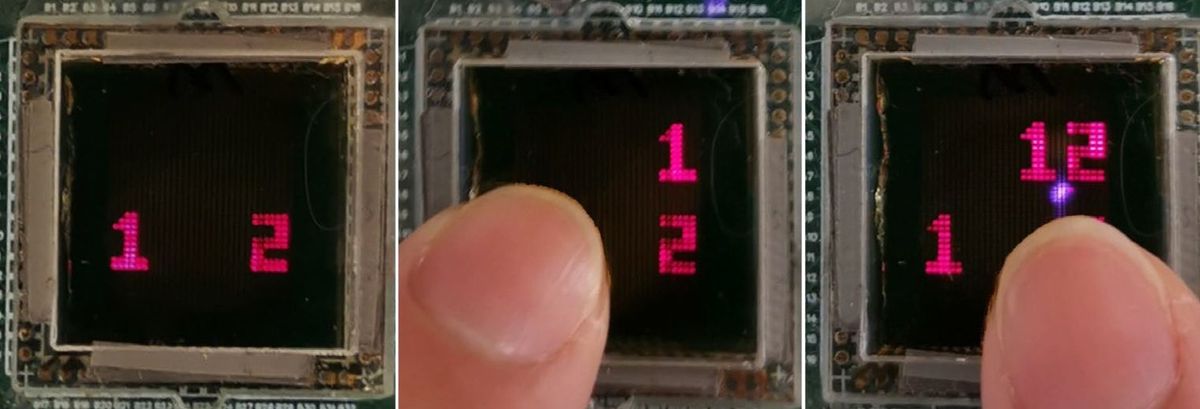
Beyond making mobile phones and other mobile devices flexible enough to wrap around your wrist, I have been a strong proponent of efforts to improve the battery life of these mobile gadgets.
There have been a number of announcements recently reporting on work that improves the li-ion batteries used in mobile phones, or efforts to reduce the amount of energy used by these devices through the use of steep-slope transistors and thereby lengthen the battery life.
It is in this latter area of seeking to lower power consumption in these devices that we have our latest breakthrough to extend the battery life of mobile phone from hours to weeks.
Researchers from the University of Illinois’s Beckman Institute for Advanced Science and Technology, led by electrical and computer engineering professor Eric Pop, have reported in Science that they have used carbon nanotubes to control bits and lower power switching in phase change materials (PCM).
Just as a bit of background on PCM, one of the major commercial initiatives with the material in memory applications was the joint venture between Intel and STMicroelectronics with their Swiss-based Numonyx, which Micron Technologies acquired last year. PCM compares quite favorably with NOR-type flash, memory NAND-type flash memory, and RAM or EEpROM. Cost is still high compared to DRAM and read speed is not as good as DRAM, but unlike it DRAM it is non-volatile. You can read more about PCM memory here.
But what the researchers recognized was that one of the drawbacks with PCM memory was that high programming currents have made it difficult to realize low power operation. The researchers overcame this drawback by replacing metal wires with carbon nanotubes. In a press release prepared by the University of Illinois, graduate student Feng Xiong, the first author of the paper, explains, “The energy consumption is essentially scaled with the volume of the memory bit,” says Xiong. “By using nanoscale contacts, we are able to achieve much smaller power consumption.”The way the system works is that bits are created by putting a small amount of PCM in the a nanoscale gap located in the middle of a carbon nanotube and then by applying just small currents to the nanotube they can switch the tube on and off.
According to the abstract in Science, the researchers were able to achieve “programming currents as low as 0.5 μA (SET) and 5 μA (RESET), two orders of magnitude lower than state-of-the-art devices.”What this may translate to for your mobile phone is that a smart phone will consume so little energy that it may not even need a battery but could run on its own thermal or mechanical energy. (Battery manufacturers are not going to like that part).“I think anyone who is dealing with a lot of chargers and plugging things in every night can relate to wanting a cell phone or laptop whose batteries can last for weeks or months,” Pop is quoted as saying in the University of Illinois press release.
Dexter Johnson is a contributing editor at IEEE Spectrum, with a focus on nanotechnology.