
This is part of IEEE Spectrum’s Special Report: Why Mars? Why Now?
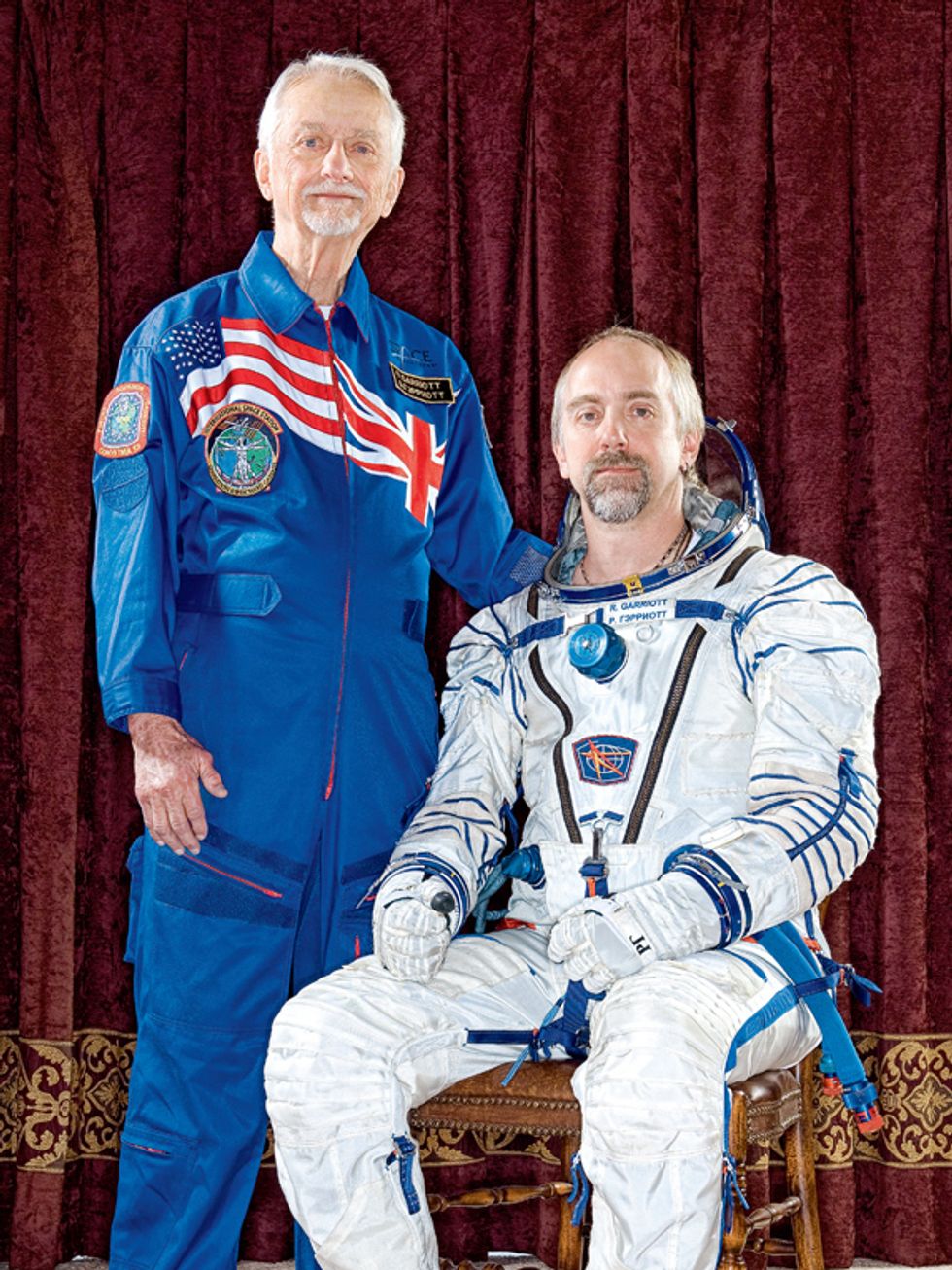 Photo: Matthew Mahon
In 1973, Owen Garriott made electrical engineering history as the first EE astronaut to travel into space, spending 60 days aboard Skylab, the U.S.–run space station. The stay set a new record for duration in space, and IEEE Spectrum commemorated the achievement with a photo of a spacewalking Garriott on the cover of its July 1974 issue. He went into orbit again in 1983, this time aboard the space shuttle Columbia, and he remained in the NASA astronaut corps until 1986. Between missions, he was based at Johnson Space Center, overseeing research in the physical sciences and advising on plans for what would become the International Space Station (ISS).
A quarter century after Garriott’s Skylab excursion, his son, computer-game designer Richard Garriott, took a 21st-century trajectory into space. The sixth self-paying tourist—or “private astronaut,” as Richard prefers to be called—he took a Soyuz spacecraft to the ISS last October. Owen was on hand at Baikonur Cosmodrome in Kazakhstan to watch his son’s liftoff and also greeted him upon his return 12 days later.
Richard and Owen are now the second family to have visited space, albeit in different decades. (Cosmonauts Alexander and Sergei Volkov hold the distinction of being the first father and son to go into orbit.) In March, veteran space journalist James Oberg interviewed the Garriotts at Richard’s mansion, Britannia Manor, on the outskirts of Austin, Texas. Here are excerpts from the interview.
Q: Owen, what advice did you give your son?
OWEN: Actually, I did not need to give Richard much information or guidance. He grew up in this kind of environment; he knows the situation. So my only advice was, don’t worry about feeling a little uncomfortable at the beginning of the flight. Almost everyone does. Just hang in there and it’ll be fine.
Q: Richard, how did you feel?
RICHARD: I feel very lucky that I was relatively free of motion sickness. But I did have a different, related problem. Starting 15 or 20 minutes after being in orbit, you begin to feel like you’re lying head down—in fact, it felt a lot like the tilt-table preparations we did. For 5 or 10 minutes, that’s not such a big deal. But when you do it for 5 or 10 hours, that gets pretty annoying. By day three or four, I was having substantial headaches from fluid shift and increased blood pressure in my head.
One of the other great pieces of advice [my dad] gave me was how to structure my flight. I devoted about a third of the time to looking out the window, because we knew that would be a very pleasurable activity. We planned another good chunk of time for ham radio. As you know, Dad took the first ham radio up [on the space shuttle Columbia] 25 years ago, and so I had this interesting historical chance to reverse the call, so to speak.
The ham radio operations, by far, became the most entertaining activity I did in orbit. My other cosmonaut buddies now do this commonly, and everyone says they really appreciate the chance to talk with people who have this very low probability of contacting the station. But when they do reach somebody, they have made this very personal connection to someone in a very unusual circumstance. The joy the ground person gets out of that contact is infectious. A lot of them have gotten their whole school together and they’ve been trying every day for a week to pull it off, and the whole class—you can hear them clapping or cheering.
Q: Were the communications adequate? Owen, there were long times in Skylab you couldn’t even talk to Houston.
OWEN: We had long breaks, that’s true, somewhat like the Russians have on their side now. But I never felt disconnected from the Earth. Intermittent communication is just fine. In Skylab we had an opportunity to talk once a week, or really more if we wanted to, with our families. [Back home] we had a speakerphone sitting on the kitchen table, and Richard and his siblings would all gather around and we could talk for a few minutes. And I was extremely busy, probably as busy as I’ve ever been in my life, during the two months on Skylab. So I thought it all right and did not feel disconnected from the Earth in any way.
RICHARD: [On the ISS] there was almost always someone on station talking to someone on the ground. Worse yet, there was a HAL kind of thing watching. There’s cameras all over the ISS that are generally always broadcasting. So I think the problem has almost swung the other way. These guys now feel like they’re in the middle of a fishbowl. I remember a few times we moved a camera or turned it to the wall, and a couple hours later a ground call would come up: “Hey, we’re no longer getting a signal from that camera. What’s wrong?” So it’s not only a fishbowl but one that notices when you’re off camera.
Q: Owen, what did you and your family talk about? things happen back on Earth that they may not want to tell you.
OWEN: That kind of thing occurred in the Skylab era. There was some editing done on the news. But if you were to talk with Richard and his mother at home in the kitchen, then you felt that you were getting the straight information without too much bias.
RICHARD: My friend Charles Simonyi paid to use NASA’s e-mail service [Editor’s note: Simonyi completed his second paid visit to the ISS in April]. Charles would make a daily blog of “here’s what happened today in space.” He had kids following along on his whole mission. It’s very timely news. It needs to go on [his] Web site immediately.
NASA says that they’re involved in the communication and therefore have some official responsibility for it. So their desire to look at it meant it was three or four days before the e-mail reached Charles’s ground team, which is already too long. But then they actually made edits. When Charles referred to things like, “Hey, when I get back I want to have a Coke and a cheeseburger,” they wouldn’t let him say “Coke.” It made it to his destination as a “soda and a hamburger.” And he’s going, “That’s not what I said.”
I understand what NASA’s worried about, I really do. I just think they’re shooting themselves in the foot by not realizing that by being so oppressive, they’re [not] creating a sense of wonder and glory and enthusiasm for the program. What ends up coming out is this sterilized, ultrasafe output that actually doesn’t serve their purposes the way more free communication would.
There was a practical joke I really wanted to play while I was in orbit. I was going to get on the VHF radio and make a joke about seeing a UFO out the window. Of course, my crew members were saying, “Please, Richard, please, please don’t.” What they’re doing by trying to censor is feeding directly into those conspiracy theories.
Q: In the Russian segment of the ISS, the controls look like submarine controls, but in the U.S. segment it’s controlled through laptops and wireless input. How would you design a user interface for a future spacecraft?
OWEN: Back in the 1970s we did not have the computer capabilities we have now—there was no way to have a software interface. Not even in the ’80s was it possible to do that. That was a sign of the times. If we want to make decisions as to how we’re going to go to Mars, we need to [think about] how we can make that flexible. And the only way to make it flexible is through software and therefore have something which we can change 5, 10, 15 years from now as we find better ways to do things.
RICHARD: You can see the switch beginning to occur. Already in the ISS there is an Ethernet backbone that runs through the whole thing. You can plug in laptops anywhere, and that is the standard method of command and control to a wide variety of the systems, because the ground needs that same remote access. I remained phenomenally impressed with how good the Ethernet backbone is up there. They can use off-the-shelf inkjet printers, and the laptops are, you know, quite conventional. So I think they’re absolutely making the right moves.
Q: Investigators on the ground can operate equipment on the station. Richard, were you told, “This science gear’s working, don’t touch it”?
RICHARD: It was very common. There were times when we avoided going into a module because we didn’t want to vibrate an experiment that was being operated by a ground team. Seeing it up there in operation is very impressive.
As we refocus government spending on going back to the moon and/or going to Mars, [there is] a big risk of eliminating funding or focus on the station. I think they have to find a way to open up access to the station to private industry or university research. And that’s what I don’t think they’re doing yet. No one can get through the red tape because of the current structure.
Q: Richard, something about the flight reminded you of Fritz Lang’s classic 1927 film Metropolis.
RICHARD: Yes, I was struck by how much like Metropolis the space station was. The movie is about a future society where there’s basically two classes of citizen: those who live belowground, who work on the machinery that keeps the power and water and lights on for the upper-class people, who live aboveground in relative comfort and opulence.
If you go on the Russian segment [of the ISS], it is less voluminous; it’s more dimly lit. It is where all of what I would call the dirty and maintenance-heavy functions of the space station take place. It’s where the water is recycled and purified. [Editor’s note: A new urine processor was installed on the U.S. side of the ISS last November.] It’s where the galley is. It’s where, up until quite recently, the only toilet facilities were. It’s where the central command post is for navigating the space station. It’s where all the thrusting and maneuvering engines are that keep the space station in orbit.
In my mind, it’s where all the work that keeps the space station alive is really happening. And because of all the water and food and other activity, it also tends to be prone to bacterial outgrowth, mold, and things of that nature.
But then you go through a hatchway into the U.S. segments, and immediately the volume is dramatically increased. Immediately the lighting level is dramatically increased. It is completely sterile. The crew discourages you from taking food or water in there to help keep it sterile. We have gleaming scientific racks for potential use, and we’ve spent 10 years and a hundred billion dollars or so building the ISS, but so far there’s really not much happening in the U.S. segment. It’s very striking, the difference between the Russian segment and the U.S. segment.
For more articles, go to Special Report: Why Mars? Why Now?