![Photo of Founder Sun-wook Kim [left] and chairman Inho Kim of NessCap Co.](https://spectrum.ieee.org/media-library/photo-of-founder-sun-wook-kim-left-and-chairman-inho-kim-of-nesscap-co.jpg?id=25560333&width=3600&height=2700)
Let’s say it’s 2010, and you’re boiling off midlife ennui or burnishing your golden years in time-honored fashion: by zooming around in a high-performance road machine. The car accelerates powerfully, and yet it moves quietly and nimbly, slaloming through curves like a go-cart. Best of all, it sips gas like a connoisseur enjoying 40-year-old Armagnac. Would you believe you owe these rejuvenating, guilt-free thrills to a bunch of capacitors?
Not just any capacitors, of course. To understand what’s going on under the hood of this car, you’ll need to leave behind the Lilliputian world of the picofarad and the microfarad and enter the realm of the kilofarad. It is a place where NessCap Co., in Yongin, South Korea, holds sway.
NessCap is one of about 10 makers of ultracapacitors, devices that can store so much charge that they are beginning to blur the functional distinction between the capacitor and the battery. And according to some experts, nobody does it better than NessCap, which offers a unit rated at an impressive 5000 farads at 2.7 volts in a package a little bigger than a half-liter soda bottle. NessCap’s capacitors “perform as well as or better than any others we’ve ever tested, in terms of energy and power density,” says Marshall Miller, a research engineer at the University of California at Davis, where he specializes in testing advanced capacitors and other devices.
Ultracapacitors made by NessCap and others are just now starting to show up in products ranging from toys to experimental buses, basically as alternatives to batteries. The worldwide market isn’t large; it was just US $38 million in 2002, the most recent year for which figures are available, according to the research firm Frost & Sullivan, in San Antonio. But NessCap and the handful of other makers of the largest ultracapacitors all have their sights set on the automotive market, which could do for their business what the iPod did for sales of MP3 songs. Frost & Sullivan, at least, is a believer; the company optimistically predicts total 2007 revenues for ultracapacitors of $355 million.
On paper, anyway, the idea is not far-fetched. In comparison with batteries, ultracapacitors can put out much more power for a given weight, can be charged in seconds rather than hours, and can function at more extreme temperatures. They’re also more efficient, and they last much longer—in tests at the Idaho National Engineering and Environmental Laboratory, in Idaho Falls, upwards of 500 000 charge-discharge cycles have been recorded. Automotive traction batteries, for comparison, have much shorter lifetimes, particularly if they are discharged deeply.
Pondering the relative strengths of capacitors and batteries, Joel Schindall, associate director of the Laboratory for Electromagnetic and Electronic Systems at the Massachusetts Institute of Technology, in Cambridge, says: “In all ways other than energy density, an electric field is superior to chemistry for storing energy regeneratively, because it is completely reversible” and therefore intrinsically efficient and durable. Part of Schindall’s research focuses on advanced materials that could be used as electrodes in future ultracapacitors.
Ultracapacitors are now establishing themselves in niches demanding a power source that can recharge quickly, be sealed into a system that has to last for years, or put out prodigious amounts of power in short bursts. Tokyo-based Ricoh Co. is using them in copier machines to store the energy needed to warm up the machines quickly, minimizing time spent in the energy-wasting standby mode. Makers of high-end car stereo amplifiers are using ultracapacitors to deliver the surges of power demanded by musical crescendos, without straining the vehicle’s battery.
Another use is in solar tiles; a new twist in landscape architecture, they’re used to guide pedestrians at night, by storing solar-generated electricity during the day and using it to power a small light-emitting diode panel after dark [see photo, "Bright Idea"]. Sealed into a walkway, wall, or staircase, these clear, rugged tiles have to last for a decade or more, working without fail night after night, withstanding subfreezing and sweltering temperatures alike—criteria only ultracapacitors can fulfill.
And then there are cars. The hybrid-electric vehicle, in its various forms, is poised for an increasing share of the automotive market in several parts of the world, including the United States. And ultracapacitors have already found their way into hybrids, albeit in a minor role: hardly noticed among the Toyota Prius’s many celebrated technical breakthroughs is the fact that it uses ultracapacitors, from Panasonic, to power an electric-hydraulic pump in the mechanical braking system.
It’s just the start of what some experts say ultra-capacitors will do for hybrids. For example, with their lightning-fast charge and discharge capability, ultracapacitors could handle the power surges needed for accelerating, allowing engineers to use a smaller battery pack in the vehicle (and eventually, perhaps, no battery pack at all). Shielded from high-current pulses, the batteries would last longer, too.
There are other intriguing possibilities, such as using the devices to give more or less ordinary cars “stop-and-go” operation, in which the gasoline engine is extinguished at stops and started instantly when the brake pedal is released. Ultracapacitors and a powerful starter motor would instantly jolt the engine back to life. Such vehicles would also make use of regenerative braking, converting into electricity the kinetic energy otherwise thrown off as heat in the brakes and storing that electricity in the ultracapacitors.
So what will it take for ultracapacitors to find a home under the hood? First, they’ve got to be a lot cheaper. Today, at roughly $9500 per kilowatthour, ultracapacitors are too expensive by a factor of five, at least, for cost-conscious carmakers. Second, automotive engineers would like to see the devices store more energy (as opposed to power) per unit weight, which would let the devices take over more of the energy-storage burden from batteries in future vehicles.
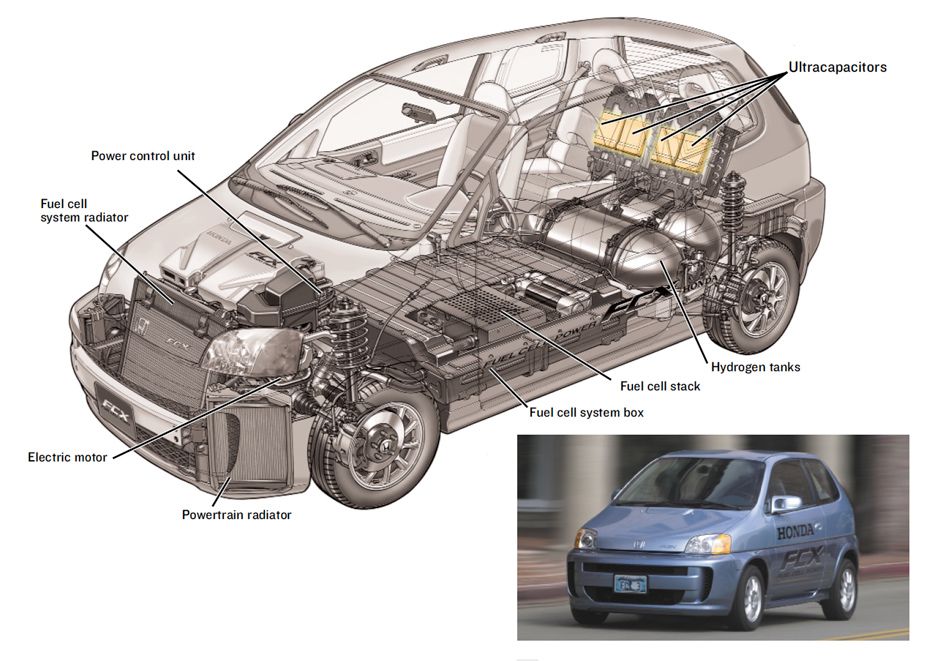
If NessCap and its competitors can achieve those goals and crack this market, the long-term future looks good. No one knows when, or even if, the fuel-cell car will become a mass-market reality—the estimates range from 10 to 30 years. But if it does happen, it’s likely that ultracapacitors will be a big part of the reason. Fuel cells, by themselves, deliver power too sluggishly to briskly accelerate a full-size car. They must be mated to a faster-acting energy-storage device, and for this coupling, ultracapacitors are superior in many respects to batteries.
“Capacitors and fuel cells are made for each other,” insists Andrew Burke, a specialist on ultracapacitors and a research engineer at the University of California, Davis. Honda, for example, used only ultracapacitors to supplement the fuel cell in its experimental FCX-V3 and FCX-V4 vehicles, several of which have been leased in California and Japan [see illustration, "Fueling Around"]. For these vehicles, Honda used its own ultracapacitors.
At first glance, at least, NessCap may seem an unlikely candidate to get ultracapacitors into a production car. NessCap’s three main competitors—Maxwell Technologies in San Diego; Epcos in Munich, Germany; and Panasonic in Osaka, Japan—all have either deep-pocketed parent companies or revenue from other product lines with which to support their ultracapacitor development. (Panasonic ultracapacitors are manufactured by Matsushita Electronic Components Co., in Kadoma City, Japan.)
But what NessCap lacks in resources, it makes up in resourcefulness and determination. The company was founded in 2001 by Sun-wook Kim, a Korean entrepreneur and former research director at the Daewoo Group. Although Kim has a few other ventures, including a new organic-LED display factory in Singapore, NessCap is basically a stand-alone enterprise that will either succeed or fail on the strength of its ultracapacitors and on its executives’ ingenuity in promoting them.
Certainly, the company is efficient: all of NessCap’s 65 employees work in a boxy, yellowish, blue-trimmed building in a gritty suburb outside the Korean industrial city of Suwon. It houses NessCap’s factory, offices, and R&D laboratories and its quality-control, testing, and shipping and receiving departments, as well as a subsidiary consumer-electronics spinoff and a warehouse. And though it’s a small company, NessCap makes all its own electrodes for its capacitors. Among the company’s closest competitors, only Panasonic can also make that claim, says NessCap’s chairman, Inho Kim (who is not related to Sun-wook Kim).
This distinction is important, he says, because he expects electrode refinements to be the main source of future improvements in ultracapacitor performance—greater energy storage, for example—and decreases in cost. Electrode technology, Inho Kim estimates, determines “70 or 80 percent” of the capacitor’s performance. “If you own the electrode-manufacturing technology, you can basically do anything,” he argues.
To get an idea of where these improvements will come from, you’ve got to understand what separates an ultracapacitor from an ordinary capacitor (other than a whole lot of farads). First, consider the classic parallel-plate capacitor, a sandwich of two conductive plates separated by an insulator, or dialectric. When the plates are connected to the positive and negative terminals of a battery, opposite charges separate from each other and accumulate on the plates. Driven by the battery’s voltage, an electric field permeates the dielectric. Associated with that field is a voltage that opposes the battery’s voltage.
The field holds the accumulated, opposing charges apart; in doing so, it stores energy. So, unlike a battery, which stores energy in chemical form, a capacitor stores energy in an electric field; there are no moving parts and no chemical changes of state. To use a capacitor’s energy, you just let its accumulated charges flow through a circuit, driven by the voltage associated with the field.
Capacitance is simply a measure of how much charge a capacitor can store for a given voltage. In mathematical terms, the capacitance equals the charge on the plates divided by the voltage difference between them. The charge, however, is proportional to the area of the plates; larger plates can hold more charge. And the voltage is related to the distance between the two plates; less separation allows more charge to accumulate for a given voltage. So to wring the most capacitance from a device, you want plates, or electrodes, that have a large area, and you want to separate those plates by a very small distance.
In the early 1960s, at the once mighty research laboratories of Standard Oil of Ohio (Sohio), researchers discovered that two pieces of activated carbon immersed in a liquid electrolyte formed an amazingly good capacitor, owing mainly to the fact that the activated carbon’s myriad microscopic nodules had enormous surface area. Sohio licensed the technology to NEC Corp., Tokyo, in 1971, but it was Panasonic that pushed the concept hardest in the 1980s, followed by various projects sponsored by the U.S. Department of Energy in the 1990s.
Since Sohio’s initial experiments 40 years ago, the basic concept has not changed much. Coat two metal-foil electrodes with activated carbon and put a paper separator between them. Immerse the whole thing in a liquid electrolyte.
Attach wires from the terminals of a battery to the two metal foils, and electrons immediately start accumulating in the carbon coated on the foil attached to the battery’s negative terminal [see illustration, "Pluses and Minuses"]. Those electrons, in turn, attract positive ions from the electrolyte into the pores of the carbon on that foil. In the other electrode, meanwhile, positive charges accumulate, attracting negative ions from the electrolyte into the pores of the carbon. Both kinds of ions migrate freely through the paper separator that prevents the electrodes from touching each other and conducting current.
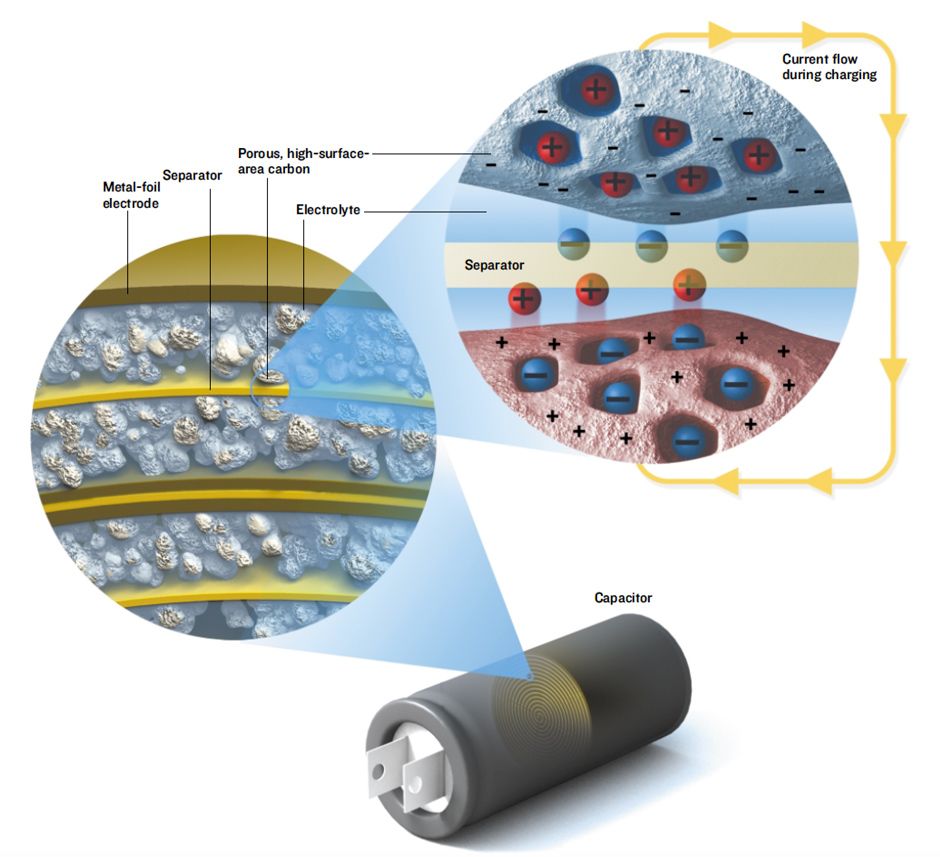
Notice that this so-called capacitor is actually a pair of capacitors in series with each other. At each electrode, there is a separation of charges—electrons and positive ions at the negative electrode, and positive charges and negative ions at the positive electrode. So at each electrode there are two layers of charge, which is why ultracapacitors are also known as electric double-layer capacitors.
The activated carbon’s huge surface area comes from the great porosity of its microscopic nodules. It enables the positive and the negative ions migrating through the electrolyte to find plenty of nooks and crannies to occupy as they insinuate themselves as closely as possible into the oppositely charged carriers inside the carbon. Basically, as an electrode material, the activated carbon provides exactly the characteristics you want for high capacitance: vast surface area and the opportunity for the oppositely charged carriers to get atomically close to each other.
The surface area of the carbon varies, but 1500 square meters per gram is not unusual. So for typical electrodes weighing 250 grams, the total area would be 375 000 square meters—or roughly 50 soccer fields.
The trick, of course, is getting that carbon onto the metal foil as uniformly and efficiently as possible. It is the first step in NessCap’s manufacturing process—and the first topic of discussion on a tour of the company’s small but spotless factory. All manufacturing at NessCap goes on in a series of three brightly lit rooms, whose Kelly green floors are all marked with yellow lines to show visitors where to walk.
In big, shiny, stainless steel mixers—think Cuisinarts on steroids—technicians mix several types of activated carbon with water and with binding agents that cause the carbon-powder particles to stick to each other and to the long strips of aluminum foil electrodes. The resulting slurry gets coated onto one side of the aluminum, dried in a kiln, and then coated onto the other side. After more drying, the coated strips are run through a hot press to increase the density of their carbon layers and give those layers a uniform thickness.
In the next room, machines scratch the carbon off the aluminum precisely and at regular intervals to make places where electrical leads are attached. Then the same machine winds together two long strips of the carbon-coated metal—one will be the anode, the other the cathode—with a strip of paper in between. “No other such machine exists in the world,” says Inho Kim proudly.
In the third room, the wound electrode-separator assemblies are dried in a kiln and inserted in aluminum cases that are filled with electrolyte and welded shut. The finished capacitors are tested in a room across the hall; every single capacitor is tested before leaving the factory.
Upstairs, NessCap’s R&D department occupies a couple of rooms that take up about the same total area as a decent restaurant kitchen. As in an old-time apothecary, glass cabinets filled with bottles of powders and reagents line the walls.
Not surprisingly, ultracapacitor researchers are mainly interested in two things: electrolytes and carbon. In virtually all high-performance ultracapacitors, the electrolyte is acetonitrile. It’s great stuff, in the one way that really matters: it has terrifically low ionic resistance, roughly 15 ohm-centimeters, and that means high power density. But when acetonitrile burns, it can release cyanide, a fact that makes automakers unhappy. “Everybody’s looking for a replacement for acetonitrile,” says Burke at UC Davis. Several organic compounds, notably propylene carbonate, show promise, but none at the moment has ionic resistance as low as acetonitrile. (Honda used propylene carbonate in its own ultracapacitors, in the FCX fuel-cell cars.)
Still, it is the carbon challenge that most consumes ultracapacitor researchers now, because it is the key to the two main goals: getting costs down and improving the energy (as opposed to power) density. In a typical ultracapacitor, the electrode materials—the carbons, essentially—account for more than half the cost of the device, Sun-wook Kim says.
During a tour of the laboratory, NessCap’s R&D director, Young-ho Kim, casually mentions that he’s in the midst of running tests on no fewer than 10 mixtures of activated carbons, looking for a combination of low cost, high performance, and durability that has so far eluded ultracapacitor makers.
It all comes down to pores, he explains, drawing little circles on a piece of paper. You want pores that are all about 20 to 30 angstroms in diameter. Pores that are smaller than that aren’t big enough to allow the ions to move in and out freely, which hurts performance. Lots of big pores, on the other hand, mean that the overall surface area is less than it should be, which also limits performance.
Ultracapacitor makers are working with two main types of carbon, phenyl-resin based and pitch based. Phenyl-resin carbons perform better and are the standard now. But the attraction of pitch-based carbons, which are derived from coke and are used in asphalt, is their low cost—about one-fifth to one-tenth that of phenyl-resin carbons.
The problem, Young-ho Kim says, is that it’s harder to control the pore-size distributions in the pitch-based carbons, so they wind up with poorer characteristics. Their capacitance is usually about 30 percent less than that of the phenyl-resin-carbon devices, he explains. That means that 30 percent more material must be used, which, of course, detracts from the cost savings and makes the finished devices larger. Still, Sun-wook Kim is confident that work on the pitch-based carbons will be a key factor in reducing the overall cost per farad of the devices.
In the next breath, though, he dismisses the conventional wisdom that the carbons have to get down to $10 a kilogram to make ultracapacitors cost-competitive, from about $100 today (for the phenyl-based carbons). He insists that getting costs down will depend as much on manufacturing as on carbon prices. He points out that NessCap is now changing its manufacturing process to put its largest capacitors in cylindrical rather than rectangular cans. The simple shape change allows the electrode assembly to be wound more quickly, which in turn shaves more than 20 percent off the cost of making the capacitors, Inho Kim estimates.
While NESSCAP and its competitors focus on getting the cost of the carbons down, a few other researchers are investigating exotic, pricey forms of carbon that could eliminate the one clear drawback of ultracapacitors—low energy density—and let them mount a serious challenge to batteries. Commercially available ultracapacitors generally can be counted on to store about 3 or 4 watthours per kilogram, Burke says. That’s a far cry from the 60 or 70 Wh/kg typical of nickel-metal hydride batteries or the 110 to 130 Wh/kg delivered by lithium-ion batteries.
An ultracapacitor with batterylike energy density would be almost irresistible to automakers, to say nothing of countless other manufacturers, says John M. Miller, a retired Ford Motor Co. researcher. With high enough energy density, ultracapacitors could reduce or even eliminate the need for traction batteries in a hybrid car. “It’s a pivotal time for energy-storage systems,” he concludes.
Tantalizing claims have surfaced of exotic carbon-based technologies that could boost the energy density of ultracapacitors 10- or even 100-fold—well into the realm of advanced batteries. But so far, these claims have not held up to independent scrutiny, say both Burke and Marshall Miller at UC Davis. An independent Japanese researcher, Michio Okamura, claims to have developed a carbon-based electrode material that he calls nanogate, which is nonporous and can deliver energy densities well above 50 Wh/kg. But solid, independent verification of his claims is not yet available, according to Burke.
At MIT’s electromagnetic laboratory, Schindall and lab director John Kassakian, with Ph.D. student Riccardo Signorelli, are leading a project to investigate the use of carbon nano-tubes, the latest miracle material, in electrodes. They are creating materials in which the nanotubes grow out perpendicularly from a substrate, like hair on a piece of scalp. The nanotubes would become electrically charged, just as the activated carbon does, so they would attract oppositely charged ions in the electrolyte. The nanotubes would also be spaced so as to hold these ions, much as a sea anemone grips small sea creatures in its tentacles. The advantage is that this arrangement can in theory trap many more ions than even the pores of activated carbon—enough perhaps to raise the energy density of an ultracapacitor 100-fold, Schindall estimates.
So far, he and Signorelli have demonstrated technology that can grow the right kind of nanotubes and space them appropriately. By next summer, they hope to grow a patch of electrode big enough to test in an electrolyte, in order to assess its capacitance characteristics. If it works as well as their studies suggest, and if it can be easily manufactured—two big ifs—the dream of a near-ideal energy storage device will be that much closer to realization. “Suddenly, electrical energy storage turns on its head—potentially,” Schindall says.
Meanwhile, for NESSCAP and its competitors, the game is basically this: find enough niche markets to stay afloat until technology advances make ultracapacitors even more attractive and automotive markets develop. And NessCap isn’t waiting for the niche markets to come to it. Last year, the company started its own consumer-electronics firm, Infinity Inc., which is selling everything from crank-powered radios to solar tiles, all outfitted with NessCap capacitors.
NessCap is also working with several other companies on niche automotive applications. A well-known courier company, for example, is about to start using NessCap’s ultracapacitors in 200 of its delivery vans. As they go about dropping off packages in densely populated areas, these vans must stop and restart their engines as many as 200 times a day. The short distances between stops means that the starter batteries can’t recharge sufficiently and soon wear out. But the short distances are not a problem for ultracapacitors, which recharge in seconds and can easily store enough energy to fire up the engine. So the delivery-van system couples ultracapacitors for short-term energy storage with lead-acid batteries for longer-term storage.
Looking beyond these niche applications, Inho Kim has high hopes for “micro-hybrids,” which would have a 12-V battery, as in a conventional car. Micro-hybrids are basically a very mild form of mild hybrid, propelled mainly by a gasoline engine but with a beefed-up electric starter motor fed by a small rack of ultracapacitors. The capacitors and motor provide the stop-and-go operation described above; the car could also make use of regenerative braking.
The guilt-free ultracapacitor-based roadster is probably more than a couple of years away. But a conventional car with a more reliable starter system, or even a micro-hybrid with an ultracapacitor boost, could be in your immediate future. If so, the revolution in energy storage will be well under way.
To Probe Further
Kilofarad International, a trade group formed to promote the ultracapacitor industry, is an affiliate of the Electronic Components, Assemblies, and Materials Association. Its Web site is at https://www.kilofarad.org/.
Andrew Burke of the University of California, Davis, has written numerous technical articles on ultracapacitors. Several are available online, including a survey from 2000: https://repositories.cdlib.org/cgi/viewcontent.cgi?article=1050&context=itsdavis.
Menahem Anderman, president of the consulting firm Advanced Automotive Batteries, plans to release a report on ultracapacitors for automotive uses in February. You can order the US $7200 report at https://www.advancedautobat.com/Ultracapacitor/index.html.