
Last year, vinyl record sales rose 15 percent while the rest of the music industry kept on tanking. Like Converse sneakers, the LP has a way of sticking around long after obsolescence—and even, somehow, maintaining an aura of cool.
Now another old technology, the laser turntable, is making a comeback too. Manufactured by ELP Corp., in Saitama, Japan, it uses five lasers instead of a physical tone arm and stylus, and it can do something no stylus can: play a broken record.
John Hora, a retired cinematographer and lifelong classical music buff who owns two laser turntables, saw this firsthand. One day, in a Los Angeles thrift store, he found violinist Albert Spalding’s performance of Johannes Brahms’s Hungarian Dances, an LP he had sought for decades. Because the record had broken into two pieces, the store’s owner let him have it for free. He took the pieces home, laid them on the laser turntable’s platter, and pressed play. “It was thrilling being able to play a broken record,” he says.
Proponents claim that these devices—bearing hefty price tags of US $10 990 to $14 990—can capture the warmth of vinyl while still hitting every frequency and harmonic preserved in the groove’s ridges with a CD’s cold precision. Unfortunately, the turntable’s sophisticated optics will also pick up dust and grime too small to move a stylus needle. So to reduce vinyl’s trademark pops and crackles, the listener has to clean the record carefully, typically with a special device that can cost upwards of $500. Further noise reduction mandates an external on-the-fly “declicker” signal processing box, which itself costs about $2800. Little wonder then, that with starter kits running into five figures, the laser turntable is a high-end boutique item that won’t be sold at your neighborhood Best Buy anytime soon.
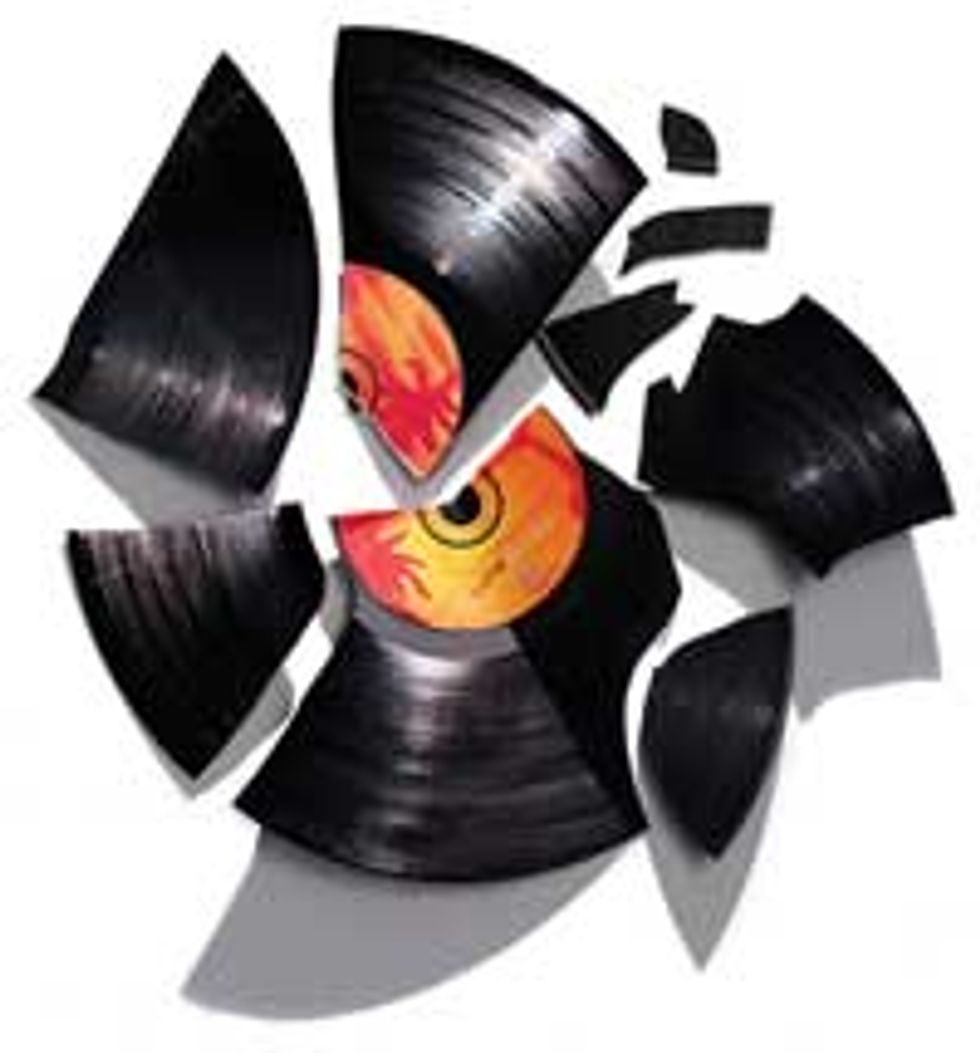 Photo: Jonathan Kantor/Getty Images
The laser turntable was originally patented in 1988 as the Finial by Stanford engineers Robert Stoddard and Robert Stark. A year later, they sold the rights to electronics company CTI Japan. After some further handoffs, ELP began selling its LT series of turntables in 1991. Eighteen years later, a mere 1500 have been purchased worldwide, mostly in Japan. The more expensive models play at 78 revolutions per minute, as well as 33 and 45, and can handle a greater variety of disk sizes.
But as CD sales plummet and vinyl enjoys its own small bounce, ELP’s American vice president, Jim Peek, hopes to capitalize on the old medium’s resurgence. Twenty percent of ELP queries, he says, come from the twentysomething generation of vinyl enthusiasts.
Hora, who boasts 38 000 LPs in his collection, says what draws him to high-end turntables—both laser and mechanical—is his deep love for the music and his desire to reproduce it as perfectly as technology will allow. “I mostly talk to other record collectors,” he says, “and I don’t have to explain myself.”