Energywise iconEnergywise

Offshore Wind Transmission "Backbone" Clears Regulatory Hurdle

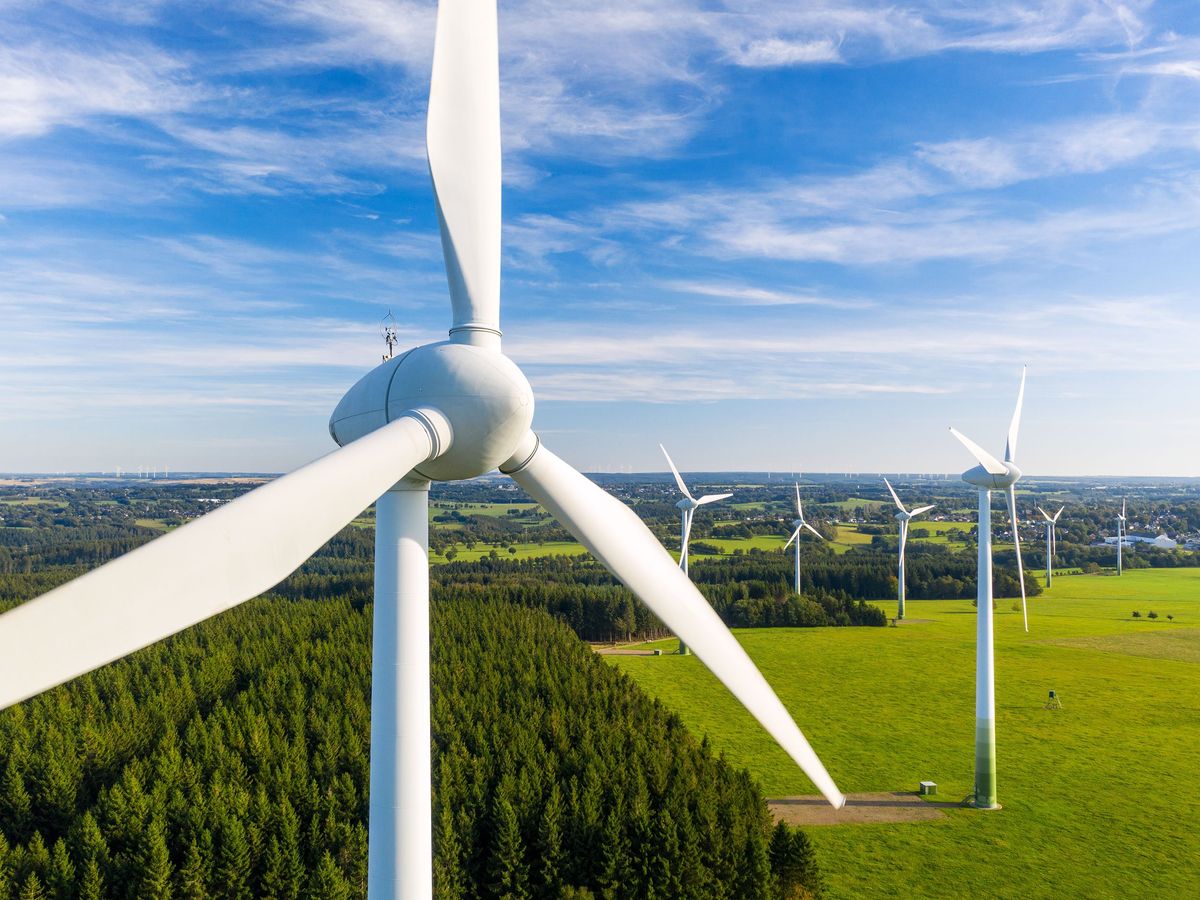
The Department of the Interior has issued a "no competitive interest" finding for the Atlantic Wind Connection, a 790-mile transmission "backbone" that will theoretically allow connection of offshore wind power along the Atlantic coast to the onshore grid. The finding basically means that no one else wants to spend 10 years and billions of dollars building transmission lines along the sea floor to connect offshore turbines that don't yet exist, so the company -- Atlantic Grid Holdings -- can go ahead and start an environmental review for the project.

This is just the first piece of a lengthy regulatory process. "Our next step will be to evaluate the potential environmental impacts of issuing a renewable energy right-of-way grant for this project," said Tommy Beaudreau, the director of the Bureau of Ocean Energy Management (BOEM), which is responsible for offshore development.

The Atlantic Wind Connection, funded in part by Google, is a forward-thinking project, given that no offshore wind turbines yet spin in American waters (Cape Wind is getting there! They've selected a construction contractor! But they won't build until 2013). Transmission is a challenge for many renewable energy projects, offshore wind perhaps most of all. Bringing the power from where the wind blows to where the lights go on is a huge undertaking, especially when the wind blows miles away from land.

The transmission project would involve high voltage direct current (HVDC) lines running for nearly 800 miles along the sea floor. It could theoretically connect up to 7000 megawatts of wind power to the grid. Even with the biggest new turbines, though, that means more than 1000 of the monster windmills, and the U.S. doesn't have the best of records when it comes to building offshore wind farms. Some think, though, that once the first turbines go up in the next year or so, the floodgates will open. Having transmission ready to support that flood is certainly a worthwhile undertaking.

The environmental review process for the backbone could take up to two years, so even the first stage of the project likely won't be built until at least mid-decade. But with many gigawatts of potential off the Atlantic coast and a number of projects pushing forward through a tough regulatory environment, there may even be a few turbines spinning when the transmission lines are finally laid down.

Image via Atlantic Grid Holdings


New York City to Explore Electricity from Water Mains

It sounds so sensible, you have to wonder why everybody isn't already doing it: Tap the excess pressure found in many urban water mains to drive small turbines that could feed electricity into the grid, block-by-block. Often such pressure has to be relieved by means of specially installed valves that do no work. Why not exploit it to generate power?

It took a New York City wireless company executive, musing idly about emergency power shortly after 9/11, to dream up the idea of electricity from water mains. The startup he founded and leads, Rentricity, has been attracting attention and interest locally. It has obtained modest R&D funding from the New York State Energy Research and Development Authority (NYSERDA) and is a tenant of the  New York University Polytechtechnic Institute Incubator that was started by the New York City Accelerator for a Clean and Renewable Economy. On 1 May, NYC Mayor Michael Bloomberg signed into law a city council resolution calling on New York to do an 18-month study of the feasibility of widely deploying electricity-from-water-main technology throughout the city.

The city, which gets all its drinking water from reservoirs that at are much higher elevations upstate, has a water distribution system that is inherently highly pressurized. As such, it would seem to be ideal for what Rentricity is proposing to do. It is not, however, the site of the first test installation. That honor goes to Keene, N.H., a town close to that state's southern border and Boston's high-tech periphery. Rentricity has also installed a 30-kilowatt generator at a reservoir near Pittsburgh; though that setup is in a water distribution system, it is basically a standard low-head hydro installation, and not an example of the power from water mains concept.

Could Rentricity turn out to be a company that is better at PR than engineering? To judge from its website, the opposite may be the case. The listing of its executive leadership makes a credible impression. The videos promoting its work, on the other hand, leave a good deal to be desired in terms of production values.

Climate Consequences

Whatever you may think about climate change, there’s no denying that the whole controversial subject has become so intimately intertwined with long-term energy planning, they are inseparable.  Just about every press release about any novel energy technology, every public statement in favor of a new energy project, makes reference to expected climate impact. By the same token, every major development in climate science has energy implications.

The issue of Science magazine that appeared yesterday, May 4, carried three articles on the sensitive issue of how much ocean levels may rise in this century as waters warm and glaciers melt. The news is more good than bad. Though there are many uncertainties, the latest research indicates that the rise will not be nearly as high as the worst-case projection of two meters by 2100 and much closer to two thirds of a meter (or two feet).

On the other hand, in news more bad than good, researchers at Stanford and the University of California, Santa Cruz, believe they have shown the Permian extinction that took place 252 million years ago was closely associated with global warming and ocean acidification. Some trends they discern are closely analogous to what we are seeing today.

The lynchpin of the Science magazine report is a research article, "21st Century Evolution of Greenland Outlet Glacier Velocities," which is based on satellite observations of Greenland ice. The scientists found a high degree of variability: "Changes on fast-flow marine-terminating glaciers contrast with steady velocities on ice-shelf–terminating glaciers and slow speeds on land-terminating glaciers. Regionally, glaciers in the northwest accelerated steadily, with more variability in the southeast and relatively steady flow elsewhere."

In a comment piece, Richard B. Alley and Ian Joughin observe, "Early models of the coupled ocean-atmosphere system treated the ice sheets [of Greenland and Antarctica] as static white mountains." A new generation of ice sheet models incorporating more physics, they suggest, may inaugurate an important new phase of geological and climate research.

A second comment by Josh K. Willis and John A. Church argue that there is still a great deal we need to learn about how ocean rises will vary regionally, which will require better understanding of ice sheets and Antarctic precipitation, among other things. The stakes are high, in terms of climate adaptation and mitigation strategies, "Without adaptation, a rise [of average sea levels] by 0.5 m would displace 3.8 million people in the most fertile part of the Nile River Delta. A rise by 2 m could displace 187 million people globally."

Even if the average rise in ocean levels could be close to two feet that two meters, the effects of ocean acidification could be as bad as or worse than pessimists have suggested. In work featured in the New York Times science section on May 1, two California researchers analyzed the Permian extinction in terms of which living beings were most vulnerable. They found that the main marine victims were "genera with poorly buffered respiratory physiology and calcareous shells." That is to say, animals died from a shortage of ocean oxygen, and reduced ability to build shells in water that was warmer and more acidic.

In a second closely related article, the same authors, Jonathan L. Payne (Santa Cruz) and Matthew E. Clapham (Stanford) attribute warming and acidification to widespread volcanic eruptions in the Siberian Traps. "The end-Permian extinction may serve as an important ancient analog for twenty-first century oceans," they warn.

Photo: Puturana Plateau in Siberian Traps


DOE Completes Field Test of Methane Hydrate Extraction in Alaska

The Department of Energy, along with the Japan Oil, Gas, and Metals National Corporation and ConocoPhillips, completed a successful field trial of methane hydrate extraction along Alaska's North Slope.

Methane hydrate is basically natural gas locked up in ice. Actual, commercial-scale production of gas from these formations has never been accomplished, but the DOE's success here might open the door to the industry. The method the DOE used was novel: carbon dioxide was injected into the hydrates, where it was exchanged with the methane molecules locked up in the ice. Using this technique, they were able to extract natural gas continuously for 30 days. The previous longest run was six days.

If methane hydrate production becomes cheap and easy, it could change the global energy picture dramatically. The exact amounts aren't totally clear, but around the world there could be more energy locked up in hydrates than in all the rest of the planet's fossil fuels combined. Of course, burning all of it wouldn't be great for the climate, even if natural gas is a bit better than coal in that regard. And some think that methane hydrates might melt on their own as the climate warms, releasing a gas that is more than 20 times as potent as a warming agent than CO2

The DOE says the next step is to test methane hydrate production over even longer periods of time, with the goal of bringing costs down into the economically-viable range. This process, though, "may take years to accomplish." Along with its own tests, the DOE is also offering $6.5 million in funding this year research into methane hydrate extraction technology, and is asking for another $5 million from Congress to add to the effort next year.

Image: USGS

San Diego Blackout Report Has a Familiar Ring to It

In September 2011 a blackout in the area around San Diego, Calif., left 2.7 million customers without power for up to a half day or so. A report issued this week [PDF]  by the North American Electric Reliability Corporation and the Federal Energy Regulatory Commission blames the outage on "inadequate planning and a lack of observability and awareness of system operation conditions on the day of the event," as a press release puts it.

The report's executive summary says that the cascading disturbance on Sept. 8, 2011 started with the loss of a single 500 KV transmission line, which the system should have been able to withstand. Instead, the loss led to a wide redistribution of power, sizeable voltage deviations, transformer overloads, and overloading of a key transmission corridor south of the San Onofre nuclear power plant, designated Path 44 by the Western Electricity Coordinating Council (WECC).

Excessive loading of Path 44 prompted the San Onofre nuclear power generating station to go off line, plunging San Diego and a Baja Caifornia operating-area into a complete blackout. Yet during the 11 minutes the outage lasted, "the WECC Reliability Coordinator issued no directives, and only limited mitigating actions were taken by the transmission operators of the affected areas."

Yikes! The executive summary goes on to detail underlying factors that contributed to the event, including grid operators not properly having evaluated how loss of generating facilities smaller than 100 kV could affect bulk power reliability, "not recognizing" Western Interconnection reliability limits, "not studying and coordinating" how protection systems might function under certain contingencies, and "not providing effective tools and operating instructions for use when reclosing lines with large phase angle differences across the reclosing barriers."

The report also finds operators and regulators were insufficiently aware of adjacent system particulars and how neighboring systems might interact in an emergency. The report recommends improving external visibility of systems, use of real-time tools, and communications among entities. In conclusion, says the report, "The Sept. 8th event shows that all protection systems and separation schemes … should be studied and coordinated periodically to understand their impact on bulk power system reliability to ensure their operation, inadvertent operation, or misoperation does not have unintended or undesirable effects."

From the sounds of it, lessons that ought to have been learned from previous outages—the big Northeast-Midwest blackout of 2003, and the two big western system disturbances of the late 1990s—are still being absorbed.

Photo: Sean M. Haffey

Did Climate Change Drive Record High U.S. Temperatures?

The United States had the hottest March this year since record keeping began in 1895, with some 15,000 localities around the country registering record highs. In the map above, which comes courtesy of the National Atmospheric and Oceanographic Administration (NOAA), the red states had the warmest March ever, beige states temperatures well above normal, pink states above normal, and white states about normal; only Washington state had a cooler than usual March.

Is global warming responsible for the March temperatures? Writing earlier this week in the Los Angeles Times, John Michael Wallace, a professor of atmospheric science at the University of Washington, delivered a measured assessment. Wallace, one of the world's most highly regarded specialists in climate dynamics, first of all affirms that the effects of global warming are clearly evident in a statistical increase in record high temperatures, which now outnumber record lows by a ratio of three to one. Rising average global temperatures raise all ships, he observes.

Yet when it comes to March's madness, Wallace withholds judgment. "The cause of last month's strange weather was an extraordinarily large and persistent meander of the jet stream that swept tropical air, with temperatures reaching into the 80s as far north as southern Canada," he writes. "But let's remember where the burden of proof lies. In the world of sports, when an athlete is accused of relying on performance-enhancing drugs, it is the prosecutor who must prove the case. The same should apply to claims that the behavior of the jet stream is being profoundly altered by global warming. Thus far, such assertions are not well supported by scientific evidence."

Much more serious, concludes Wallace, is the projected impact of rising average global temperatures on biodiversity and crop yields in tropical Africa and southern Asia.

"The gradual warming of the tropics may not seem as weird as March Madness, but it has much more important implications for biodiversity, food security and the stability of world financial markets. If global warming continues as projected, the global consequences of deteriorating conditions in the tropics will soon be a lot more serious than a foretaste of summer weather in late winter."

High-tech Diesel

If your eyes have been locked on hybrid and electric vehicles in the race to design and build the advanced vehicles of the near future, watch out for diesel coming around the outside track. As stubborn concerns about cost and range are putting a drag on electrics, the introduction of advanced-technology diesels is accelerating.

IEEE Spectrum magazine, in this month’s “Top 10 Tech Cars 2012” report, features two such automobiles: Volkswagen’s diesel Passat and the Mercedes-Benz E300 diesel Bluetec hybrid. One-fifth of the VWs sold in the United States last year were diesels.

Meanwhile, Ford Motor Co. CEO Alan Mulally caused a stir last week with a public statement about the high cost of EV batteries. They can run between US $12 000 and $15 000 for a car that might otherwise sell for just $22 000, he said.

The news here is not so much what Mulally said as the fact he said it. It would seem that the highly regarded Ford chief executive is getting cold feet about some of the hybrid and electric vehicles his own company is introducing.

And no wonder. According to a New York Times run-down of pay-back periods for such cars, published on 5 April, the break-even time for the Ford Fiesta with the super fuel economy (SFE) package that lets it go 100 kilometers on only 5.88 liters of fuel is 26.8 years, for the Ford Focus SE SFE 9.0 years, and the Fusion 8.5 years. (Breakeven is the time it would take to pay off the additional cost of the car, as compared with its non-electric version.)

Many of the cars being introduced by other manufacturers fared little or no better. Break-even for Chevrolet’s Volt was estimated at 26.6 years, and Honda’s Civic hybrid at 12.1. Some, to be sure, did much better, among them the Toyota Camry hybrid (6 years), and  the Prius, with an impressively short payback period of just 1.2 years.

But VW’s advanced diesel Jetta does even better than that, with a payback period of 1.1 years. Volkswagen and Daimler pioneered the introduction of high-tech diesels in the U.S. market several years ago, with their development of diesel cars capable of meeting U.S. clean air standards—including California’s, the most exacting of all.

Now, U.S. carmakers and other non-U.S. manufacturers are racing to match them in the American market. Chrysler, General Motors, Audi, and Mazda all plan to introduce diesel models in the next couple of years.

The Diesel Technology Forum, a U.S. trade group, has hailed the ability of such diesel vehicles to comply with California's latest and strictest clean air standards. The forum boasts that NOx emissions from diesel trucks and buses have been cut 99 percent in the last ten years, and particulates emissions by 97 percent, as a result of new technology. With the introduction of the ultra-low-sulfur diesel fuel required by law since 2010, sulfur emissions from diesel trucks and buses are down 97 percent already, the forum claims.

Photo: Volkswagen Jetta TDI

China's Solar Price

As China’s photovoltaics makers continue to lay waste to the nascent U.S. and European industries, we need to be clear about an economic fundamental. According to conventional wisdom,  the progress of solar energy has been vastly accelerated by the availablity of low-cost Chinese PV modules. But that assumes prices will remain rock-bottom and progress will continue. In fact, the general presumption is that China is "dumping" PV on world markets--that is to say, selling them below cost. If that's so, we won't know what the real world price of PV is until China sells PV at or above real production costs and a lot of other things get sorted out.

At a New York Times energy conference last week China specialist Kevin Juanjun Tu of the Carnegie Endlowment for International Peace suggested that the major countries need to get together and negotiate what kinds of solar subsidies are legitimate and what is unacceptable. That is a good idea, but it won't be easy to act on. Only the specter of all-out trade war in renewables will spur the major players to action.

Meanwhile, the solar crunch continues to claim victims. The week before last, Brightsource Energy, a U.S. startup developing large-scale thermal solar plants, had to cancel a planned initial public offering at the last minute. The absence of investor confidence reflected some concerns about Brightsource's particular kinds of projects like its 392-MW Ivanpah project in California but also a general unease about where solar is headed, given controversy over subsidies worldwide and the impact in the United States of ultra-low natural gas prices. Earth2Tech/GigaOm, the tech blogging site, has compiled a chart detailing "the death spiral of solar bankruptcies."

An encouraging development, Earth2Tech reports independently, is Japan's decision to aggressively promote solar projects. Post-Fukushima, facing a drastic loss of nuclear generation, Japan adopted a law requiring utilities to purchase renewable energy at a premium. It is expected to give Japan's big solar manufacturers, like Panasonic, Sharp and Solar Frontier (part of Showa Shell), a boost.


River Mouths Could Offer Hundreds of Gigawatts of Clean Energy

There are a lot of rivers in the world, and a lot of places where those rivers discharge into an ocean. And according to a study published recently in Environmental Science & Technology, taking advantage of even 10 percent of those interfaces of fresh and salt water could provide more than 150 gigawatts of power.

The process is called pressure-retarded osmosis. Basically, a membrane divides fresh water coming in from the river with the salt water of the ocean or sea. The fresh water flows through the membrane due to the salinity gradient, and the pressure difference spins a turbine to generate electricity. Simple, no fuel required, and clean.

The total river discharge globally is about 37,000 cubic kilometers (somewhere in the vicinity of 10 quadrillion gallons); the new study suggests that if 10 percent of that could be exploited using pressure-retarded osmosis, it would generate 157 gigawatts of power. (For comparison: The U.S. has an electricity capacity of just over 1,000 gigawatts.) And that's 157 gigawatts of emissions-free power; the same amount from coal-fired power plants would release a billion tons of CO2 every year.

The authors of the study, Ngai Yin Yip and Menachem Elimelech of Yale University, might overshoot a bit with one number: they estimate that this power could provide electricity for 520 million people. They base that on the DOE's Energy Information Administration per-capita electricity consumption numbers, but somewhere between one and two billion people still lack electricity access. So, a couple of caveats to what seems like a really good idea: somehow using 10 percent of the world potential for river discharge power is an immense undertaking and extremely unlikely to happen on time scales that matter for emissions reductions; and no, 157 gigawatts will not provide power for half a billion people.

Still, this seems worth doing. There is one prototype facility already in place, in Norway, which we'll watch closely to see if it delivers on the concept's promise.

Image via Environmental Science & Technology

More Solar Blight: First Solar and SunPower Cut Back

The latest bad news today is First Solar's announcement that it is cutting its global workforce 30 percent and shutting down its European operations based near Frankfurt. "After a thorough analysis, it is clear the European market has deteriorated to the extent that our operations there are no longer economically sustainable," said First Solar's interim CEO and chairman Mike Ahearn.

In the latter part of 2011 there was a surge in solar installations, with a U.S. cash grant program set to expire at the end of the year and European subsidies scheduled to be cut sharply "across the board," as Lux Research put it in a recent report, "Market Size Update 2012: The Push to a Post-Subsidy Solar Industry." This year Lux expects global installations to be flat, totaling 26.9 GW, compared to 26.5 GW in 2011.

It's a grim prospect for any solar company based in North America or Europe that is battling fierce competition from China, even when such companies are doing much of their production overseas. Yesterday, SunPower announced it was closing one of its two plants in the Philippines. That leaves the company, headquartered in San Jose, with two plants, one in the Philippines and one in Malaysia. The plant it’s shuttering is the oldest of the three, and the decision to close it is connected with SunPower's effort to focus on production of higher-efficiency solar cells.

Four years ago, when the industry was abuzz with talk of a "photovoltaic Moore's law," SunPower and First Solar, based in Tempe, Ariz., were considered the star performers among U.S. PV manufacturers.

Photo: courtesy of SunPower


Most Commented Posts

Energywise

IEEE Spectrum’s energy, power, and green tech blog, featuring news and analysis about the future of energy, climate, and the smart grid.

Contributors

 
Editor
Bill Sweet
New York City, USA
Contributor
Dave Levitan
New York City, USA
 
Contributor
Peter Fairley
British Columbia, Canada
 

Newsletter Sign Up

Sign up for the EnergyWise newsletter and get biweekly news on the power & energy industry, green technology, and conservation delivered directly to your inbox.

Advertisement
Advertisement
Advertisement
Load More
IEEE Spectrum logo Continue to site ➔
ADVERTISEMENT