
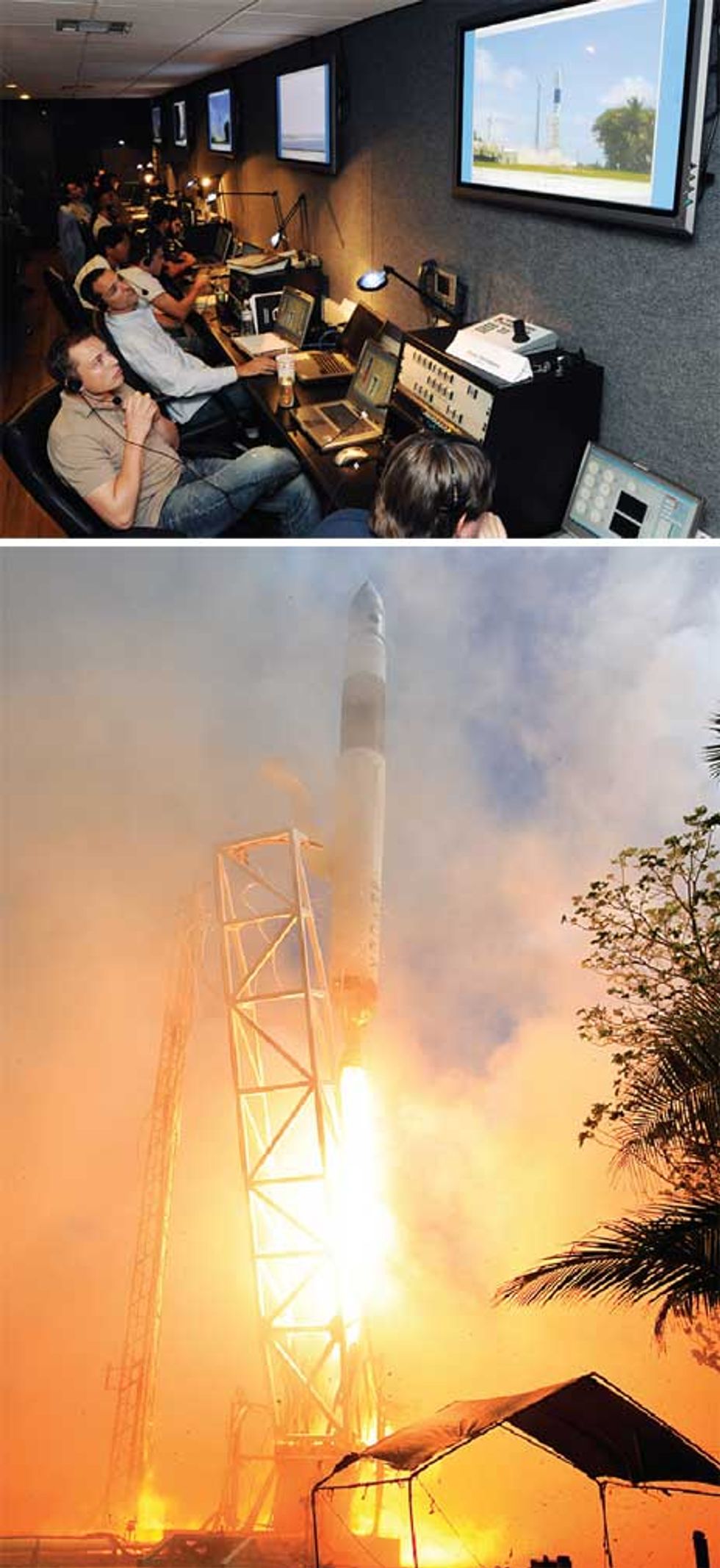
Success, Finally: SpaceX's fourth launch of a xFalcon 1 rocket from Kwajalein Atoll goes off without a hitch.
In the history of life itself, there are only a handful of really big milestones: single-celled life, multicellular life, differentiation of plants and animals, life extending from the oceans to land, mammals, consciousness. On that scale, the next important step is obvious: making life multiplanetary. By that I mean the permanent extension of life beyond Earth. A goal like that, something that is important on the scale of life itself, deserves at least a small amount of our resources—less than we spend on health care but probably more than we spend on cosmetics.
To me, making life multiplanetary means going to Mars. We can skip Venus, whose atmosphere is highly acidic and roasting hot; Mercury, which is too close to the sun; and the moons of the gas giants, which are too far away from the sun. Mars alone is doable.
When I was studying physics in college, it seemed to me that space exploration was one of the three areas that would most affect the future of humanity, along with the Internet and sustainable energy. At the time, I didn't expect to be personally involved in space, an arena I thought was so expensive that it could only be the province of government. As for the Internet, I wasn't sure how I could earn a living in an industry that barely existed apart from university and government networks. Therefore, I started on the sustainable energy problem by trying to develop ultrahigh-energy capacitors for electric vehicles.
But in the summer of 1995, just before embarking on a Ph.D. program in materials science and applied physics at Stanford University, I realized that the Internet was entering a phase of exponential growth. I had the choice of either watching the Internet get built or helping to build it, and I felt pretty sure I could do something useful there while earning at least enough money to pay the rent (although at the time no one had made any significant money on the Internet). The capacitor research, on the other hand, seemed much less likely to succeed.
I applied to Netscape, the only major Internet software company at the time, but got no response, so I deferred grad studies to start my own company, Zip2. About four years later, Compaq bought Zip2 for US $300 million, allowing me to cofound PayPal, which eBay bought in 2002 for $1.5 billion. I then had enough capital to think seriously about space exploration (and sustainable energy, too—but that's another story).
At first, I thought I'd use some of my PayPal money to popularize the idea of life on Mars. I settled on a mission called Mars Oasis, which would land a small robotic greenhouse that would establish life on another planet and show great images of green plants on a red background. It would get the public excited, and we'd learn a lot about what it takes to sustain plant life on the surface of Mars.
I quickly found that the biggest obstacle was the cost of the launch. A U.S. Delta II rocket would cost $60 million, while a refurbished Russian intercontinental ballistic missile would cost $10 million—without the necessary third stage.
I gathered a group of engineers from the space industry to find a way to get the launch cost down. We determined that we could do it by optimizing the design for cost and by making the rocket reusable. Of course, we also had to ensure that it performed at least as well as other available rockets. I dropped the greenhouse idea; my goal now was to make it technically and financially possible to extend life to Mars. In 2002 I founded Space Exploration Technologies.
The question was whether I could finance SpaceX myself. I didn't expect anyone to invest with me until I had demonstrated success. Ironically, with my track record, I could have gotten funding for almost any business except rockets.
We launched our first Falcon 1 rocket in 2006 from the Kwajalein Atoll in the Marshall Islands. Unfortunately, an engine fire started on liftoff, and the engine lost power after 30 seconds in the air. It really hurt seeing four years of work come crashing down.
I had realized going in that we faced steep odds. We had built an entire rocket from the ground up, with almost no legacy hardware. The reason was simple: If you use legacy parts, you'll limit opportunities to reduce costs; if you don't use them, the risk of failure goes up. We traced the engine fire to fuel leaking through a nut that had cracked on ignition due to stress corrosion, so we replaced the aluminum nuts with stainless steel.
The second flight almost made orbital velocity before the second-stage engine flamed out. It turned out that the liquid oxygen sloshing in the tank, coupled with the engine-control system, had caused the second stage to revolve in a conelike motion around the insertion vector, a process called mode coupling. This motion centrifuged propellant to one side of the tank, prematurely uncovering the propellant outlet. The engine then slurped in a helium bubble, and that's what made it flame out. So we added a baffle to eliminate the sloshing that caused the wobble, and we lowered the gains on the engine to make mode coupling less likely.
Flight three would have worked if we hadn't changed anything else from flight two—but we did. We chose to test our new Merlin engine on this flight, rather than on a future flight of the Falcon 9, which we had under development. Instead of cooling the combustion chamber ablatively, by letting the chamber burn away slowly from the inside, the Merlin cooled it regeneratively, by flowing fuel through a jacket around the chamber. However, that flow left just enough fuel in the jacket to extend the thrust enough to make the first stage lightly recontact the second stage. When the second-stage engine ignited, this contact reflected back the engine's own exhaust, and the second stage fried itself.
That was a tough blow, but the SpaceX team rallied hard, and we launched flight four last September, just a month later. Our only change was to extend the time between the main engine cutoff and stage separation by a few seconds. Flight four was a complete success, including the restarting of the upper stage on the other side of Earth.
Before that launch, I'd talked to everyone working on the project. I said that if flight four failed we'd do flight five, and if flight five failed we'd do flight six. I would never give up on something as long as I believed there was a reasonable chance of success.
Space is risky, and we knew it. The phrase "It ain't rocket science" implies that rocket science is pretty hard—and it is. Only a few countries in the world have gotten anything at all into orbit.
While our first three test flights did not reach orbit, it would be inaccurate to call them failures, as each one taught us a lot about the design of the rocket. And none of the problems were related to production or quality assurance. So even though we had only one success out of four flights, that doesn't mean our success rate is 25 percent. In principle, all our future flights should work if we build them the same way.
Reusability will come later. It's hard; nobody has ever really achieved it. Even the space shuttle isn't really reusable, in that it costs more per flight than it would to buy a new expendable launch vehicle of greater cargo capacity. I think we can do it. So far, though, we haven't even been able to recover the first stage; on flight four, it didn't have enough thermal protection and was fried on reentry. On flight five, which is coming up later this year, we took off the recovery system to give us more room in the payload module. But on flight six we plan to make a strong effort to recover the rocket. Reusability is critical to making multiplanetary life financially possible, so this is something we have to get right and hone to perfection.