
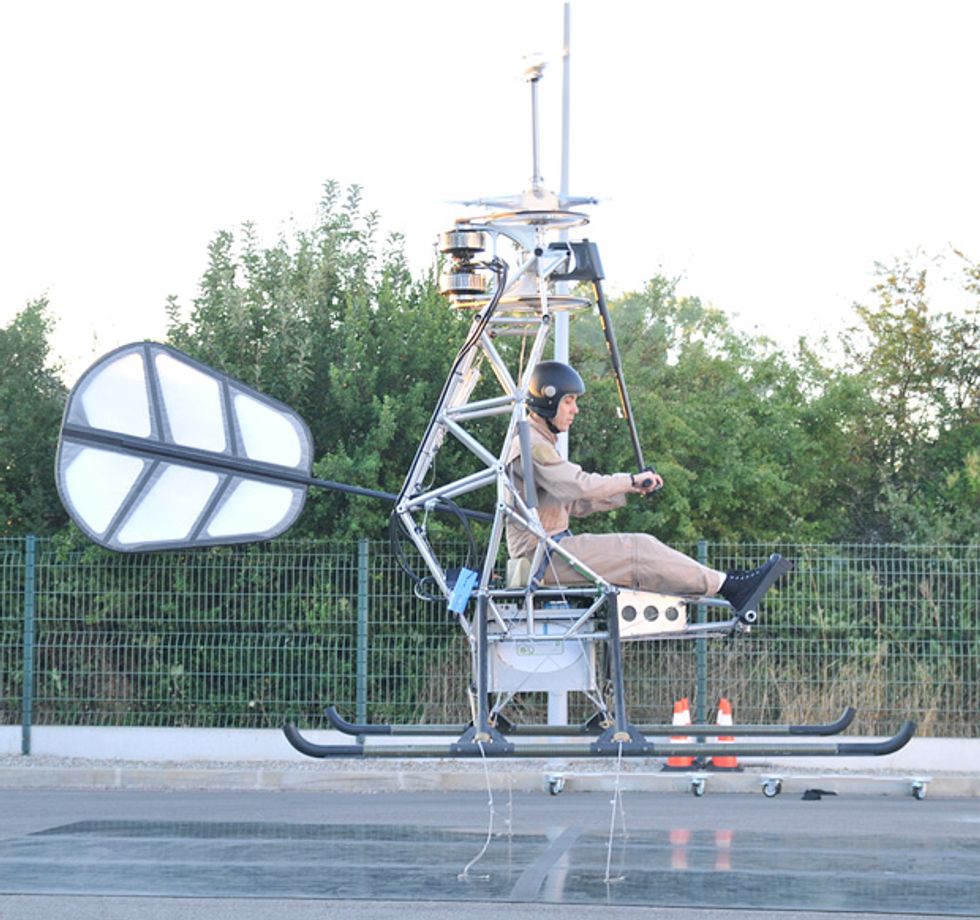
 Liftoff: Pascal Chretien tests this record-setting electric helicopter.Photo: Solution F
The past six months have seen some remarkable advances in the budding world of electric flight, in a realm where until now internal-combustion engines have held firm: helicopters. Three separate demonstrations—of an electrically assisted helicopter and two tiny but fully electric choppers—suggest that the era of electric whirlybirds can’t be far away.
The first development took place in early July 2011, when pilots at Eurocopter, the world’s largest helicopter manufacturer, based in Marignane, France, test-flew a single-engine chopper that had been fitted with lithium-ion batteries and an auxiliary electric motor intended to help out in case of engine failure. Helicopter pilots deal with such emergencies using a technique called autorotation, which requires some deft manipulation of the helicopter’s rotor when power first cuts out and again when the helicopter nears the ground. According to Jean-Michel Billig, executive vice-president for R&D at Eurocopter, the hybrid electric system his group designed provides the brief bursts of power needed at those two critical moments. “We’re not talking about minutes here—we’re talking about seconds,” says Billig. With the new system, engine-off landings were “extraordinarily comfortable” from the pilot’s perspective, he says.
Eurocopter is not the only helicopter manufacturer experimenting with electric power. Since 2008, Sikorsky Aircraft Corp. has been working to remove the normal piston engine from a small helicopter, a Sikorsky S-300C, and replace it with an electric motor, a demonstration project it calls Firefly. Sikorsky, based in Stratford, Conn., has been showing its modified S-300C at aircraft exhibitions but so far has not flown it.
So it came as a surprise to some when another group beat the venerable helicopter company into the air, in the year’s second stunning development in electric flight. Solution F, a French company that builds race-car engines and associated equipment, underwrote the development of what in August became the first manned electric helicopter to take off and land on its own power. It was the result of an unlikely collaboration.
Pascal Chretien, an independent engineering consultant and commercial helicopter pilot, began working two years ago for Solution F, which was then starting to explore the helicopter-engine market. Chretien floated the idea of designing a hybrid-electric power plant, which he viewed as inherently safer than traditional designs for helicopters. That sparked discussions of building the world’s first all-electric helicopter instead, a notion that captivated the imagination of this unlikely team. Chretien set about designing such a craft in mid-2010. “I pretty much did all the work as a volunteer,” says Chretien. Solution F paid for everything else.
Chretien’s design uses two counterrotating rotors, one on top of the other, spinning around the same axis, to avoid the need for a power-sapping tail rotor. Each of the main rotors is driven by a brushed DC motor, with a bank of lithium-ion batteries mounted under the pilot’s seat. “The machine has buckets of power,” says Chretien, although the maximum flight duration demonstrated so far is just 6 minutes.
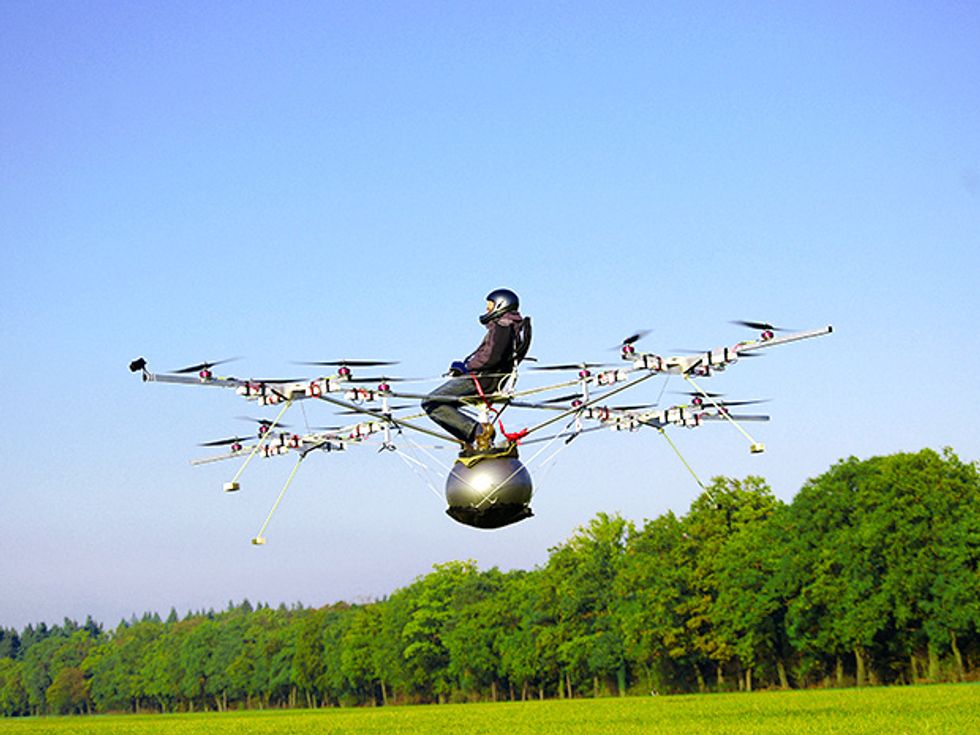 Batteries included: Sixteen brushless motors sent Thomas Senkel flying for the first time this past October.Photo: E-volo
“Sikorsky was in the race, and we thought they would be flying quickly, and we really wanted to fly before them,” says Chretien. “Solution F didn’t want to be the second one.” He admits that he took some calculated risks with his design to get it into the air fast and that his prototype is far from anything you could sell. As it turns out, Chretien did have some close competition for the honor of building the first manned electric helicopter to fly untethered—but not from Sikorsky. It came from a German team that accomplished another manned electric-helicopter flight [video] at the end of October, the third milestone in electric rotorcraft technology in the span of just four months.
Work leading up to that flight began in 2009. It was then that Thomas Senkel (a physicist who has worked on various electric vehicles), Stephan Wolf (a software developer), and Alexander Zosel (a businessman) started thinking about building an electric quadrocopter—like the four-rotor designs that many radio-control modelers fly, only big enough to carry a person. “After discussing it for three months, we said, ‘Okay, let’s do it,’” says Senkel.
The design they ultimately came up with resembles four radio-controlled quadrocopters flanged together—16 rotors in all. “If you have less, there’s not enough redundancy,” says Senkel. “If you have more, it would be too complex.” Lithium-ion batteries and motor controllers are strapped to the spidery contraption’s aluminum frame near each motor, eliminating the need for heavy cabling. The physical design is stunningly simple, although there’s more to it than meets the eye, Senkel says.
Their first craft is just a proof of concept, but the German trio has formed a company, called E-volo, to explore commercialization of their design for the ultralight-aircraft market. Senkel thinks such a vehicle would cost considerably less than a conventional helicopter—more in line with the cost of a car. “Most helicopters have a lot of mechanics that have to be maintained and could fail. We don’t have that much stuff,” he says.
“We congratulate [Solution F and the E-volo group] for moving the needle forward,” says Jonathan Hartman, who heads Sikorsky’s Firefly project. Given the head start and resources that Hartman’s team had, Chretien remains surprised that he was able to beat Sikorsky into the air. But, he says, “One thing’s for sure: The day they start flying, it’ll fly a lot better than ours.”